Siem Reap, Angkor, and three unhurried mornings
A flat provincial town on a small river, with the largest religious monument on earth eight kilometres up the road. The temples are the reason to come and the town is where you sleep, eat and recover, and since the new airport opened both are quieter than they were.
What this place actually is
| Region | Northwest Cambodia |
| Worth staying | 3 to 4 nights |
| Nearest airport | Siem Reap–Angkor International (SAI), 40 – 50 km, 45 – 60 min |
| Best months | November to February |
| Known for | Angkor Wat, the Bayon, Ta Prohm, Banteay Srei, the Tonle Sap |
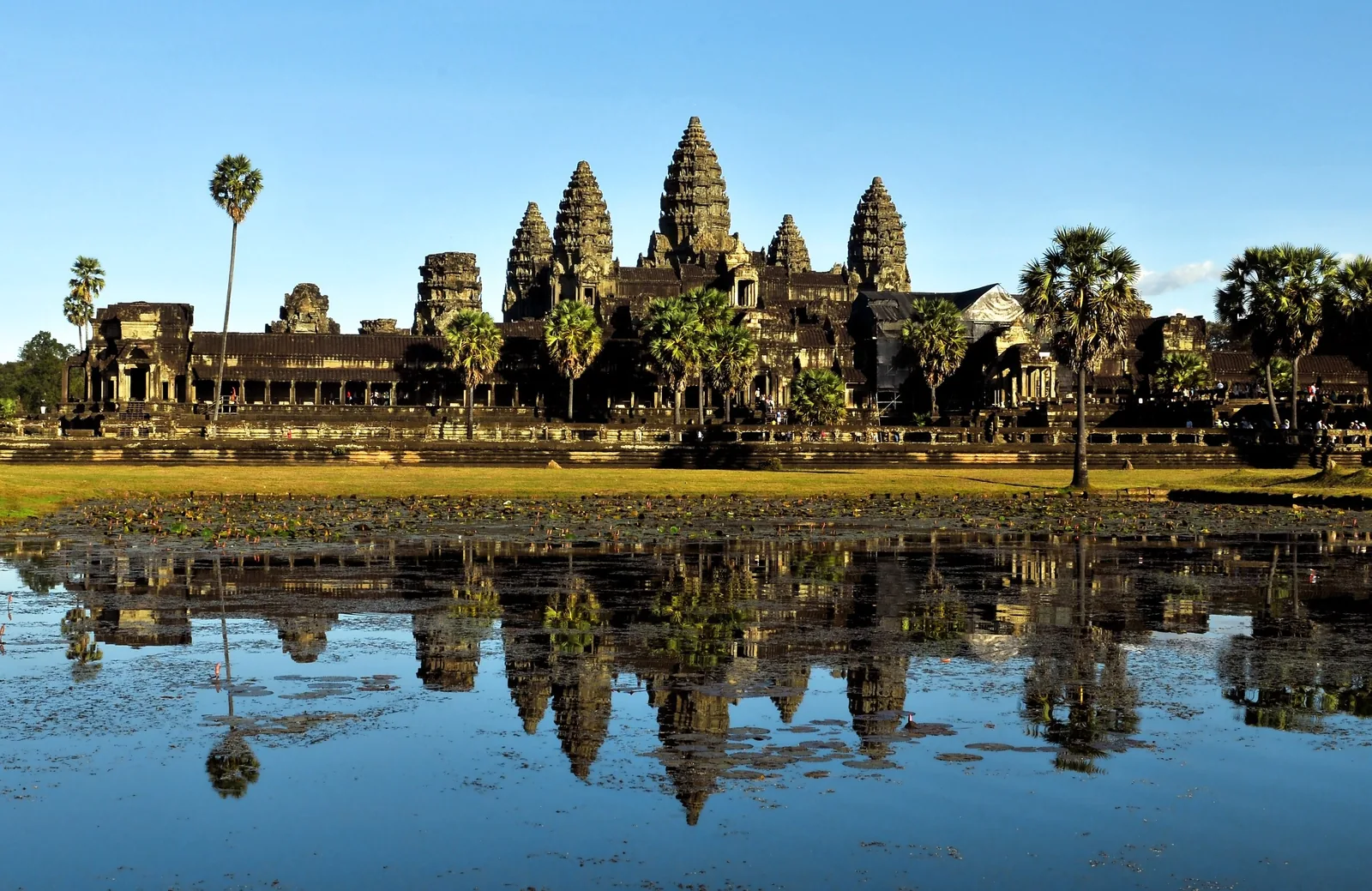
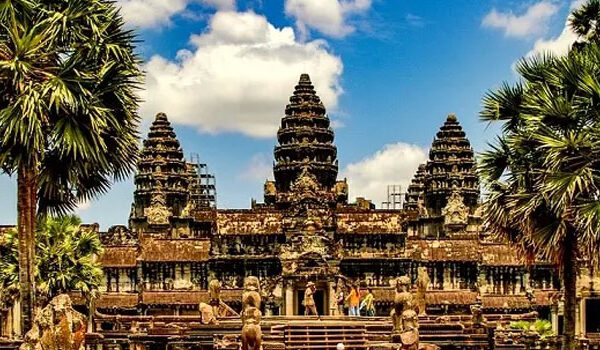
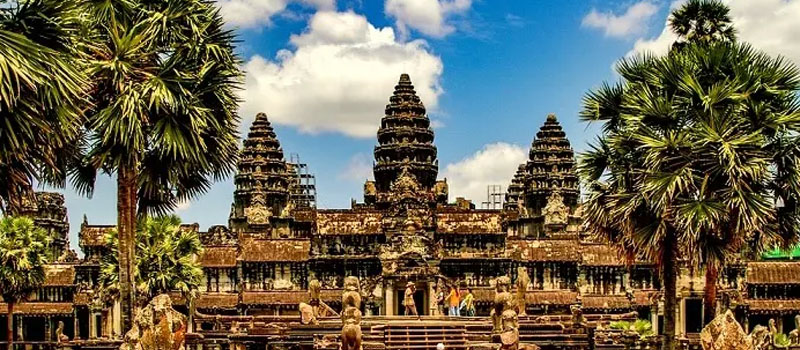
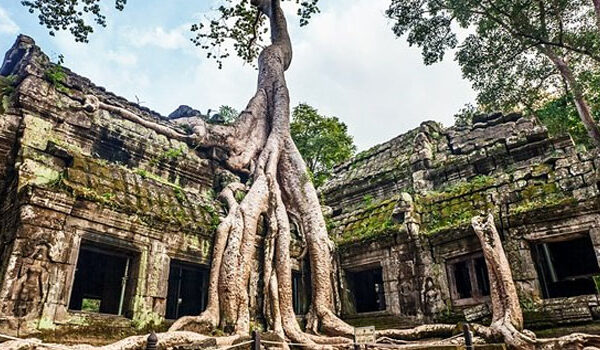
The Angkor Archaeological Park covers roughly 400 square kilometres of forest, reservoirs and stone north of the town. At its centre is Angkor Wat, built for Suryavarman II in the first half of the twelfth century, with a moat 190 metres wide and around 600 metres of bas-relief on the third enclosure. Two kilometres north is Angkor Thom, the walled city of Jayavarman VII, with the Bayon and its towers of faces at the crossing of its axes. East of that is Ta Prohm, left partly unrestored so that the strangler figs are still on the walls. Banteay Srei, the small pink sandstone temple with the finest carving on the plain, is 37 km further out and worth the drive. These are not ruins in the sense of rubble: they are standing buildings that people still worship in.
The town is a grid of low buildings between the river and the airport road, and the part that has been overbuilt is not in dispute. Pub Street and the surrounding blocks were built for a volume of visitors that Siem Reap no longer receives, and in the evening they are loud, cheap and interchangeable with any backpacker strip in the region. The souvenir markets sell the same reproductions. There are more hotel rooms than the town can fill and several half-finished shells on the ring road that have been standing empty since 2020.
The counterweight is that the town is genuinely quieter than it was, and that is a recent and measurable change. Siem Reap–Angkor International opened in October 2023 40 to 50 kilometres out, and the old in-town airport was closed to commercial traffic. In 2025 the new airport handled 1.47 million passengers, about 38 per cent of the 2019 figure. What that means on the ground is that temples which were unpleasant in 2018 are workable again: you can stand in the Bayon at eight in the morning with fewer than a dozen other people in the gallery. The trade-off is the transfer — 45 to 60 minutes from the runway to your hotel, where it used to be ten.
The Angkor pass, and the rules that catch people out
| Pass | Price | Validity |
|---|---|---|
| 1 day | USD 37 | The calendar day of purchase |
| 3 days | USD 62 | Any three days within ten |
| 7 days | USD 72 | Any seven days within thirty |
The three-day pass is the one we buy on almost every journey, because it is valid on any three days within ten and therefore lets you take a day off in the middle without wasting a ticket. Children under twelve are free with a passport as proof of age. The pass carries your photograph, taken at the counter, and it is not transferable — there is no resale market and anyone offering one has sold you a piece of card. The ticket office is on Apsara Road, open 04:30 to 17:30, and it is not at the park entrance, so it is a stop on the way rather than a queue at the gate.
The park is generally open 07:30 to 17:30, with Angkor Wat itself opening at 05:00 for sunrise. Shoulders and knees must be covered at the inner temple entrances and this is enforced by staff at the stairs, not suggested by a sign. Phnom Bakheng has a hard cap of 300 people at sunset and the queue for those places forms well before the hour. At Ta Prohm you stay on the boardwalks; the trees are on the walls and the walls are the point. Drones need a permit from APSARA and flying one without it is a straightforward way to lose the drone.
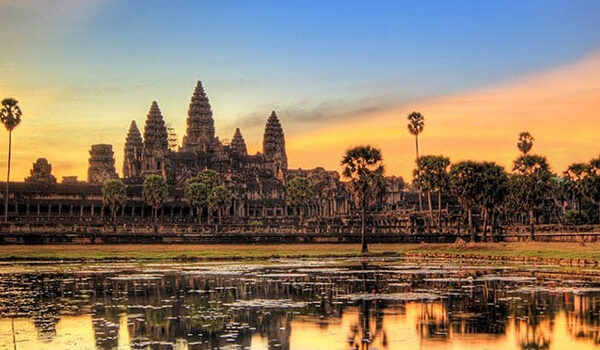
Sunrise at Angkor Wat means somewhere between 800 and 2,000 people packed around two reflecting ponds, arriving from 05:00, most of them holding a phone above their heads, and the whole thing over by 06:15. The photograph is real. The experience of taking it is a car park. What we do instead is start at Angkor Wat at 07:30 when the sunrise crowd has left for breakfast and the light is on the western face, or take sunrise at Srah Srang or Ta Prohm where there is nobody. If a client specifically wants the pond shot we will get you there at 04:45 and say nothing about it — but we will have told you first what you are queuing for.
How many nights, and why fewer breaks it
Three nights is the minimum that works and four is better. The constraint is not distance, it is heat and daylight.
Here is the arithmetic. Temple days run from about 07:30 to 11:00 and then again from 15:00 to 17:30, because the middle of the day at Angkor is between 33 and 40 degrees on flat stone with no shade and nobody looks at carving properly in it. That gives you roughly six usable hours a day, split in two, with a long lunch and a swim in between.
Morning one covers Angkor Wat and its bas-reliefs, which is two and a half hours on its own if you actually read the Churning of the Sea of Milk. Afternoon one takes Angkor Thom: the south gate, the Bayon, the Baphuon, the terraces. Morning two goes east to Ta Prohm, Banteay Kdei and Srah Srang, or north to Preah Khan and Neak Pean. Afternoon two, or a full morning if you prefer, is Banteay Srei at 37 km each way, about an hour of driving in each direction, usually combined with the Landmine Museum or Banteay Samre. That is three nights with the arrival afternoon and the departure morning eaten by a 45 to 60 minute airport transfer at each end.
The fourth night buys the things people are sorriest to have missed: the Roluos group, which is a century older than everything else on the plain; the floating villages on the Tonle Sap, which are a half day and best in the wet season when the lake is high; the Angkor National Museum, which makes the temples legible if you go on the first afternoon rather than the last; and a morning with nothing in it. At two nights you get one full day and one half day, you will see Angkor Wat and the Bayon and nothing else, and you will do both in a hurry. We do not build two-night Siem Reap stops.
When to go
| Months | Conditions | What it buys you, and what it costs |
|---|---|---|
| November – February | Dry, 22 – 32 °C, low humidity | The best conditions of the year. Also the busiest and the most expensive; hotels in the top tier sell out by September. |
| March – May | Dry and 35 – 40 °C on the stone | Low rates and thin crowds, paid for in heat. April is the hardest month and Khmer New Year in mid-April closes much of the town. |
| June – August | Wet season building, hot, short storms | Green forest, cheap rooms, and rain that mostly falls in the late afternoon rather than all day. A better month than its reputation. |
| September – October | Wettest of the year | The moats full, the stone at its greenest, reflections in the ponds, and the fewest visitors. Roads to the outlying temples get muddy and some afternoons are lost. |
The wet season is not the problem people expect. Rain at Angkor in September falls hard for an hour and then stops, the temperature drops with it, and the temples photograph better wet than dry. What it buys you is the moats at full level and a Ta Prohm where the moss is alive rather than grey. What it costs you is flexibility: the Banteay Srei road and the Tonle Sap access can both be slow, and a full afternoon can go.
How to get there
By air
Siem Reap–Angkor International (SAI) opened in October 2023 and took all commercial traffic; the old in-town airport is closed to it. SAI is 40 to 50 km from the hotels, which is 45 to 60 minutes by road and USD 25 to 35 in a private car. Anyone who books a ten-minute airport transfer for Siem Reap is quoting the wrong airport.
Bangkok to Siem Reap is about 1 hour 15. Ho Chi Minh City is about 1 hour 10, Hanoi about 1 hour 50, and Luang Prabang 1 hour 25 five times a week on Vietnam Airlines. Phnom Penh is a 45-minute hop.
By road
Phnom Penh to Siem Reap is about five and a half hours on National Road 6, which is a decent two-lane highway with heavy truck traffic. Battambang is about three hours west. Anyone who has been sold an overland Bangkok to Siem Reap leg is being sold something that cannot be run: every Thailand–Cambodia land crossing, Poipet–Aranyaprathet included, has been closed since 23 June 2025 and Thai authorities have said there is no plan to reopen during 2026. That leg is a flight.
By boat and by rail
The Tonle Sap boat from Phnom Penh runs only when the lake is high, roughly August to early January, takes five to seven hours, and is uncomfortable. Mekong river ships on the Siem Reap to Ho Chi Minh City route cannot cross the lake in low water — roughly December to July — and drive or fly that leg instead. There is no useful passenger rail to Siem Reap.
What things cost here
Siem Reap is a dollar economy: prices are quoted and paid in US dollars, with riel used as small change. There are more rooms than guests at the moment, which has held rates down outside the December peak.
| What | Rough cost |
|---|---|
| Guesthouse or simple hotel, per night | USD 25 – 50 |
| Comfortable four-star with a pool, per night | USD 90 – 180 |
| The top houses — Amansara, Raffles Grand Hotel d’Angkor, Park Hyatt | USD 350 – 1,500 |
| Bowl of kuy teav or a market lunch | USD 2 – 4 |
| Dinner for two, good Khmer restaurant, with drinks | USD 35 – 70 |
| Angkor pass, 3 days | USD 62 |
| Angkor National Museum | about USD 12 |
| Tuk-tuk to the temples for a day | USD 18 – 25 |
| Private car with driver for a temple day | USD 45 – 65 |
| Airport transfer, 40 – 50 km | USD 25 – 35 |
| Licensed English-speaking Angkor guide, per day | USD 45 – 75 |
The guide is the line worth spending on. Angkor without one is a very large amount of carved stone with no story attached, and the difference between a licensed guide who knows the reliefs and a driver who knows the route is the difference between three good mornings and three hot ones.
In pictures


When to skip it
Angkor is not a universal recommendation, and there are trips it does not belong on.
- April and early May, if anyone in the party struggles with heat. Flat sandstone at 40 degrees with no shade is not a photogenic inconvenience; it ends temple days at ten in the morning.
- Any itinerary that gives it a single night. One morning at Angkor is worse than none, because it converts the largest religious monument on earth into a stop between two airports. Two nights is the floor we will build to, and we say on the page which journey it applies to and what it costs you.
- Travellers who want a town in the evening. Siem Reap after dark is Pub Street, hotel restaurants and a handful of good places that need booking. If the evening matters more than the morning, Phnom Penh and Hoi An serve you better.
- Anyone unwilling to be up at seven for three days running. The mornings are the whole thing. A party that wants to start at ten will see the temples at their hottest and their most crowded, and will not enjoy them.
The journeys that come here
Siem Reap is on nine of our routes, more than anywhere else in the region. The longest treatments are on Grand Indochina, 28 days and Indochina Classic, 21 days, both of which take three nights and use a three-day pass across those days so that the middle day can be left free. Laos and Cambodia, 14 days gives it four, more than any other route, because that trip has only two countries to spend its days on. Vietnam and Cambodia, 16 days gives it two, which is the floor and a real compromise — that page says so itself and prices a third night on request.
On Thailand, Laos and Cambodia, 19 days and Cambodia and Thailand, 13 days the arrival is by air from Bangkok at about 1 hour 15, because the land border is closed and has been since June 2025. Mekong River Journey, 15 days starts here before the ship, and in low water the Siem Reap leg is a road transfer by design rather than a surprise.
Two routes handle it differently on purpose. Indochina Honeymoon, 16 days puts the temple mornings early and the afternoons entirely free, and Family Journey, 18 days shortens each temple session, moves Ta Prohm to first thing, and skips the outlying group. Under-twelves are free at Angkor with a passport, which changes the pass arithmetic for families. If you are deciding between three nights and four, read when to go first, then send us your dates.
Ask about Angkor
Give us your month and party size and we will tell you which pass, how many mornings, and what the guide will cost.
Questions travellers ask most
Which Angkor pass should we buy?
The three-day pass at USD 62 on almost every trip. It is valid on any three days within ten, so a rest day in the middle costs you nothing, and three unhurried mornings is the right amount of temple for most people.
The one-day pass at USD 37 only makes sense on a transit stop we would not sell. The seven-day pass at USD 72 is for people with a specific interest in the pre-Angkorian and outlying groups. Under-twelves are free with a passport.
Do we have to do the Angkor Wat sunrise?
No, and we would gently steer you away from it. Between 800 and 2,000 people crowd the two reflecting ponds from 05:00 and the whole thing is over by 06:15. The photograph is real; the morning is a car park.
Our default is Angkor Wat at 07:30 when the crowd has gone to breakfast, or a sunrise at Srah Srang or Ta Prohm where there is almost nobody. If you want the pond shot we will take you at 04:45 without argument.
How far is the new airport?
Siem Reap–Angkor International is 40 to 50 km from town, a 45 to 60 minute transfer costing USD 25 to 35. It opened in October 2023 and the old in-town airport no longer takes commercial flights.
This matters when you are comparing quotes. Any hotel or operator still costing a ten-minute airport pickup is working from the old airport and has not updated the transfer, which will show up on your arrival day.
Can we drive from Bangkok to Siem Reap?
No. Every Thailand–Cambodia land crossing has been closed since 23 June 2025, including Poipet–Aranyaprathet, and Thai authorities have said there is no plan to reopen during 2026.
The leg is flown, about 1 hour 15. Any itinerary that still shows an overland Bangkok to Siem Reap day is selling something it cannot run, and you should ask the operator about it before you pay.
Read next
Tell us about the journey you have in mind
Dates, party size and the places you care about are enough to start. You get a draft route and an indicative price, not a brochure.