Bangkok in three nights, not one
The air hub of mainland Southeast Asia and the reason most four-country routes are open-jaw. It is also the city that gets treated as a corridor: one night by the airport, a transfer, gone. Three nights is where it stops being a corridor and starts being a place.
What this place actually is
| Region | Central Thailand, on the Chao Phraya |
| Worth staying | 3 nights |
| Nearest airport | Suvarnabhumi (BKK), 30 km, 45–60 min; Don Mueang (DMK) 25 km |
| Best months | November to February |
| Known for | The Grand Palace, Wat Pho, the Chao Phraya express boat, regional flight connections |
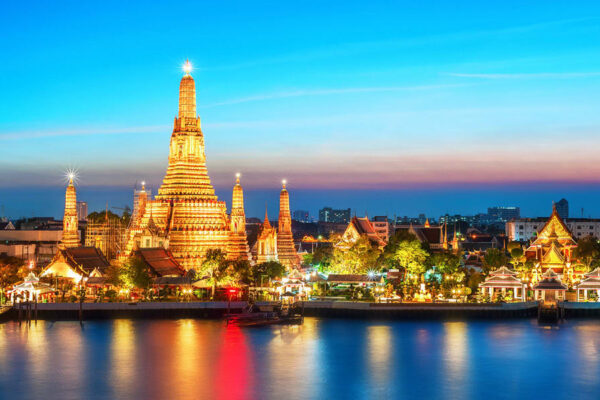
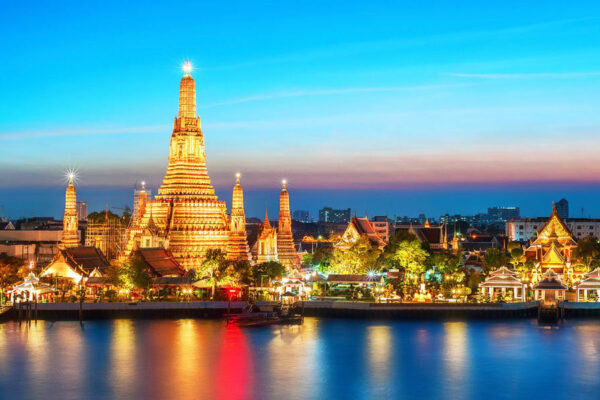
Bangkok is a city of roughly eleven million people built on a bend of the Chao Phraya, and almost everything a first-time visitor comes for sits within about three kilometres of that bend. The Grand Palace compound was begun in 1782 and is still a working royal and religious site rather than a museum: entry is 500 baht, the gates are open 08:30 to 15:30, and the dress code — shoulders and knees covered, for men and women alike — is enforced at the gate by staff who turn people away rather than by a sign nobody reads. Wat Pho, ten minutes on foot to the south, costs 300 baht and opens 08:00 to 19:30, holds a reclining Buddha 46 metres long, and is the founding school of Thai massage, which is still taught and given in the compound. Across the water at Wat Arun the prang is faced in broken Chinese porcelain that arrived as ship ballast. Those three sit in a triangle you can walk and boat between in a morning.
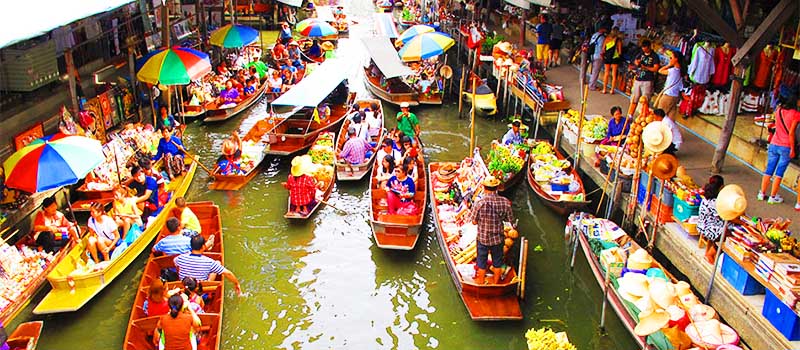
The over-visited part is easy to name and worth naming. The Grand Palace between 10:00 and 13:00 is a slow-moving queue of several thousand people, most of them delivered by coach from hotels that sold the ticket at the desk. Khao San Road has been a caricature of itself for twenty years. The floating market at Damnoen Saduak, 100 km west, is a two-hour drive each way to a canal of souvenir boats staged for photographs, and the operators who sell it know exactly what it is. Tuk-tuk drivers outside the palace will tell you it is closed for a royal ceremony and offer a cheap tour that ends at a gem shop or a tailor, and that specific script has been running since the 1990s. None of it stops the city being one of the best places to eat in Asia, and none of it touches the parts of Bangkok that people who live here use.
What survives is the river and the food. The Chao Phraya express boat is not a tourist attraction, it is public transport, and at 16:00 on a weekday it is the fastest way to move across the old city while the roads are solid. Talat Noi and the lanes behind Charoen Krung are machine shops and shrines and eighty-year-old shophouses that have not been converted into anything. Chinatown on Yaowarat Road after dark is a working street-food economy, not a night market for visitors. The Jim Thompson House, six teak buildings assembled by an American silk trader who disappeared in Malaysia in 1967, takes an hour and explains more about Thai domestic architecture than the palace does.
How many nights, and why fewer breaks it
From 15 September 2026 the visa exemption drops from 60 days to 30 days for the sixty countries and territories that hold it, including the United States, the United Kingdom, Canada, Australia, Japan and most of Europe. One extension of up to 30 further days can be applied for at a Thai immigration office. Visa-exempt entries made by land are capped at twice per calendar year; arrivals by air are not capped. Separately, the Thailand Digital Arrival Card is mandatory and free for every arriving traveller and must be filed within 72 hours of arrival at tdac.immigration.go.th. Sites that charge a fee for it are not official. Our office files nothing on your behalf and sells nothing here — we send you the link and a reminder, and you complete it yourself in about five minutes. See visas and entry for the other three countries.
Three nights. Here is the arithmetic, and it is mostly about the clock rather than the sightseeing list.
A long-haul flight from Europe lands at Suvarnabhumi between 06:00 and 08:00 or between 22:00 and 00:30, depending on the carrier. Immigration, bags and a 45 to 60 minute transfer put you at a hotel door around two hours after wheels down. Rooms are rarely ready before 14:00. So the arrival day is not a sightseeing day in either case: the early arrival gives you a shower, a slow lunch and an early night against jet lag, and the late arrival gives you a bed. Call that night one, and count nothing from it.
The first full day has a hard constraint at its centre: the Grand Palace shuts its gates at 15:30 and stops selling tickets before that, and it is unbearable in the middle of the day in any month. So it wants an 08:30 start, which runs the palace, Wat Pho and the river crossing to Wat Arun from 08:30 to about 13:00, leaves the afternoon for the Jim Thompson House or a rest, and puts you on the express boat north at the hour when the roads have stopped moving. The second full day is the one that decides whether you have seen Bangkok or seen its postcard: Talat Noi and Charoen Krung on foot in the morning, the Bangkokian Museum or a market that sells to cooks, an early dinner in Chinatown. Two full days, and the third night is what allows the second one to exist.
Cut it to two nights and you have exactly one usable day, which the palace consumes. Cut it to one night and you have an airport hotel with a river view. Most operators build Bangkok as a transit night because their routing needs a connection here and their itinerary needs a line for it, and that is an honest description of what one night buys: a connection, not a stay. If your route genuinely cannot spare three nights, we would rather put the two spare nights somewhere else and give you a clean same-day connection through Suvarnabhumi than sell you a stay that is really a layover.
When to go
Bangkok has three seasons and only one of them is comfortable to walk in. The city sits at 13 degrees north and is hot in every month; the variable is humidity, rain and the length of time you can stay outdoors before you need to sit down somewhere cold.
| Season | Months | What it is like | What that season buys you |
|---|---|---|---|
| Cool and dry | November to February | 26–32 °C, low humidity, little rain | The only months you can walk the old city all morning. Also the busiest and the most expensive. |
| Hot | March to May | 35–40 °C, still, heavy air | Thin crowds at the palace and softer hotel rates. April brings Songkran, when the city closes down and gets very wet on purpose. |
| Wet | June to October | Afternoon storms, 60–90 minutes at a time | The cheapest rooms of the year, green light for photography, and mornings that are usually dry. September and October are the wettest. |
The bad season is worth stating properly rather than warning you off. Rain here is not a British drizzle that ruins a day; it is a violent hour in the late afternoon that floods a few streets, stops, and leaves the evening clear. If you plan mornings outdoors and afternoons indoors from June to October, you lose very little and you pay perhaps 40 per cent less for the same hotel. What the wet season genuinely costs you is river-boat comfort and the certainty of a dry evening walk. April costs you something different: 40 °C at the palace with no shade, and during Songkran, roughly 13 to 15 April, a city where every street is a water fight and most museums and offices are shut. Some travellers plan around Songkran deliberately. Nobody should meet it by accident. Read when to go for how Bangkok months line up against Vietnam, Laos and Cambodia on the same route.
How to get there, and how to leave
Suvarnabhumi (BKK) is 30 km east of the city and is the reason Bangkok anchors most four-country routes. Every long-haul carrier that serves mainland Southeast Asia calls here, and the open-jaw pairings that make a three-week journey work — into Hanoi and out of Bangkok, or into Bangkok and out of Ho Chi Minh City — are cheap and plentiful because of it. A private transfer to a riverside or Sukhumvit hotel takes 45 to 60 minutes and costs about 1,000 to 1,400 baht; at 17:00 on a Friday allow 90 minutes. The Airport Rail Link runs to Phaya Thai in 26 minutes for 45 baht, which beats the car in traffic but leaves you with a taxi at the far end and your luggage on a platform.
Don Mueang (DMK), 25 km north, handles most low-cost regional and domestic flying. It is a 40 to 70 minute drive from the centre and a genuinely awkward 60 to 90 minutes from Suvarnabhumi. We do not build itineraries that require you to change airports in Bangkok with checked bags on the same day, and if a fare difference tempts you to, the taxi and the risk eat the saving.
Onward flights are short. Chiang Mai is about 1 h 15. Samui is about 1 h 5 into the island airport, or a flight to Surat Thani plus a ferry. Hanoi is roughly 1 h 50 and Ho Chi Minh City roughly 1 h 30. Since all Thailand–Cambodia land crossings closed on 23 June 2025 — Poipet–Aranyaprathet, Cham Yeam–Hat Lek, O’Smach–Chong Jom and Ban Pakard–Pailin — the Cambodian legs are flown: Bangkok to Siem Reap about 1 h 15, Bangkok to Phnom Penh about 1 h 20. Thai authorities have said there is no plan to reopen the border during 2026. Any itinerary still advertising an overland Bangkok to Siem Reap day is selling a leg it cannot run, and you should ask the operator about it before you pay a deposit.
By land and rail, the useful numbers are these: Ayutthaya is 80 km north, about 1 h 30 by car; Kanchanaburi and the River Kwai are 130 km west, 2 h 30 to 3 h; Hua Hin is 200 km south, about 3 h. The overnight sleeper to Chiang Mai covers 751 km in roughly 12 to 13 hours and is a genuine experience in a second-class air-conditioned berth, but it costs you a night and arrives before breakfast, so we offer it only where a client asks for it by name.
What things cost here
Prices are in Thai baht, which has traded in a rough band of 32 to 36 to the US dollar through 2026. Bangkok is the cheapest city on an Indochina route for food and the most expensive for a top-tier hotel room, and both of those facts shape a quote.
| What | Rough cost |
|---|---|
| Comfortable four-star hotel, per night | USD 90 – 150 |
| Upper-comfort, river or Sukhumvit, per night | USD 180 – 320 |
| Mandarin Oriental, The Peninsula, The Siam, Aman Nai Lert, per night | USD 450 – 1,200 |
| Bowl of noodles or rice from a street cook | 60 – 90 baht |
| Dinner for two at a good mid-range restaurant | 900 – 1,600 baht |
| Grand Palace, adult | 500 baht |
| Wat Pho, adult | 300 baht |
| Chao Phraya express boat, orange flag | 16 baht |
| Metered taxi across the old city | 80 – 200 baht |
| Private car and driver, airport to city | 1,000 – 1,400 baht |
A note on the taxi line, because it is where visitors lose money and temper. Bangkok taxis are metered, the flagfall is 35 baht, and a driver who refuses the meter and quotes a flat 500 baht should be left standing. Ride-hailing apps work well here and remove the argument entirely. The other place money leaks is the gem shop, the tailor and the suit deal that a helpful stranger recommends near the palace. Our guides are salaried, take no commission anywhere, and will not take you to a shop of any kind unless you ask for one by name.
Against our own land-only band of USD 250 to 500 per person per day, Bangkok sits at the lower end for the same standard of hotel you get in Luang Prabang or Siem Reap, because the food and the transport are cheap and the guiding day is short. That is worth knowing when you are deciding where the extra nights on a three-week route should go.
In pictures



When to skip it
- Your route cannot spare three nights. One night by the airport is a connection, not a stay, and we would rather route you through on the same day and give the two nights to Chiang Mai or the Gulf.
- You are travelling in mid-April and did not plan for Songkran. Roughly 13 to 15 April the city is 40 °C, largely shut, and comprehensively soaked. Wonderful if you chose it; miserable if you did not.
- Your journey is Vietnam and Laos only. Adding Bangkok adds a flight, a transfer and a night for a city that is not on your thread, and the same nights buy more in Luang Prabang or Hue.
- Heat, crowds and traffic are the specific things you travel to avoid. Bangkok has all three in quantity, and no amount of hotel quality removes them from the pavement outside.
The journeys that come here
Bangkok appears in every Thailand route we build, and it is almost always the arrival or departure point rather than a stop in the middle, because the flight economics push it there. Grand Indochina, 28 days gives it three nights at the end, after Vietnam, Laos and Cambodia, when a client has stopped adjusting to the region and can use a city properly. Thailand, Laos and Cambodia, 19 days opens here for three nights and then flies north to Chiang Mai before crossing into Laos.
On Vietnam and Thailand, 15 days the city is the hinge in the middle of the route, and on Cambodia and Thailand, 13 days it follows Angkor on a flown leg of about an hour and a quarter, because the land border is closed. The Indochina honeymoon, 16 days uses two Bangkok nights as a decompression stop before Koh Samui, and the family journey, 18 days keeps the city short, cool and boat-heavy, because children last about ninety minutes in a temple compound and considerably longer on a river.
Every one of those quotes names the hotel, includes a licensed English-speaking national guide in Thailand and a car with a driver, and prices the Suvarnabhumi transfer honestly rather than assuming a clear road. Tell us your dates and your arrival time and write to us; we will say plainly whether Bangkok earns three nights on your particular route or whether it should be a connection.
Ask about Thailand
Send us your dates and who is travelling, and we will tell you how the Bangkok nights should fall.
Questions travellers ask most
Is one night in Bangkok enough?
It is enough for a connection and nothing else. Arrival day is consumed by the flight, the transfer and a 14:00 check-in, so a single night gives you a bed and a breakfast, not a city.
Three nights gives you two full days, which is what the Grand Palace morning and one unhurried day of river, market and Chinatown actually need. If your route cannot spare that, we will connect you through the same day instead.
Can we drive from Bangkok to Siem Reap?
No. Every Thailand–Cambodia land crossing has been closed since 23 June 2025, including Poipet–Aranyaprathet, and Thai authorities have said there is no plan to reopen during 2026.
The leg is flown, about 1 h 15 to Siem Reap and about 1 h 20 to Phnom Penh. Treat any itinerary that still offers the overland day as a warning about the operator.
What is the dress code at the Grand Palace?
Shoulders and knees covered, for men and women. It is checked at the gate and people are turned away, not waved through. Sleeveless tops, shorts, short skirts and torn jeans all fail.
There is a counter that lends cover-ups against a deposit, but the queue for it in high season is long and hot. Your guide will tell you the night before so it is not a surprise at 08:30.
What is the fastest way across the old city in the afternoon?
The Chao Phraya express boat. Between roughly 16:00 and 19:00 the roads on both banks are solid and the river is not, and an orange-flag boat costs 16 baht.
It is public transport used by commuters, so it is crowded and it does not wait. Your guide will put you on the right pier and the right flag, which is the part visitors get wrong.
Read next
Tell us about the journey you have in mind
Dates, party size and the places you care about are enough to start. You get a draft route and an indicative price, not a brochure.