Koh Samui and the inverted season
An island of 228 square kilometres in the Gulf of Thailand whose weather runs opposite to Phuket and Krabi. That single fact decides where a June, July or August beach finish goes, and it is the reason this page exists.
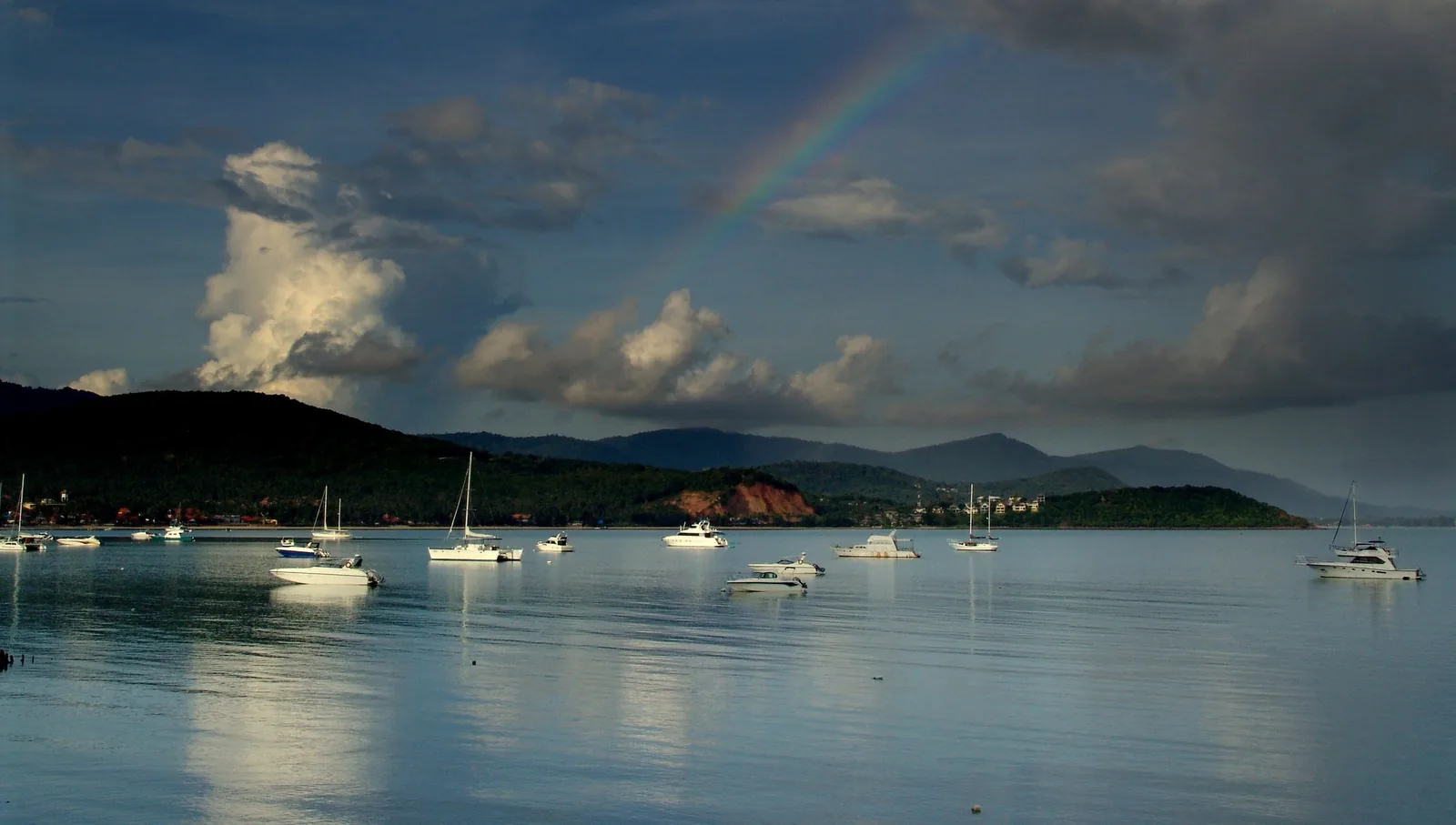
What this place actually is
- Region
- Gulf of Thailand
- Worth staying
- 4 to 5 nights
- Airport
- Samui (USM), 2 km, 10 min
- Alternative
- Surat Thani (URT) plus ferry
- Best months
- June to August
- Avoid
- November
Koh Samui is the third largest island in Thailand, 228 square kilometres of granite hills and coconut plantation about 80 km off the Surat Thani coast, ringed by a single road roughly 51 km long. It was a coconut island with no road at all until the 1970s. It now has an international airport, two Four Seasons-class resorts, a hospital that handles most of what a traveller can do to themselves, and a permanent population that has roughly quadrupled in forty years. The interior is still forest and plantation and almost nobody goes into it.
The over-developed part has a name and a postcode: Chaweng. The main east-coast beach is 6 km of continuous resort frontage with a parallel strip of bars, tattoo shops, tailors and massage signs behind it, and at the northern end the noise runs late. Lamai, further south, is a smaller version of the same thing. If your idea of an island is a quiet bay, do not book Chaweng and then be surprised by Chaweng — it is not a failure of the island, it is a specific 6 km of it that has been developed to a specific market, and it does that job well for people who want it.
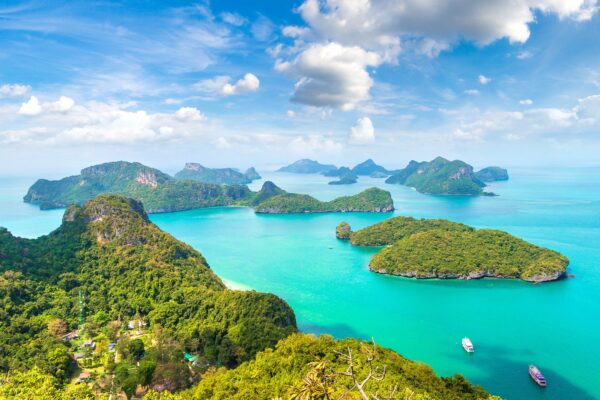
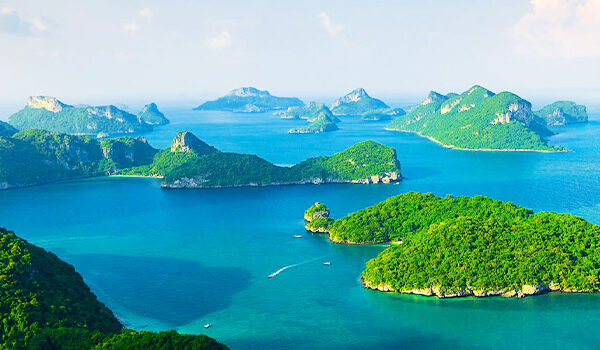
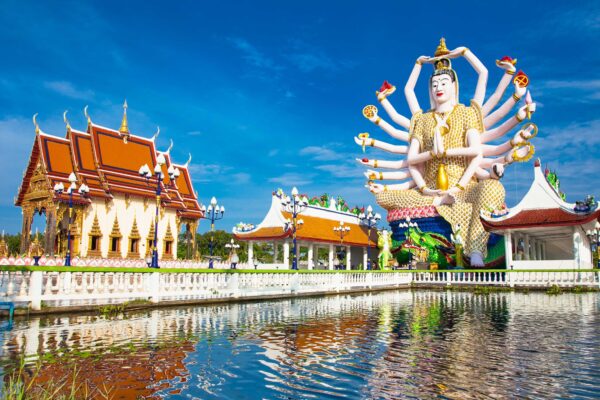
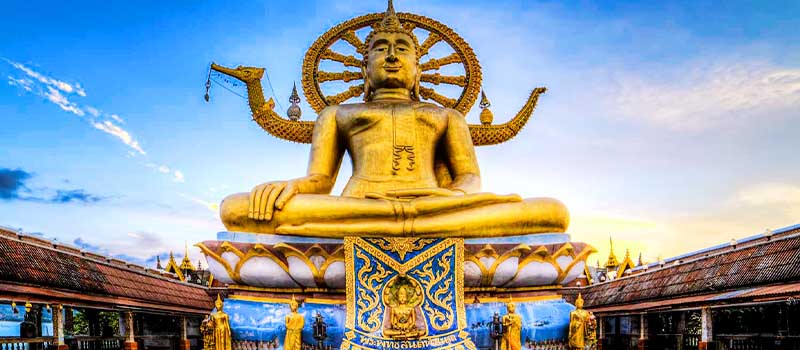
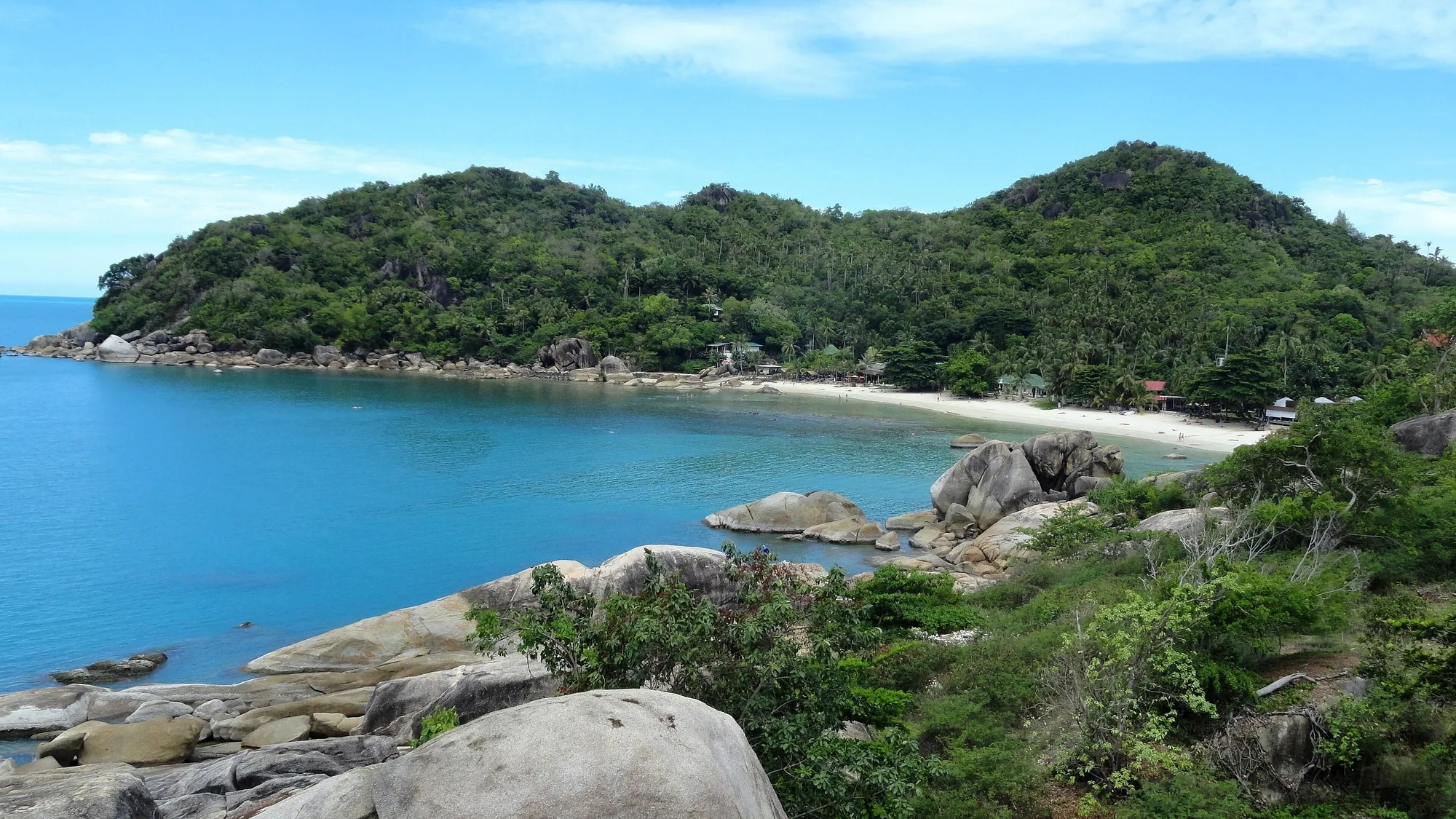
Where the island has not gone that way is mostly the west and the south. Lipa Noi and Taling Ngam face the mainland and the Ang Thong islands and get the sunset; the water there is shallow and calm and the road behind is still plantation. Laem Set and Bang Kao in the south-east are a handful of small resorts and a fishing pier. Bang Por and Mae Nam on the north coast have long flat sand, a scattering of family-run places, and a village that still functions as a village. Bophut’s Fisherman’s Village is the middle ground: an old Chinese-Thai shophouse street turned into restaurants, busy but not loud, and the best evening walk on the island. Inland there is Wat Phra Yai’s 12-metre Big Buddha at the north-east tip, the Na Muang waterfalls, and the Secret Buddha Garden up a track that needs a proper vehicle.
The inverted season — the whole point of this page
Almost everything written about the Thai beach season describes the Andaman coast, and the Andaman coast is wrong for half the year in exactly the months when most families and honeymooners travel. Phuket, Krabi, Phi Phi and the Similans sit under the southwest monsoon from roughly May to October: onshore wind, grey water, red flags on the beaches, and boat trips cancelled at short notice. The Gulf of Thailand is sheltered from that monsoon by the peninsula, so the Gulf islands — Samui, Pha Ngan, Tao — run on the opposite calendar.
In practice that means Samui is at its best from June to August, which is precisely when Phuket and Krabi are at their worst. It then takes its own rain from the northeast monsoon in October, November and December, with November the wettest and the month we tell clients to avoid outright. January to April is dry, hot and calm and perfectly good. So the island has two dry windows and one genuinely poor month, and the poor month is not the one the guidebooks warn you about.
This is why our summer beach finishes go to Samui rather than Krabi or Phuket. A family flying in July who ask for a Thai island at the end of a Vietnam or Cambodia route will be sold Phuket by most operators because Phuket has the flights and the inventory. What they get is a week of onshore swell and cancelled boats. The same week on the Gulf side is flat water and dry mornings. It costs a little more to fly there and it is worth it, and if your dates fall in October or November we will send you to Phu Quoc or move the beach to the front of the trip instead.
| Months | Gulf coast (Samui) | Andaman coast (Phuket, Krabi) |
|---|---|---|
| January to April | Dry, hot, calm water | Dry and calm — peak season, peak prices |
| May | Mixed, some rain, warming | Southwest monsoon beginning |
| June to August | The best window. Dry, breezy, flat sea | Monsoon. Swell, grey water, boats cancelled |
| September | Generally good, occasional rain | Monsoon, often the wettest month |
| October to December | Wettest. November is the month to avoid | Clearing through November into a dry December |
What the bad season buys you here is real, if you can take the risk. November room rates on Samui are 40 to 55 per cent below February for the same suite, the beaches are close to empty, and the interior is green and the waterfalls are running. Rain in November is not constant — it comes in multi-day systems with clear spells between — but the Ang Thong marine park closes for parts of it, the ferries are cancelled on bad days, and a five-night beach finish that gets three wet days out of five has failed. We will book November for a client who understands exactly that trade, and we will say no to a honeymoon in it.
How many nights, and why fewer breaks it
Four nights minimum and five is the right number, and the arithmetic here is the opposite of a city’s. Nothing on Samui takes a whole day. The reason for the nights is the shape of a beach stay after two or three weeks of moving.
Count it out. The arrival day is a flight from Bangkok, Siem Reap or Ho Chi Minh City, which lands in the afternoon after a morning of packing and a transfer at the far end; nobody swims on that day. The departure day starts with an 11:00 checkout and a flight, so it gives you a morning at most. That leaves the middle. Three nights yields two usable days, which is a long way to travel and a lot of money to spend on two days by a pool. Four nights yields three, which is where the point of a beach stop — the third morning where you stop checking the time — actually arrives. Five nights allows one of those days to be spent off the island, on a boat to Ang Thong or across to Pha Ngan, without eating the rest.
There is a second reason on longer routes. On a 21 or 28-day journey through four countries, the beach is not an extra destination, it is the decompression that makes the previous three weeks survivable, and cutting it to three nights re-introduces the packing rhythm the client came here to stop. Where a route is short and the budget is tight, we would rather remove the island entirely and add the nights to Hoi An or Luang Prabang than sell a two-night beach.
How to get there
Samui Airport (USM) is 2 km from Chaweng and a ten-minute transfer, and it is the most pleasant small airport in the region — open-sided pavilions, no jet bridges, buggies to the aircraft. It is also privately owned by Bangkok Airways, which has held most of the slots since it built the place in 1989, and the fares reflect that. Bangkok to Samui is about 1 h 5 in the air and can cost as much as a flight three times the distance. Direct services also run from Singapore, Hong Kong, Chiang Mai and Phuket, and seasonally from Kuala Lumpur.
The alternative is Surat Thani (URT) on the mainland, served by the low-cost carriers into Bangkok, Don Mueang and elsewhere for a fraction of the Samui fare. From there it is a bus or car of about 1 h 30 to the Donsak pier and a ferry of 1 h 30 to 2 h to Nathon or Lipa Noi, so figure four to five hours door to door with the connections, and more if a ferry is missed. On a family booking with four or five air tickets that saving is genuinely large and the day it costs is genuinely long. We price both, say which we recommend, and let the client choose.
Within the region: Samui connects to Siem Reap and Ho Chi Minh City through Bangkok, generally with a change at Suvarnabhumi rather than Don Mueang. A same-day connection works comfortably; we do not build itineraries that need an airport change in Bangkok with bags. Getting around the island is a private car and driver on our bookings — the ring road carries fast traffic, the scooter accident rate here is the highest in Thailand, and no client of ours is put on a rented motorbike.
Entry rules are the Thai national ones and they changed this month. From 15 September 2026 the visa exemption runs 30 days rather than 60 for the sixty countries and territories entitled to it, one extension of up to 30 additional days can be requested at a Thai immigration office, and visa-exempt land entries are limited to two per calendar year, though arrivals by air are unlimited. Every arrival must also complete the Thailand Digital Arrival Card, which is mandatory, costs nothing, and is filed within 72 hours of arrival at tdac.immigration.go.th; any third-party site charging a fee for it is not official. The detail for all four countries sits on visas and entry.
What things cost here
Samui is the most expensive place on a Thailand route per night and among the cheapest per meal, which is a strange combination until you have been. Resort rates swing by a factor of three between November and February.
| What | Rough cost |
|---|---|
| Comfortable beachfront resort, per night | USD 120 – 220 |
| Upper-comfort villa or pool suite, per night | USD 280 – 550 |
| Four Seasons Koh Samui, Six Senses Samui, per night | USD 700 – 2,200 |
| Meal for two at a beach or village restaurant | 600 – 1,400 baht |
| Plate of food from a market stall in Mae Nam or Nathon | 60 – 100 baht |
| Ang Thong marine park day boat, per person | 1,800 – 3,500 baht |
| Big Buddha and Na Muang waterfalls | Free; small parking fee |
| Taxi, Chaweng to the airport | 400 – 600 baht |
| Private car and driver, half day | 1,500 – 2,500 baht |
| Surat Thani ferry crossing, per person | 300 – 700 baht |
Island taxis do not use meters and the quoted fares are three or four times a Bangkok equivalent for the same distance; this is a long-standing local arrangement and arguing with it at the roadside does not work. Our bookings put a car and driver with you, which removes the negotiation and costs less than four taxi rides a day. A Samui night pushes a quote toward the upper end of our USD 250 to 500 per person per day band, and on a honeymoon quote it is usually the single largest line.
In pictures

When to skip it
- Your dates land in October, November or December. November in particular is the wettest month on the Gulf, and a beach finish that loses three of five days to rain has failed. Phu Quoc or an Andaman island is the better answer for those weeks.
- You have fewer than four nights to give it. The arrival afternoon and the departure morning are not beach days, and a two-night island stop is a plane ride to a pool.
- You want reefs and clear-water diving. The Gulf around Samui is shallow and often silty; Koh Tao two hours north is the diving island, and the Andaman side is better still in its dry months.
- You want an island that has not been developed. Samui has an airport, a ring road, a hospital and a Tesco. If quiet is the whole point, we will talk to you about Koh Yao Noi or the smaller Vietnamese islands instead.
The journeys that come here
Samui is a finish, not a middle, and it appears on the two journeys where a beach genuinely belongs. The Indochina honeymoon, 16 days ends with five nights here in a pool villa on the quiet west or south coast after Vietnam, Cambodia and two nights in Bangkok, and for departures between June and September that is Samui rather than Krabi for the reason set out above. The family journey, 18 days gives it four or five nights at the end of a route that has already covered Hanoi, Hoi An and Siem Reap, and puts the family in a resort with a shallow bay rather than a surf beach.
On longer four-country routes such as Grand Indochina, 28 days a Samui extension can be added after the Thai leg; the flight from Bangkok is about an hour and the fourth week is exactly where most clients find they want it. If your dates are wrong for the Gulf we will say so and offer Phu Quoc or a different position in the route rather than sell you November on the wrong coast.
Every quote names the resort, includes the transfers, and prices the Samui air fare honestly instead of assuming the Surat Thani routing. Tell us the month you are travelling and who is in the party, then write to us and we will tell you which coast your dates belong on.
Ask about the beach finish
Give us your month and we will tell you whether the Gulf or the Andaman is the right side of the country.
Questions travellers ask most
Why Samui rather than Phuket or Krabi in July?
Because the Gulf runs opposite to the Andaman. Phuket, Krabi and the Andaman islands sit under the southwest monsoon from roughly May to October, with onshore swell, grey water and boat trips cancelled at short notice.
The peninsula shelters the Gulf from that monsoon, so June to August is Samui’s best window. A summer beach finish on the wrong coast is the most common mistake we are asked to fix.
Which month should we avoid?
November. It is the wettest month on the Gulf coast, the Ang Thong marine park closes for parts of it, and ferries are cancelled on bad days. October and December are only a little better.
Rates in November are 40 to 55 per cent below February and the beaches are nearly empty, so we will book it for a traveller who understands the trade. We do not put a honeymoon in it.
Is the Samui airport worth the fare?
Usually yes for two travellers, often not for a family of five. Samui Airport is privately owned and fares from Bangkok are high for a 65-minute flight.
The alternative is Surat Thani on the mainland with a low-cost carrier, then about 1 h 30 by road to Donsak and 1 h 30 to 2 h on the ferry — four to five hours door to door. We quote both and let you choose.
Where should we stay if we do not want Chaweng?
The west and south. Lipa Noi and Taling Ngam face the mainland and the sunset with shallow calm water; Laem Set and Bang Kao in the south-east are quiet and small; Bang Por and Mae Nam on the north coast have long flat sand and a working village behind them.
Bophut’s Fisherman’s Village is the compromise if you want restaurants within walking distance without the Chaweng strip.
Read next
Tell us about the journey you have in mind
Dates, party size and the places you care about are enough to start. You get a draft route and an indicative price, not a brochure.