Ha Long and Lan Ha, and why we sail from Haiphong
Two names, one drowned limestone landscape. Ha Long is the famous half and carries several hundred licensed overnight boats; Lan Ha is the southern half, entered from Haiphong, and carries a fraction of them. This page covers the July 2025 capsize and what changed after it, the difference between a 46-cabin ship and a 12-cabin boat, and why a one-night cruise costs you two half-days of road.

The short version
- Region
- Gulf of Tonkin, northern Vietnam
- Nights
- 1 aboard, 2 if you can
- From Hanoi
- Noi Bai (HAN), then 2 h 30–3 h by road
- For Lan Ha
- Cat Bi (HPH), Haiphong
- Best months
- October–April
- Known for
- Tower karst, sheltered anchorages, kayaking
What this place actually is
The bay is a drowned tower-karst landscape: something over 1,600 limestone islands and stacks standing in shallow green water, the eroded remains of a plateau that the sea flooded. The geology does not stop at the administrative line. Ha Long Bay belongs to Quang Ninh province, Lan Ha Bay to Haiphong and the Cat Ba archipelago, and Bai Tu Long lies to the north-east. From the deck of a boat they are the same landscape; on paper they are three separate places with different port authorities and different boat fleets.
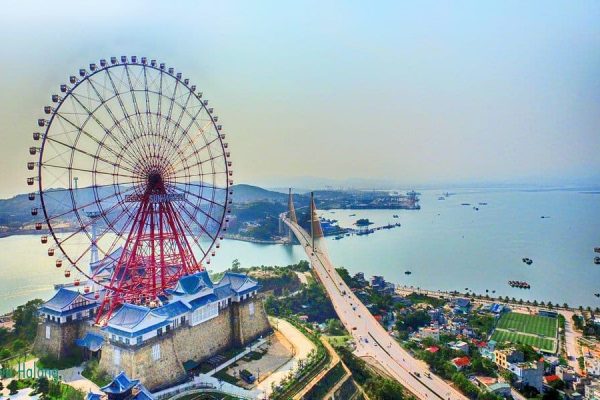
The overbuilt part is the shore, not the water. Bai Chay and Tuan Chau on the Ha Long side have been developed into a resort strip with a marina, a cable car, a ferris wheel and hotel blocks, and the harbour there dispatches several hundred licensed overnight vessels into a core route that has only a handful of usable anchorages. The result is predictable: forty boats at the same evening mooring, and a queue at the same two caves. Sung Sot and Dau Go take thousands of visitors a day through concrete stairways under coloured lighting. They are worth seeing once and they are not worth planning a trip around.
Lan Ha is the same rock with a different traffic problem, which is to say much less of one. Fewer operators are licensed out of Haiphong, the anchorages are narrower and more numerous, kayaking is permitted in more places, and Cat Ba island gives the bay a working population rather than a resort strip. On a January afternoon in Lan Ha you can be the second boat in an inlet. On the same afternoon in the Ha Long core you will not be the fortieth.
The safety position, stated plainly
A tourist boat capsized near Dau Go Cave on 19 July 2025 in a sudden squall during Tropical Storm Wipha. At least 37 people died. All cruises were suspended for a safety review and have since resumed. Quang Ninh authorities now close the port outright when a storm warning is issued, and every cruise on that day is cancelled rather than shortened or rerouted.
That rule is the correct one and it has consequences for your itinerary. A port closure is not negotiable, it is announced at short notice, and it applies to every boat regardless of price. Two things follow.
- Any route that includes the bay needs a buffer day between the cruise and any fixed international flight. One night aboard that becomes zero nights aboard is an inconvenience; one night aboard that becomes a missed flight home is a different problem.
- Travel insurance has to be real, with cancellation and curtailment cover that responds to a weather event and an operator-side cancellation. If your policy excludes named storms, it is the wrong policy for this region between July and October.
- We rebook a cancelled cruise where the calendar allows it and refund the cruise element where it does not. What we will not do is put a party on the water against a port closure, and no operator who would is one you should be buying from.
- The July to September window is the exposed one. October to April is a low-risk period for closures and the reason we put the bay there whenever the route permits.
A 46-cabin boat and a 12-cabin boat are not the same holiday
Read two brochures side by side and you will find the same six words on both: cruise, sun deck, spa, cooking class, kayaking, sunset. The photographs are shot on the top deck of each, which is the one part of the two vessels that genuinely looks alike. Everything that determines your day is below that deck.
| What changes | 40–46 cabins | 8–14 cabins |
|---|---|---|
| Guests aboard | About 80 to 95, plus 25 or more crew | About 16 to 28, plus 10 to 14 crew |
| Where it can moor | The deep main channels, with the other large ships | Narrow inlets the big hulls cannot enter |
| Getting into kayaks | 30 to 45 minutes of queueing on the tender platform | 10 minutes, in one group |
| Dinner | Two sittings or a buffet, fixed times | One sitting, one table plan, food cooked to order |
| Cave visits | Arrives with the fleet, at the fleet’s hour | Can go early or skip it for a quieter stop |
| Cabin price per person, twin share | USD 110–180 per night | USD 280–480 per night |
Neither is a bad boat. The large ships are stable, well run and cheaper, and a family that wants a pool and a kids’ menu is better served on one. What the small boat buys is the thing you came for — being somewhere the fleet is not, for the four hours around sunset and the two hours after dawn when the bay is worth the journey. On our journeys the default is a boat under fifteen cabins in Lan Ha, and it is named in the quote with the cabin category, not described as a category of star.
How many nights, and why fewer breaks it
One night aboard is the standard and the arithmetic explains why. Boarding is around midday, lunch is served as the boat leaves the harbour, the afternoon gives two to four hours of cruising and one kayak or swim stop, then sunset from the deck, dinner, and a dark quiet anchorage. Next morning is a cave or a beach walk, brunch, and disembarkation around 10:30 to 11:00. Of about twenty-two hours aboard, roughly five are daylight hours actually moving through the islands.
Two nights roughly doubles that figure and changes the itinerary in kind rather than degree. The second day runs south and east into water the one-night boats never reach, because they have to be back at the pier by late morning. If your route can afford it, this is the single upgrade on the whole northern leg that we push hardest.
Against that, count the road. Hanoi to the Ha Long piers is two and a half to three hours, Hanoi to Haiphong about two to two and a half, and you pay it in both directions. A one-night cruise therefore consumes two travel half-days plus the night, which is why it sits directly after Hanoi in every route we build rather than floating somewhere in the middle. Three nights aboard is for people who want to swim and read, and it is a legitimate way to spend them; most parties are ready to be back on land after two.
When to go
| Months | What it is like | What it buys you |
|---|---|---|
| October–December | 18–26 °C, dry, clear air, the best visibility of the year. Water is cool but swimmable in October. | The bay as it appears in photographs, and the lowest chance of a port closure. |
| January–March | 14–20 °C, grey, with sea mist that can sit over the islands for days. | Empty anchorages and low rates. The mist is atmospheric on the water and ruinous in a photograph, and this is why some visitors feel cheated. |
| April–June | 25–32 °C, warm water, good swimming, increasing haze. | The best swimming and kayaking conditions of the year. |
| July–September | 30–35 °C, hot, humid, and the typhoon window. Port closures happen at short notice. | Green light, dramatic skies and low season rates, in exchange for real cancellation risk and a buffer day you must build in. |
How to get there
For Lan Ha Bay, which is what we book
- Hanoi to Haiphong is about 2 h to 2 h 30 by road on the expressway, then a short transfer to the pier and a tender out to the boat.
- Cat Bi International (HPH) at Haiphong takes domestic flights — Ho Chi Minh City is about 2 h — and puts you 40 minutes from the boarding pier, which is useful on a south-to-north routing.
- Boarding is normally between 11:30 and 12:30, so a Hanoi departure at 08:00 to 08:30 is comfortable and one at 09:30 is not.
For the Ha Long core
- Hanoi to the Ha Long piers is 2 h 30 to 3 h on the Hai Phong–Ha Long expressway, about 175 km.
- The same drive from Noi Bai airport, without going into the city first, is roughly the same duration and avoids the Hanoi traffic peaks.
What it costs to get there
- A private car with driver, Hanoi to Haiphong or to Ha Long, runs about USD 70 to 110 each way as a standalone booking. It is included in our journeys.
- The road is expressway for most of its length and we still count it as a half-day, because boarding and disembarkation times are fixed and being late costs you the boat.
What things cost here
| Item | What we see |
|---|---|
| Cabin on a 40-cabin-plus ship, per person twin share, all meals | USD 110–180 per night |
| Cabin on a 20-cabin ship | USD 180–260 per night |
| Cabin on an 8- to 14-cabin boat, such as Heritage Cruises Bình Chuẩn on Lan Ha | USD 280–480 per night |
| Whole-boat charter for a family or group of friends | USD 2,500–5,500 per night depending on the vessel |
| Bay route and mooring fees | A few hundred thousand dong per person, normally inside the cabin price |
| Drinks aboard | USD 4–8 a beer, USD 40–90 a bottle of wine |
| Cat Ba national park entry, if you walk there | Under 100,000 VND |
| A night in Haiphong or Cat Ba town, four-star | USD 60–120 |
| Kayaking, cooking demonstration, tai chi on deck | Included on every boat we use |
The one line worth reading twice is the first three. Cabin price on this water tracks guest count almost exactly, and what you are buying at the top of the range is not a better breakfast — it is fewer people between you and the anchorage.
The bay in photographs



When to skip it
- You are travelling between July and September and your route has no buffer day before an international flight. A cancelled cruise in that situation is not a disappointment, it is a rebooked airline ticket.
- You have twelve or thirteen days for two countries. The bay costs two half-days of road plus the night, and those days are better spent giving Hoi An or Angkor their proper length.
- You need to control your own schedule. A cruise is a fixed timetable: meals at set hours, activities announced by the guide, and no ability to leave early. Parties who hate that on a river ship will hate it here too.
- You want a beach holiday. This is a sheltered bay of rock and deep water with a handful of small sand coves. The beaches are on Phu Quoc or Koh Samui, and the month tables for those two are not the same as this one.
The journeys that come here
Every northern route we run puts the bay directly after Hanoi. Grand Indochina, 28 days and Vietnam In Depth, 20 days are the two with room for two nights aboard, and both take Lan Ha out of Haiphong. Indochina Classic, 21 days and Vietnam and Cambodia, 16 days take one night, which is the standard shape.
Two routes change the boat rather than the bay. The honeymoon, 16 days uses a boat under twelve cabins with a private balcony cabin and a late disembarkation, and the family journey, 18 days either charters a small vessel outright or uses a larger one with connecting cabins, depending on the ages in the party.
Whichever route you start from, tell us the month before anything else. It decides the boat, the buffer day and the insurance conversation — the month table above and when to go cover the reasoning, and contact is where to send the dates.
Questions travellers ask most
Is it safe to cruise the bay now?
Cruises resumed after the safety review that followed the capsize of 19 July 2025, in which at least 37 people died when a boat went over in a squall during Tropical Storm Wipha. What changed since is the port rule: Quang Ninh authorities close the harbour outright on a storm warning and every departure is cancelled. That is the mechanism you are relying on, so build a buffer day and hold insurance that covers weather cancellation.
What happens to our money if the port closes on our day?
We rebook the cruise if the itinerary has room, which is what the buffer day exists for. If it does not, the cruise element is refunded and the night is spent ashore in Haiphong or back in Hanoi. What does not happen is a boat sailing against a closure, and that is not a commercial decision.
Ha Long or Lan Ha — does the difference really show?
Yes, and it shows in boat count rather than scenery. The rock is the same drowned karst on both sides of the line. Lan Ha is licensed out of Haiphong, has far fewer overnight vessels on it, and its anchorages are narrower, so a small boat can moor where the large fleet cannot follow. We book Lan Ha by default and only use the Ha Long core when a specific vessel or a specific date makes it the better option.
Do we get seasick?
Rarely. The bay is enclosed by hundreds of islands and the water is flat for most of the year; boats also anchor overnight rather than sailing. In the July to September window the sea can get up quickly, which is the same reason the port closes. If you are sensitive, take something before boarding rather than after.
Read next
Tell us about the journey you have in mind
Dates, party size and the places you care about are enough to start. You get a draft route and an indicative price, not a brochure.