Vietnam, end to end, in twenty days
Twenty days is the length at which Vietnam stops being a corridor of highlights and starts being a country. This route runs from the Chinese border to the Gulf of Thailand, takes in nine places, and ends with four nights on an island so that the last thing you do is nothing.
Who this journey is for
- Length
- 20 days, 19 nights
- Group
- Private, 2 to 8 people
- Starts
- Hanoi
- Ends
- Phu Quoc
- Pace
- Easy to moderate
- From
- USD 5,000 per person
This is the trip for someone who has decided on one country rather than three. Twenty days in Vietnam alone means you cross no borders, change no currency, keep one guide culture and one set of expectations, and you still spend two nights minimum almost everywhere. It suits a couple with time, a family with older children, or two couples travelling together who would rather go deep than tick four flags.
The route is honest about what it asks. There is one genuinely long road day, from Sapa down to the coast, and there are four domestic flights. The reward for that is Sapa in the north, the imperial middle, the delta in the south and four nights on Phu Quoc at the end, which is a real holiday rather than a transfer to an airport.
Trip highlights
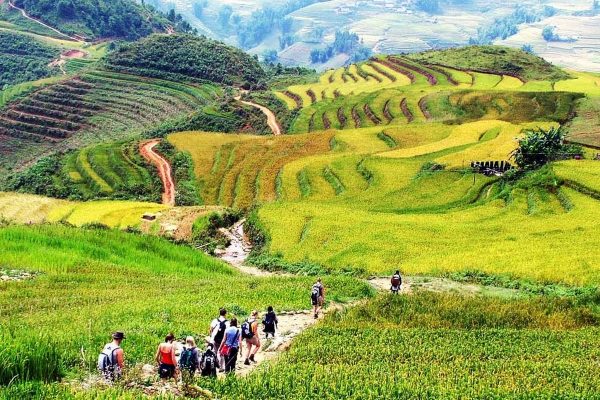
- Two nights at Sapa, walking the Muong Hoa valley to villages where people live, not to a staged performance with an entrance fee
- A night aboard in Lan Ha Bay, entered from Haiphong rather than from the Ha Long tourist port
- Trang An by rowed sampan through three flooded caves, about two hours on the water
- The Hue Imperial City at 07:00 and two royal tombs, with a guide who reads the inscriptions
- The Hai Van Pass by road rather than through the tunnel, with the weather changing at the top
- Four nights on Phu Quoc with nothing scheduled, at the end rather than in the middle
One country, three climates
The single hardest planning constraint on any Vietnam trip is that Vietnam is not one climate but three, and they do not line up. The north is dry and cool from November to April but cold, grey and drizzling from December through February, with Sapa dropping close to freezing and the valley often under cloud. Central Vietnam is dry from February to August and floods from September to November; Hoi An goes under water most years, and October and November are the worst of it. The south is dry from December to April and wet the rest of the time. There is no month that is good everywhere.
So this route is built for late February to April, or for November. Late February to April gives you the best compromise: central Vietnam dry and warm, the south still in its dry season, the north out of the worst of the winter grey and the Sapa terraces being ploughed and flooded, which is when the valley looks like the photographs. What you give up is the green rice, which comes in June, and the harvest gold, which is September.
November is the alternative and it has a different trade. The north is at its best, clear and mild. The south has just dried out. The risk sits in the middle: a late typhoon can still put Hoi An under water in the first half of the month, which is why this itinerary carries three nights there rather than two, and why we build a buffer into the flight south. December to February works if you accept a cold, grey north and take Sapa out. May to September is out of the question for the north and the coast together.
If your dates are fixed and they fall in October or early November, we would rather reverse the route and run it south to north, or move Hoi An earlier in the trip, than pretend the flooding does not happen. Ask us before you book flights.
The route, day by day
Driving times are door to door in normal conditions and include stops. Where a leg is flown, the flight and its duration are given in place of the drive.
Arrive Hanoi
Your flight lands at Noi Bai and your guide meets you past customs. The run into the Old Quarter takes about 45 minutes, longer in the evening rush, and the hotel will have your room ready whatever the hour because we book the night before on early arrivals.
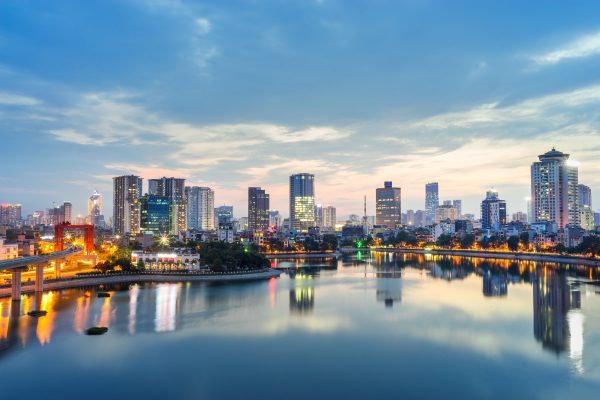
The rest of the day is free. If you can stay upright, walk down to Hoan Kiem lake at dusk, when the whole neighbourhood comes out to move around it.
The thirty-six streets on foot
A walking morning through the Old Quarter with a guide who lives in it: the guild streets that still sell what they were named for, Bach Ma temple, the tin-beaters, and Dong Xuan market at the top. Coffee is taken where it is made properly rather than where the queue is.
The afternoon covers the Temple of Literature, Vietnam’s first university, founded in 1070, and the Ho Chi Minh complex with the stilt house and the One Pillar Pagoda. About six kilometres of walking, all of it flat.

Museums, and an afternoon of your own
The Vietnamese Women’s Museum is ninety minutes well spent and the best-curated collection in Hanoi. Hoa Lo Prison takes another hour and is uncomfortable in places; your guide will separate the documented history from the display text.
The afternoon is deliberately unscheduled before the drive north tomorrow. A water puppet show at 18:00 lasts forty-five minutes and is genuinely old rather than made for visitors.
North-west to Sapa
The expressway to Lao Cai has cut this drive to about five and a half hours including a stop, against nine before it opened. The alternative is the overnight train to Lao Cai and an hour of road at the far end, which suits people who would rather sleep than sit; we book a soft-sleeper cabin for four when a group asks for it.
Sapa sits at 1,500 metres and it will be ten degrees cooler than Hanoi, often in cloud. The afternoon is a short walk out of town to the Cat Cat side for the first view down the valley.
Walking the Muong Hoa valley
A full walking day down the valley from Lao Chai to Ta Van, between six and eleven kilometres depending on your legs and the mud, on paths between terraces that are worked by the households you pass. You have lunch in a house that cooks it for you.
These are villages where people live, and that is the whole test we apply. There are no staged performances, no costume photographs at a gate, no admission booth, and no shop we get a percentage from at the end.
The long day: Sapa to Lan Ha Bay
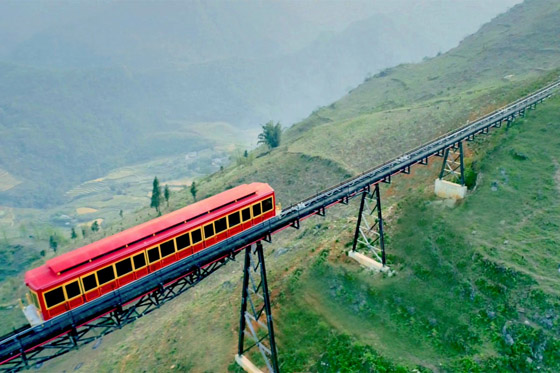
This is the one hard transfer on the route and there is no way to disguise it. You leave at 05:30 and drive about six and three-quarter hours to the pier at Got, on the Haiphong side, to board the boat by early afternoon. Breakfast is a box and the stops are short.
Anyone who would rather not do it can add a night in Hanoi here and pick the boat up the following day; we will quote it either way. Once aboard, lunch is served as the boat moves out into Lan Ha, which is entered from Haiphong and carries a fraction of the traffic of the Ha Long core.
Off the water, south to Ninh Binh
Tai chi on the sun deck at 06:30 for anyone who wants it, then a kayak into a lagoon or a visit to a floating fish farm before the boat turns for the pier. You are back on land by 11:30.
The road south to Ninh Binh takes about two and a half hours and the hotel sits out among the limestone with no traffic noise. The afternoon is free, and dinner is goat and burnt rice, which is what this province cooks and does well.

Trang An, then the flight to Hue
A sampan takes you through Trang An in the morning, rowed by a woman steering with her feet, through three flooded caves where the roof drops to a metre above the water. Two hours afloat, and the earlier the start the fewer boats there are.
You drive to Noi Bai after lunch for the flight to Hue, 1 h 20 in the air into Phu Bai, and reach the river in time for dinner.
The citadel and two tombs
The Imperial City opens at 07:00 and you are there for it, at 200,000 VND a head, before the heat. Half the compound was destroyed in 1968 and the restoration is ongoing, which makes it a more interesting site than a complete one would be.
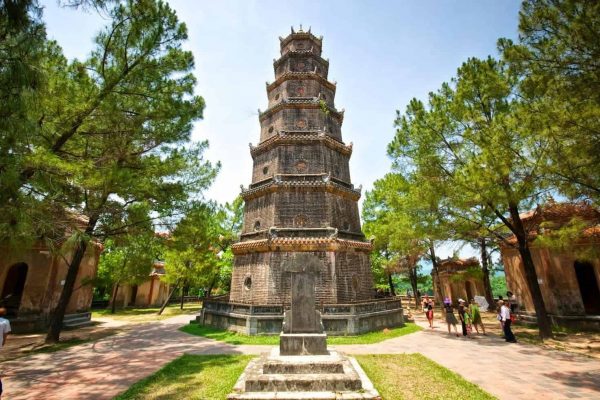
The afternoon takes two royal tombs rather than five: Minh Mang for its axis and its lakes, Tu Duc for the poetry and for the fact that the emperor is not buried in it. Each is 150,000 VND. Thien Mu pagoda on the river on the way back.
Over the Hai Van Pass to Hoi An
You take the old road over the Hai Van Pass instead of the tunnel. The summit holds French and American bunkers and the coast falls away on both sides; there is usually cloud on the Hue side and sun beyond, because the pass is a genuine weather boundary.
Lunch is at Lang Co lagoon. You arrive in Hoi An mid-afternoon with the rest of the day free, and the old town is a different place after the lanterns come on.
Hoi An old town
The old town walk starts at 07:00, the only hour it belongs to the people who live in it. The town ticket is 120,000 VND and admits you to five of twenty-two heritage buildings; your guide chooses the five worth the entry rather than the five nearest the car.
The middle of the day is yours. Late afternoon is Tra Que, where the herb beds are worked with river weed and no chemicals, or a basket boat in the water coconut palms if the group wants it.

My Son, or a day at the beach
My Son leaves at 06:30 to beat the heat and the buses: an hour each way and about two hours among the Cham brick towers, several still carrying bomb damage from 1969. The alternative is a cooking class or simply the beach, and roughly half of our travellers take it.
An Bang is fifteen minutes from the hotel and has real surf from October to February. The evening is free; Hoi An after 21:00 empties out and becomes walkable again.
South to Saigon
A short drive to Da Nang and a flight of 1 h 25 to Tan Son Nhat. Ho Chi Minh City is a different country from Hoi An: nine million people, the traffic to match, and a skyline that has changed every year for a decade.
The afternoon starts with the Reunification Palace, left exactly as it was on 30 April 1975 down to the maps in the basement bunker, and the Central Post Office and the cathedral square. Dinner is on a rooftop, which is the only way to see the scale of the place.
Saigon, and Cho Lon
The War Remnants Museum takes two hours and is deliberately one-sided; go anyway, and go with a guide who will say so. Afterwards you cross into Cho Lon, the Chinese quarter, for Thien Hau temple, the herbalists and the Binh Tay market building.
The afternoon is free. Groups who want the Cu Chi tunnels take them instead, an hour and a half each way and a claustrophobic hour underground; we will tell you honestly that the museum and Cho Lon are the better half day.

Into the Mekong Delta
Two and a half hours south-west puts you in the delta at Cai Be or Ben Tre. You transfer to a small boat and spend the afternoon in canals narrow enough that the palms meet overhead, stopping at a brick kiln and a family that makes coconut candy in a shed.
The night is at a garden lodge or a good homestay on an island, where dinner is elephant-ear fish and the electricity is reliable but the wifi is not. It is one night and it is enough.
Delta to Phu Quoc
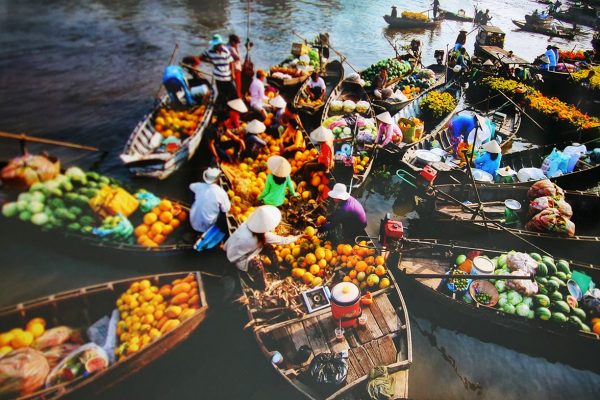
An early boat takes you to a floating market that still trades wholesale rather than performing for cameras, with each boat advertising its produce on a pole at the bow. You then drive back to Tan Son Nhat for the flight west.
Phu Quoc is an hour in the air and sits in the Gulf of Thailand, closer to Cambodia than to Saigon. The transfer from the airport is twenty to forty minutes depending on which coast your hotel is on, and nothing at all is scheduled after that.
Phu Quoc
The first full island day has nothing in it. The west coast faces the sunset and has the calmer water from November to April; the south has the better sand and the north has the forest, which covers more than half the island and is a national park.
If you want to move, we can arrange a boat to the An Thoi islands for snorkelling, or a morning at a pepper farm and a fish sauce distillery, which smells exactly as you expect and is the island’s oldest industry.
Phu Quoc
A second empty day. Most people spend it between the water and a book, and the point of putting four nights here rather than two is that the third day is the one where you stop checking the time.
A boat, a cooking lesson, a massage or a long lunch at a beach shack are all half an hour away and all optional. Your guide is contactable but not present.
Phu Quoc
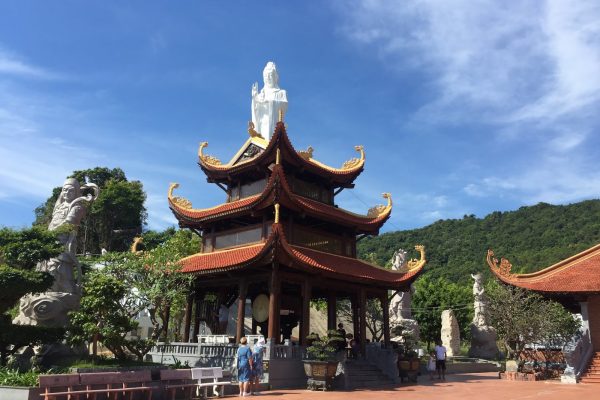
The last full day. Sunset from the west coast is the island’s one fixed appointment, and the night market at Duong Dong is worth an evening if you want to eat with your feet in flip-flops rather than at the resort.
Bills, tips, bags and airport timings are settled tonight so that tomorrow morning is nothing more than breakfast and a car.
Depart Phu Quoc
Phu Quoc International is 20 to 40 minutes from most hotels and handles both international departures and connections through Ho Chi Minh City or Hanoi for the long leg home.
Our representative sees you to check-in. Where the hotel allows it, late departures get a late checkout rather than four hours in a lobby.
What it costs
Per person, sharing a twin or double, land only. Twenty days at this standard includes four domestic flights, a cabin on a Lan Ha boat and four nights of beach resort, which is why this route prices above a two-week trip pro rata. The Excellent column buys the Metropole or Capella in Hanoi, the Four Seasons Nam Hai near Hoi An, Park Hyatt or The Reverie in Saigon, and the top of the market on Phu Quoc.
| Party size | Comfortable | Excellent |
|---|---|---|
| 2 travellers | USD 6,400 | USD 9,920 |
| 3 – 4 travellers | USD 5,500 | USD 8,530 |
| 5 – 8 travellers | USD 5,000 | USD 7,750 |
Roughly USD 250 to USD 500 per person per day. Below USD 200 a day this route cannot be run with private guides, a cabin in Lan Ha and four nights on a good beach, and we will decline rather than quietly move you to a coach and a shared boat.
What is and is not included
What the price includes
- 19 nights of accommodation, every property named in your quote before you commit
- A private air-conditioned vehicle with driver for every road day
- An English-speaking national guide with you throughout, plus local guides in Sapa and the delta
- One night aboard a small boat in Lan Ha Bay with a private cabin and all meals on board
- Domestic flights Hanoi–Hue, Da Nang–Ho Chi Minh City and Ho Chi Minh City–Phu Quoc, booked in advance
- The overnight train to Lao Cai in a soft-sleeper cabin, if you prefer it to the road on day 4
- All entrance fees on the itinerary, including the Hue Imperial City, two royal tombs, Trang An, the Hoi An town ticket and My Son
- All meals listed day by day: 19 breakfasts, 12 lunches and 6 dinners
- Airport transfers on every arrival and departure day, including Phu Quoc
- A local number that reaches a person rather than a call centre, at any hour of your trip
What it does not include
- International flights into Hanoi and out of Phu Quoc
- Vietnamese e-visas and the arrival paperwork, which we prepare with you but cannot file on your behalf; US, Canadian, Australian and New Zealand passports have no exemption and must hold an e-visa
- Travel insurance, which we require of every traveller and check before departure
- Tips for guides and drivers, which are discretionary and never solicited
- Meals not listed above, and all drinks including bottled water outside the vehicle and the boat
- Everything on Phu Quoc beyond breakfast and the two dinners named, because those four days are deliberately yours
- Laundry, spa, minibar and other hotel extras
The journey in pictures


Who this journey is wrong for
Five reasons this is the wrong trip.
- You want more than one country. This route never leaves Vietnam, and adding Cambodia to it means cutting Sapa and the delta, not adding days.
- You cannot face a six-and-three-quarter-hour drive on day 6. It is the price of putting Sapa and Lan Ha Bay in the same trip, and the only alternative is an extra night in Hanoi.
- Your dates are locked to October or early November. That is flood season in Hue and Hoi An, and no operator can promise you a dry old town.
- You want beach time in the middle rather than at the end. Phu Quoc sits last on purpose; moved earlier, it kills the momentum of everything after it.
- You want to travel below USD 200 per person per day. At that number this itinerary is a different product, and we would rather tell you so than sell it.
Ask us about these twenty days
Give us your month and your party and we will send a dated itinerary with hotels named and flights costed.
Questions travellers ask most
Which month should we choose for a trip the whole length of Vietnam?
Late February to April is the best compromise: central Vietnam dry, the south still in its dry season, the north out of the winter grey, and the Sapa terraces flooded for ploughing. November is the alternative, with the north at its best and a small late-typhoon risk in Hue and Hoi An.
December to February works if you accept a cold, grey north; in that case we usually drop Sapa. May to September is not a month we would run this route in, because the north and the coast are both wet and hot at once.
Do we have to do the long drive from Sapa on day 6?
Not if you would rather not. The alternative is a night in Hanoi between Sapa and the bay, which adds a day and about USD 200 to 350 per person depending on hotel standard, and turns a 05:30 start into a civilised one.
The other option is the overnight train down from Lao Cai, which suits people who sleep well on trains and nobody else. We will quote all three.
Why Lan Ha Bay rather than Ha Long Bay?
Lan Ha is entered from Haiphong rather than from the Ha Long tourist port, and it carries a small fraction of the boat traffic of the Ha Long core while sitting in the same limestone.
Safety is the other half of the answer. A tourist boat capsized in a sudden squall on 19 July 2025 during Tropical Storm Wipha with at least 37 deaths, and the whole fleet was suspended for review. Ports now close early on a storm warning, so we build a buffer into the following day and require insurance.
Is four nights on Phu Quoc too long at the end?
Two nights on a beach is a transfer with a swim in it. Four is the number at which people stop checking their phones, and putting it at the end rather than in the middle means you are not trying to restart a touring trip after it.
If you would genuinely rather be moving, we would swap Phu Quoc for two nights in Da Lat or Nha Trang and use the other two to slow down Hue and Saigon.
Read next
Tell us about the journey you have in mind
Dates, party size and the places you care about are enough to start. You get a draft route and an indicative price, not a brochure.