A trading port, a beach four kilometres behind it, and two hours that work
Hoi An is a fifteenth- to nineteenth-century trading port on the Thu Bon river in central Vietnam, with a beach four kilometres behind it and Da Nang airport forty minutes up the coast. The old town is small enough to cross on foot in twenty minutes and busy enough, between 17:00 and 21:00, that crossing it takes an hour. The hours that work are before 08:00 and after 21:30, which is the single most useful thing anyone can tell you about this town.

What this place actually is
| Region | Central Vietnam, Quang Nam province |
| Nights worth staying | 3 nights |
| Nearest airport | Da Nang (DAD), 30 km, 40 min by road |
| Best months | February to August; February to April is driest and coolest |
| Known for | A preserved trading port, the Japanese covered bridge, tailors, An Bang beach, lantern-lit lanes |
Hoi An was a port. Japanese, Chinese, Dutch and Portuguese traders worked the Thu Bon estuary from the fifteenth century to the nineteenth, and the merchant houses, assembly halls and the covered bridge are what that trade left behind. Then the river silted, the deep-water business moved north to Da Nang, and the town spent most of the twentieth century too poor to knock anything down. That is why it still stands: not preservation policy, but a hundred years of no money. UNESCO listed the old town in 1999 and the tourism arrived after.
The old town is roughly six streets deep and eight streets wide. Behind it, rice fields run four kilometres east to An Bang and Cua Dai beaches, and a working town of about 100,000 people surrounds both. Most travellers see three Hoi Ans in one stay — the heritage core, the beach, and the bicycle distance between them — and the third one is usually the part they remember.
Now the blunt part. The old town between 17:00 and 21:00 is close to unwalkable. Tour groups arriving from Da Nang cruise ships and Da Nang hotels converge on the same four riverside streets at the same hour, the lantern boats fill the river, and Nguyen Thai Hoc becomes a queue rather than a street. Tailoring, once a genuine local trade, is now several hundred shops selling roughly the same thing at roughly the same speed. The riverfront restaurants have been rebuilt to face the crowd rather than the food. None of this makes the town not worth visiting. It makes the timing of your visit the whole decision.
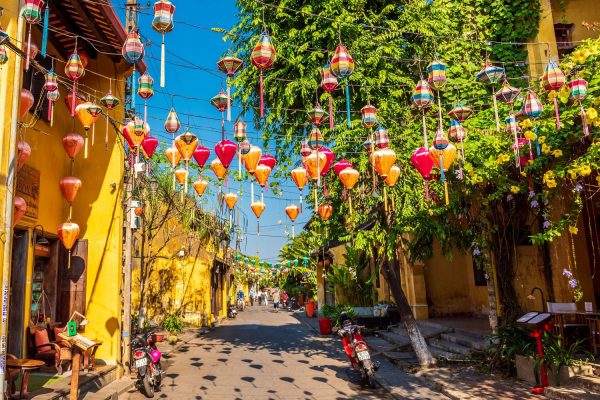
Before 08:00 the same lanes hold about a tenth of the people. Market traders are working, the assembly halls are open and empty, and the light on the yellow walls is the reason photographers come here. After 21:30 the day groups have gone back to Da Nang and the town belongs to the people who slept in it. Those two windows are the reason to stay three nights rather than day-trip in.
How many nights, and why fewer breaks it
Three nights. The arithmetic is simple and it is about hours, not sights.
- Arrival day. You land at Da Nang, transfer forty minutes, and reach the hotel some time in the afternoon. That day contains one usable evening block after 21:30 — and only if your flight was a morning one.
- Second day. Old town before 08:00, back for breakfast and the heat of the middle of the day, the beach or the countryside from 15:00, old town again after 21:30. This is the day that pays for the trip.
- Third day. My Son or the Tra Que market gardens or the Thu Bon by boat in the morning, and a second early old town walk if the first one was rained out. Tailoring, if you want it, needs a fitting on one day and a collection on the next, which is the other reason two nights fails.
- Departure morning. Da Nang airport wants you ninety minutes before a domestic flight, so a 12:00 departure means leaving the hotel around 09:30 and losing that morning entirely.
Two nights gives you one full day. One full day means one early morning and one late evening, and if it rains during either — which in the shoulder months it does — you have no second attempt. Four nights is defensible if you want the beach as a rest rather than an outing, and it is what we build for families. Five is a holiday rather than a leg, and there are better places on the coast to spend the fifth night.
The old town ticket costs 120,000 VND and admits you to five of twenty-two heritage buildings — you choose which five. Ticket booths run roughly 07:00 to 21:30 in summer; the heritage houses themselves open about 08:30 and close about 17:30. Enforcement happens at the heritage-house doors in daylight only. The lanes, the covered bridge seen from outside, the market and the lanterns cost nothing at any hour.
When to go
Central Vietnam does not share a calendar with Hanoi or Saigon. It is dry when the north is wet, and it floods in the months when southern Vietnam is at its best. Read this table before you fix your dates, not after.
| Months | What it is like | What that season buys you |
|---|---|---|
| February – April | Dry, 22–30 °C, low humidity. The best walking weather of the year. | Early mornings you can spend two hours in without sweating through a shirt. Peak room rates and the fullest old town. |
| May – August | Dry and hot, 30–38 °C, strong sun. The beach months. | Reliable sea and swimming pools that matter. Do the old town at 06:30 and the beach from 16:00; the middle of the day is for a room with air conditioning. |
| September – November | Typhoon and flood season, worst in October and November. Hoi An floods most years and the old town has had water through the ground floors. | Half-price rooms, an old town with almost nobody in it between storms, and a real chance that your two nights become a hotel lobby. Insurance and a buffer day are not optional here. |
| December – January | Cooler, 19–25 °C, grey and drizzly, sea usually too rough to swim. | The lowest crowd levels of the dry half of the year and the best light for the merchant houses. Bring a jacket; nobody expects to need one in Vietnam and everybody does. |
If your four-country journey is running in the mid-November to early February window — which is the only window that is dry across Vietnam, Cambodia, Laos and Thailand at once — then Hoi An in that window is cool and often wet. That is a trade we make deliberately, because moving the whole trip to suit one town costs more than a raincoat. The month-by-month page sets the four countries side by side.
How to get there
Everything arrives through Da Nang. There is no airport at Hoi An and there will not be one.
By air
- Da Nang International (DAD) is 30 km from Hoi An, 40 minutes by road in normal traffic and closer to an hour if you land between 17:00 and 19:00. A private transfer runs about USD 20 to 25; a metered taxi is roughly 400,000 to 500,000 VND.
- Hanoi → Da Nang is about 1 h 20 in the air, Ho Chi Minh City → Da Nang about 1 h 15. Both routes run many times a day on Vietnam Airlines, Vietjet and Bamboo.
- Da Nang also takes direct international flights from Bangkok, Singapore, Seoul and Kuala Lumpur, which makes it a sensible place to enter or leave Vietnam rather than routing through Hanoi twice.
By train
- Hanoi → Da Nang is 13 to 14 hours overnight. It is a real option if you want a sleeper night and are prepared for a four-berth compartment.
- Hue → Da Nang is 2 to 3 hours over the Hai Van Pass, and this is the scenic stretch of the whole Vietnamese network — sea on one side, mountain on the other. We put clients on it in daylight rather than driving the same pass by car, then meet the train at Da Nang with the driver.
- Da Nang → Saigon is 20 hours or more. That is a night and most of a day for a journey the plane does in 75 minutes; we do not book it.
By road
- Hue → Hoi An by car is about 3 h 30 over the Hai Van Pass with a stop at Lang Co and the Marble Mountains, or 2 h 30 through the tunnel without stops.
- Da Nang city → Hoi An is 30 to 40 minutes along the coast road past My Khe beach.
- My Son sanctuary is 40 km and about 1 hour each way, best left at 06:30 to arrive before the buses and the heat.
What things cost here
Prices below are 2026 street reality for a traveller who is not haggling hard, given in the currency the seller quotes. The dong runs at roughly 26,000 to the US dollar; a 100,000 VND note is about USD 3.85.
| Item | What you pay |
|---|---|
| Simple town hotel, double, breakfast | 600,000 – 1,100,000 VND (USD 23 – 42) |
| Good boutique in or near the old town | USD 90 – 180 |
| Beach resort, garden or pool villa | USD 250 – 700; the Four Seasons The Nam Hai sits at the top of that band |
| Cao lau or banh mi at a market stall | 30,000 – 50,000 VND |
| Two courses and a beer, mid-range restaurant | 250,000 – 400,000 VND per person |
| Old town heritage ticket | 120,000 VND, five buildings of twenty-two |
| My Son sanctuary entry | 150,000 VND |
| Taxi, old town to An Bang beach | 80,000 – 120,000 VND, about 15 minutes |
| Bicycle hire for a day | 30,000 – 60,000 VND; most hotels lend them |
| A tailored linen shirt | USD 25 – 45, two fittings, minimum 24 hours |
The number people get wrong is the ticket. It is 120,000 VND once, not per building and not per day, and it is not a gate fee for the town. Nobody stops you walking the lanes without one. It is checked at the doors of the heritage houses, and only while those houses are open.
What it looks like





When to skip it
- Your dates fall in October or November and you have no spare day. The old town has had water through the ground floors in most recent years, roads to Da Nang close, and a flooded Hoi An is a hotel lobby with a view of a brown river. Hue has the same problem; Saigon and the delta do not.
- You have only two nights on the central coast and one fixed interest. If it is imperial history, spend them in Hue. If it is the beach, spend them somewhere with a better beach. Hoi An rewards the traveller who can be out at 06:30 and again at 21:30, and two nights rarely allows both.
- You dislike crowds more than you like preserved architecture. Between 17:00 and 21:00 this is one of the busiest square kilometres in Vietnam, and no amount of clever routing changes that during peak season.
- You are chasing an untouched fishing village. That is not what this is. It is a restored trading port that has been commercially successful for twenty-five years, and it looks like one.
The journeys that come here
Hoi An sits in almost every Vietnamese route we run, because the central coast is where the country stops being two cities and starts being a country. The differences are how long it gets and what sits either side of it.
The long four-country routes give it three nights inside a larger frame. Grand Indochina, 28 days reaches it after Hanoi and Lan Ha Bay and leaves it by air for Saigon, and Indochina Classic, 21 days does the same at a faster pace with fewer stops on the coast. Vietnam In Depth, 20 days is the version that treats the centre properly — Hue, the Hai Van train, three nights here and a beach night after — and it is the one to read if the country rather than the region is the point.
Two-country journeys use it as the middle. Vietnam and Cambodia, 16 days puts it between Hanoi and Siem Reap; Vietnam and Laos, 17 days pairs it with Luang Prabang, which is the closest thing in the region to a second town of the same size and a completely different temperature; and Vietnam and Thailand, 15 days is the shortest route that still gives the coast three nights rather than two.
Where the traveller changes, so does the shape of the stay. The honeymoon journey, 16 days moves the base to the beach and treats the old town as two early mornings and one late evening. The family journey, 18 days adds a fourth night, a bicycle day through the market gardens at Tra Que, and a boat on the Thu Bon, because children handle Hoi An far better than they handle a temple schedule. If none of these is the right shape, tell us the month and the two places you refuse to leave out and we will draw one — start here.
Three nights on the central coast, timed properly
Send us your month and your arrival city. We will come back with a routing that puts you in the old town at the two hours it works.
Questions travellers ask most
Do we have to buy the old town ticket?
Not to walk the lanes, cross the bridges or look at the lanterns — none of that is ticketed. The 120,000 VND ticket admits you to five of the twenty-two heritage buildings, and it is checked at those buildings’ doors, in daylight, while they are open. Booths run roughly 07:00 to 21:30 in summer; the houses themselves open about 08:30 and close about 17:30. If you walk at 06:30 or after 21:30, there is nothing to check.
Is two nights enough?
It gives you one full day, which means one early morning and one late evening with no second attempt if either is rained out. Three nights is the number we build, and it is the difference between seeing the town at the hours it works and seeing it at 18:00 with everybody else.
How bad is the flooding, really?
Central Vietnam floods September to November, worst in October and November, and Hoi An itself floods most years — water through the ground floors of the old town is a normal event, not a rare one. Hotels move guests upstairs, boats replace taxis on some streets, and the road to Da Nang can close for a day. If you travel in those months, keep a buffer day in the itinerary and buy insurance that covers delay.
Should we stay in the old town or at the beach?
Old town for a first visit and a short stay: you can be out at 06:30 without a taxi, which is the whole point. Beach for four nights or more, for families, and for anyone treating the coast as a rest between flights. The two are fifteen minutes and about 100,000 VND apart, so neither choice locks you out of the other.
Read next
Tell us about the journey you have in mind
Dates, party size and the places you care about are enough to start. You get a draft route and an indicative price, not a brochure.