Hanoi, and the three nights it actually holds
Hanoi is the northern capital, about eight million people, and the place almost every journey through Vietnam begins or ends. Three nights is the number: one lost to the long-haul arrival, two working days on the ground, and a morning before the drive to the coast or the flight south. This page covers what the city is, which months punish you, what things cost, and when we would leave it out.
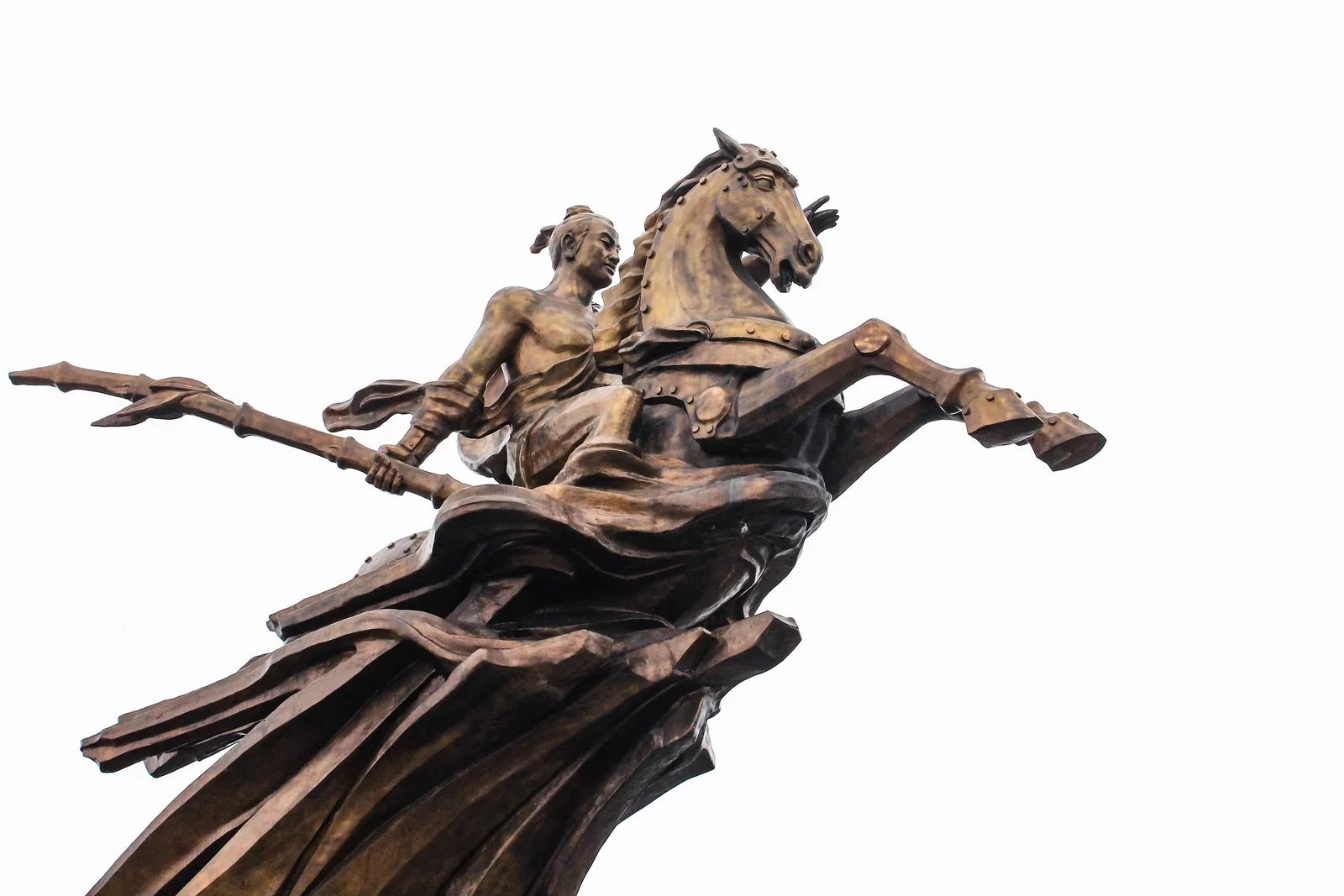
The short version
- Region
- Northern Vietnam
- Nights
- 3
- Airport
- Noi Bai (HAN), 27 km
- Transfer
- 40–50 min by road
- Best months
- October–November, March–April
- Known for
- The Old Quarter, the lakes, bun cha and cha ca
What this place actually is
Hanoi is a working city that happens to contain a thousand-year-old commercial district. The Old Quarter is thirty-six streets that were organised by guild — Hang Bac for silver, Hang Ma for paper goods, Hang Thiec for tin — and several of them still trade in roughly the thing they are named after. It is also, at street level, a continuous motorbike car park with hostels above it, and the pavements belong to parked bikes, cooking fires and plastic stools rather than to pedestrians. Walking here means walking in the road. That is the experience, and people who arrive expecting a preserved old town are describing a different city.
The part that has been overrun is small and easy to name. Ta Hien and the junction around it, marketed as beer corner, is now a block of identical bars with identical stools and identical playlists, and it is loud until it is closed. The souvenir streets at the eastern edge of the quarter sell the same lacquer trays and the same water-puppet figurines as every gift shop in the country. The railway-track cafés have been closed by the authorities and reopened more than once, and whether they are trading in the week you arrive is not something any operator can promise. None of this ruins the district; it just means the good hours are 06:00 to 09:00 and after 21:00, and the good streets are the ones nobody has written a listicle about.
The rest of the city is more interesting than the quarter. Hoan Kiem and West Lake give the place its geography, and the ring of French-colonial building around the Opera House and the old quarter of villas is dense and largely intact — ochre plaster, shutters, mature trees. The Temple of Literature, founded in 1070 as Vietnam’s first university, is the one monument in the city that repays a slow hour. The food is the strongest argument of all: bun cha is grilled pork in a bowl of sweet-sour broth with cold noodles alongside, cha ca is turmeric fish fried at your own table with dill, and both are eaten at addresses that do one dish and close when it runs out.
How many nights, and why fewer breaks it
Three nights. The arithmetic is unforgiving and it works like this.
- Night one is the arrival. Flights from Europe land in the late morning or the evening after eleven to twelve hours, and flights from Australia arrive via a connection. Whatever the timing, the first evening is a shower, a bowl of something and sleep. Nobody sightsees on day zero and the ones who try are useless on day one.
- Day one is the Old Quarter and the lake on foot in the morning, the French quarter and the Opera House in the afternoon, and dinner at a single-dish address. Six to eight kilometres of walking, most of it flat.
- Day two is the Temple of Literature, the Thang Long imperial citadel, the Ho Chi Minh complex and one museum. The mausoleum has short morning hours, closes two days a week, and shuts for maintenance for roughly two months most years, usually in the autumn — so this day gets built around it rather than the other way round.
- The morning of night three is either the drive to the coast for the bay, the overnight train north to Lao Cai, or the flight to Hue or Da Nang. It is a departure morning, not a touring day.
Cut to two nights and one of those two working days disappears — almost always the second one, which means the Temple of Literature, the citadel and the museums all go, and you have seen a shopping district and a lake. Cut to one night and you have seen an airport transfer. Hanoi is also the hinge for everything north: the bay is two and a half to three hours away by road, Sapa five and a half, Ninh Binh under two. Every one of those excursions is priced in half-days off the Hanoi total, which is another reason the three nights are not padding.
Four nights is defensible if the route has them, and the fourth day usually goes to Bat Trang and the ceramic kilns, to the Perfume Pagoda, or simply to nothing at all after a long flight. Beyond four the city starts repeating itself.
When to go
Northern Vietnam has four real seasons and only two of them are comfortable. The season that catches people out is winter, because most long-haul visitors arrive between December and February — the correct window for a four-country journey — and are then surprised by 12 °C and no sun.
| Months | What it is like | What it buys you |
|---|---|---|
| December–February | 10–17 °C, grey, damp, days of fine drizzle that never becomes rain. Sunlight is rare for weeks at a stretch. | The only window that is dry in Vietnam, Laos, Cambodia and Thailand at once. Also the fewest domestic visitors at the citadel and the tombs. |
| March–April | 20–28 °C, humidity climbing, the best light of the year alongside October. | Comfortable walking, flowering trees, and the last clear weeks before the heat. |
| May–September | 30–38 °C with high humidity and heavy afternoon rain. Streets flood. Typhoons cross the coast from July. | Low-season room rates and green landscape, at the cost of walking in the middle of the day. |
| October–November | 20–28 °C, dry, clear, low humidity. | The best month pair in the north, full stop. It is also when we most want you on the bay. |
Vietnamese New Year falls in late January or February and moves each year. Family businesses, including many of the single-dish restaurants, close for several days around it; hotels and guides work normally, prices rise, and domestic flights and trains sell out weeks ahead. It is a good time to be in Hanoi if you want to see the flower markets and a poor time to be improvising.
How to get there
By air
- Noi Bai International (HAN) sits 27 km north of the centre. The transfer is 40 to 50 minutes on the Nhat Tan bridge road, and 60 to 75 minutes if you land into the 07:30–09:00 or 17:00–19:00 traffic.
- Direct long-haul runs from London, Paris, Frankfurt and several Gulf hubs, at eleven to twelve hours from western Europe.
- Inside the region: Luang Prabang 1 h 10 (Lao Airlines daily, Vietnam Airlines three times a week), Vientiane about 1 h, Siem Reap about 1 h 50, Bangkok about 1 h 50, Da Nang and Hue about 1 h 15, Ho Chi Minh City about 2 h 10.
By road
- Ha Long: 2 h 30 to 3 h on the Hai Phong–Ha Long expressway. Haiphong, for boarding into Lan Ha Bay, is about 2 h to 2 h 30.
- Ninh Binh: 1 h 45 to 2 h. Sapa: 5 h 30 door to door on the Noi Bai–Lao Cai expressway, about 320 km.
- We cap a driving day at five hours, which is why Sapa is a dedicated leg and not an add-on to another day.
By rail
- Hanoi to Lao Cai, for Sapa, is an overnight sleeper of about eight hours, then an hour up the road to the town.
- Hanoi to Hue is 13 to 14 hours; the whole Hanoi–Saigon line is 1,726 km and 30 to 34 hours end to end. We use rail in Vietnam for the scenic Hue–Da Nang leg and for the Lao Cai sleeper, and fly the rest.
What things cost here
Land prices in Hanoi, in the ranges we see when we book them. These are what the components cost, not what a journey costs — the journeys are priced on the pricing page.
| Item | What we see |
|---|---|
| Comfortable four-star room, Old Quarter or French Quarter | USD 70–130 per night, breakfast included |
| The better boutique and five-star rooms | USD 180–320 per night |
| Landmark properties such as the Sofitel Legend Metropole or Capella Hanoi | USD 400–700 per night depending on wing and season |
| Bun cha or pho at a single-dish address | 60,000–90,000 VND, roughly USD 2.50–3.50 |
| Sit-down Vietnamese dinner with a beer | USD 12–25 per person |
| Dinner in a hotel restaurant | USD 40–70 per person |
| Temple of Literature, Thang Long citadel, city museums | 30,000–100,000 VND each; the mausoleum itself is free |
| Water puppet performance | 100,000–200,000 VND |
| Metered taxi or ride app across the centre | USD 2–5 |
| Airport transfer by private car | USD 16–22 as a taxi; included in our journeys |
Beer at a street stool is 20,000 to 30,000 VND and coffee is 25,000 to 60,000 VND depending on whether it comes with condensed milk or a laptop. The gap between the cheapest and the most expensive meal in this city is a factor of twenty, and the expensive one is not reliably better.
The city in photographs
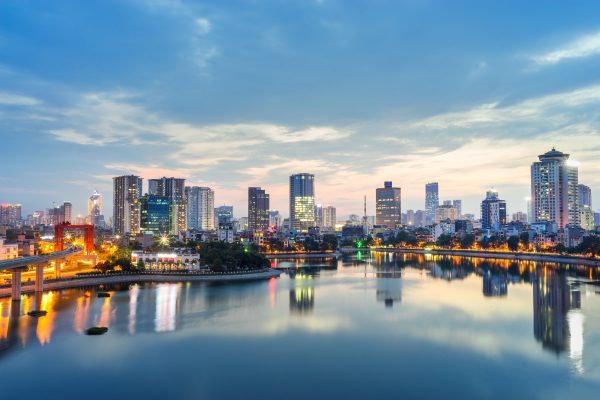



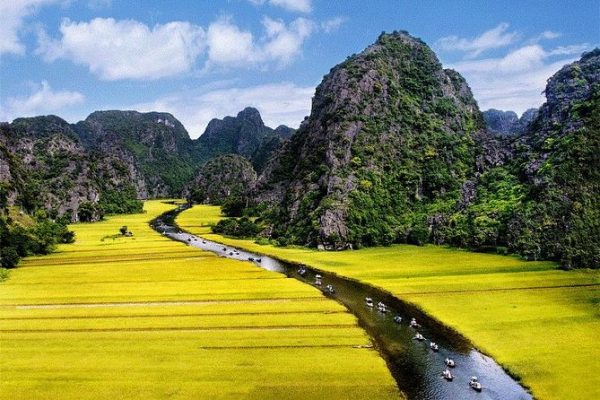
When to skip it
- You have fewer than fourteen days and you want Angkor and a beach. In that case the route enters Vietnam in the south, takes Ho Chi Minh City and the delta, and leaves the north for a second trip. Half a Hanoi is worse than none.
- You are travelling in December or January, you have exactly one Vietnamese city in the plan, and grey damp cold would spoil it. Ho Chi Minh City is dry and 30 °C in those months. The north is the better city and the worse weather, and that trade is yours to make.
- You have already booked Bangkok and Ho Chi Minh City and dense traffic cities exhaust you. Three big Asian capitals in one fortnight is a lot of the same kind of day.
- Your route runs south to north and exits overland into Laos or by air to Luang Prabang from Hanoi — in which case Hanoi is not skippable at all, and the question is only how many of its nights fall before the flight.
The journeys that come here
Hanoi opens or closes most of our routes. The four-country Grand Indochina, 28 days begins here and gives the city its full three nights before the bay, and Indochina Classic, 21 days does the same in a tighter frame. If Vietnam is the point of the trip, Vietnam In Depth, 20 days is the only route with the days to add Sapa on top of Hanoi, and Vietnam and Cambodia, 16 days is the shorter two-country version that still keeps three nights here.
For the crossings into the neighbours, Vietnam and Laos, 17 days uses the 1 h 10 flight from Hanoi to Luang Prabang, and Vietnam and Thailand, 15 days pairs the north with Bangkok and the Gulf. Two routes are built around who is travelling rather than where: the family journey, 18 days shortens the museum day and adds a cooking class and a cycling morning, and the honeymoon, 16 days puts the two Hanoi nights in a landmark hotel and skips the citadel entirely.
If none of the eight is quite right, the tailor-made page explains how a route gets redrawn, or write to us through contact with the month and the party size.
Questions travellers ask most
Is three nights really necessary, or is Hanoi a two-night city?
It is a two-night city for someone who arrives fresh from within the region and a three-night city for someone who arrives from Europe or North America. The long-haul arrival takes a day out of the count before any sightseeing happens, and the second full day is the one that holds the Temple of Literature, the citadel and the museums. If you fly in from Bangkok or Siem Reap, two nights works.
How cold does it actually get in December and January?
Ten to seventeen degrees, with fine drizzle and high humidity, so it feels colder than the number. Hotel rooms have heating, older buildings and restaurants often do not. Bring a proper jacket and a layer under it. People arriving from a beach in Thailand two days earlier consistently underpack for this.
Can we do Ha Long or Lan Ha Bay as a day trip from Hanoi?
It can be done and we do not sell it. The road is two and a half to three hours each way, which leaves about four hours on the water in the middle of the day, when the light is worst and the day boats are thickest. The overnight is the whole point — the bay after 16:00 and before 08:00 is a different place. The bay page sets out the boat sizes and the safety position.
Is the traffic as bad as people say for crossing the road?
Yes, and the technique is real. Walk at a constant slow pace, do not stop, do not run backwards, and the motorbikes flow around you. Cars and buses do not, so wait for those. Your guide will walk the first few crossings with you and after a day it stops being a topic.
Read next
Tell us about the journey you have in mind
Dates, party size and the places you care about are enough to start. You get a draft route and an indicative price, not a brochure.