Hue, the Nguyen capital, in one night or two
Hue was the imperial capital from 1802 to 1945 and it is the only city in Vietnam built as a seat of dynastic government. What survives is a walled citadel that was fought over in 1968, four royal tombs strung along the Perfume River, and a food culture that is distinct from anywhere else in the country. One night moves you through it; two nights lets you do it without a six o’clock start.
The short version
- Region
- Central Vietnam
- Nights
- 1 to 2
- Airport
- Phu Bai (HUI), 15 km, 25 min
- Or
- Da Nang (DAD), 2 h 30 by road
- Best months
- February–August
- Known for
- The Imperial City, the royal tombs, the Perfume River
What this place actually is
Hue is a provincial city of around 400,000 people wrapped around the ruins of a dynasty. The Nguyen emperors built a citadel here on the Chinese model — an outer walled city, an Imperial City inside it, and a Purple Forbidden City inside that — and ruled from it for 143 years. In February 1968 the citadel was held during the Tet Offensive and then retaken over roughly a month of fighting, and a large part of it did not survive. What you walk through today is a mixture of original buildings, careful restoration and, in the innermost enclosure, mown grass over foundations with signboards where the palaces used to be. It is a moving place if you understand that; it is a confusing one if you arrived expecting the Forbidden City.
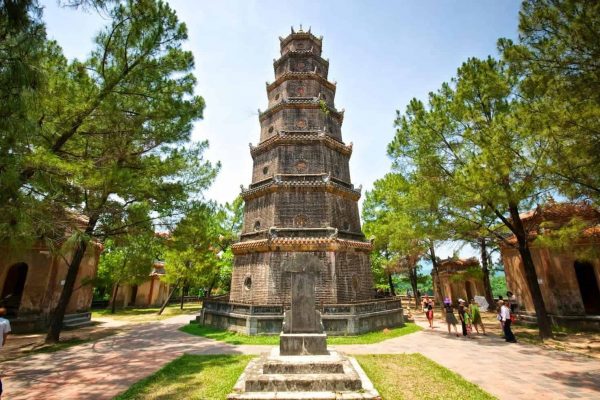
The four tombs along the Perfume River are the stronger half of the visit and each is a different argument. Minh Mang is a formal axial composition in a walled park. Tu Duc is a landscape garden the emperor used as a retreat while alive, with a lake and a theatre. Khai Dinh is concrete and porcelain mosaic, built in the 1920s, and looks like nothing else in Vietnam. Gia Long is furthest out, least visited and the most atmospheric for exactly that reason. Thien Mu Pagoda, on a bluff over the river, is free and takes half an hour.
The over-visited part is narrow and predictable. Khai Dinh between 10:00 and 14:00 takes coach parties from the Da Nang cruise berths and the staircase becomes a queue. The dragon-boat trade on the Perfume River sells a slow chug to Thien Mu with a shopping stop attached. And several hotels sell a royal dinner with costumes, plastic crowns and staged court music, which we do not book — the court music itself is a serious tradition and is worth hearing in a proper performance rather than over a set menu.
How many nights, and why fewer breaks it
One night is workable and two is better. Here is what each buys, in hours.
- The Imperial City needs two and a half to three hours to be worth the ticket, and it opens at 07:00 — the first ninety minutes are the coolest and emptiest of the day.
- Each royal tomb takes 45 to 75 minutes on the ground, plus 20 to 40 minutes of driving between them. Two tombs is a comfortable half-day; three is a full one; four is a forced march.
- Thien Mu Pagoda adds half an hour, and it sits naturally on the way back from Minh Mang or Gia Long.
- A Hue food walk, which is the underrated half of this city, wants two hours in the evening. Bun bo Hue, banh khoai, banh beo and the imperial small dishes are all local to here.
So a one-night stop looks like this: arrive by early afternoon, two tombs and the pagoda before the light goes, dinner, then the citadel at 07:00 the next morning and out by 10:30 for the Hai Van Pass. It works, and it is what most of our routes do. What it cannot include is the third tomb, the Dong Ba market, the Thanh Toan bridge or an unhurried lunch.
Two nights turns that compressed shape into two half-days with an evening in the middle, adds the third and fourth tombs for anyone who liked the first two, and gives you the option of the coastal train south rather than the road. Where a route already has Hoi An at three nights, one night in Hue is the correct allocation; where Hue is the only stop in central Vietnam, take two.
When to go
Central Vietnam runs on a different calendar from the north and the south, and getting this wrong is the single most common seasonal mistake on a Vietnam itinerary. The region is dry from February to August and floods from September to November.
| Months | What it is like | What it buys you |
|---|---|---|
| February–April | 20–30 °C, dry, moderate humidity. | The best window in the region. Comfortable walking hours at the citadel and the tombs. |
| May–August | 33–40 °C, dry, high humidity, strong sun. | Reliable weather and clear light. It also means being off the open tomb courtyards between 11:00 and 15:00, so the day starts early. |
| September–November | Typhoon and flood season, worst in October and November. The Perfume River rises and roads close. | Almost nobody else, the lowest rates of the year, and a river landscape at full volume. It also carries a real chance of a closed pass, a cancelled flight or a citadel standing in water. |
| December–January | 18–24 °C, grey and drizzly, occasional heavy days. | Cool walking and a quiet citadel, in the same window that is dry across Laos, Cambodia and Thailand. This is the compromise most four-country journeys accept. |
Hue and Hoi An flood in most years and the worst of it lands in October and November. Our routes either avoid central Vietnam in those weeks or build a spare day into the leg. If your dates are fixed inside that window, say so at the first email and the route will be drawn to survive a lost day.
How to get there
By air
- Phu Bai (HUI) is 15 km from the centre, a 25-minute transfer. Hanoi is about 1 h 15 in the air and Ho Chi Minh City about 1 h 20.
- Da Nang (DAD) has far more flights, including regional services, and sits 2 h 30 away by road over the Hai Van Pass. On a route that continues to Hoi An, flying into Da Nang and driving north to Hue, then back south, wastes the pass; flying into Hue and driving south uses it properly.
By road
- Hue to Da Nang over the Hai Van Pass is 2 to 3 hours for about 100 km, and it is worth doing in daylight. The pass climbs to 500 metres with the coast on one side the whole way. The tunnel underneath is twenty minutes faster and shows you a tunnel.
- Hue to Hoi An is 2 to 3 hours over the same pass, with stops at Lang Co and the Marble Mountains adding an hour or two if you want them.
- We cap a driving day at five hours, and this leg comes in comfortably below it even with stops.
By rail
- Hue to Da Nang is 2 to 3 hours and is the best two hours of Vietnamese railway: the line runs along the cliff above the sea and over the pass where the road cannot go. Book the seats on the seaward side.
- Hanoi to Hue is 13 to 14 hours overnight; Da Nang to Saigon is 20 hours and more. The full Hanoi–Saigon line is 1,726 km and 30 to 34 hours end to end, and we do not build journeys around it.
What things cost here
| Item | What we see |
|---|---|
| Imperial City, 07:00–17:30 | 200,000 VND |
| Each royal tomb — Minh Mang, Tu Duc, Khai Dinh, Gia Long | 150,000 VND |
| Combination tickets covering the citadel and two to four tombs | 200,000–530,000 VND |
| Thien Mu Pagoda | Free |
| Comfortable four-star room in the city | USD 60–110 per night |
| Riverside and heritage-style rooms at the top of the market | USD 150–300 per night |
| A bowl of bun bo Hue | 40,000–60,000 VND |
| Dinner with a beer in a good local restaurant | USD 10–20 per person |
| Metered taxi across the city | USD 2–4 |
| Phu Bai airport transfer | USD 12–18 |
| Dragon boat on the Perfume River | USD 8–15 per person shared, USD 40–60 for a private hour |
The combination ticket is worth buying at the citadel gate if you intend to see two tombs or more, and worth ignoring if you are only doing Khai Dinh. Entrance fees are the one budget line in central Vietnam that adds up faster than people expect: a citadel plus three tombs is 650,000 VND per person before anyone has eaten lunch.
Hue and the coast in photographs



When to skip it
- You are travelling in October or November on fixed dates with no spare day. Central Vietnam floods in those two months more often than not, and Hue is the part of the route most exposed to it.
- You have fourteen days or fewer and Hoi An is already in the plan. Hue can be taken as a long day from Hoi An — leave at 07:00, citadel and two tombs, back by 19:00 — which is worse than a night here but better than losing a night there.
- Dynastic history and palace architecture do not hold you. If Angkor and the Grand Palace are already in the route, this is the third set of royal buildings in a fortnight and the tombs will blur.
- Your route enters Vietnam from the south and turns around at Hoi An. Adding Hue means either a fifth internal flight or two more hours on the road each way, and neither is worth it for one night.
The journeys that come here
Hue sits on the central leg of four routes and its length varies with what else is in them. Grand Indochina, 28 days and Vietnam In Depth, 20 days both give it two nights, which is enough for the citadel, three tombs and an evening on the food, with the coastal train to Da Nang as the exit south.
On the shorter pair, one night is the allocation. Vietnam and Cambodia, 16 days arrives from the bay, takes the citadel at opening and drives the Hai Van Pass to Hoi An in the afternoon, and Vietnam and Laos, 17 days does the same before turning inland for the flight to Luang Prabang. Both of those routes protect Hoi An at three nights, which is the right trade.
Whether Hue gets one night or two on your journey is usually decided by the month rather than by taste, so read when to go before you fix the dates, then send them to us through contact with the party size.
Questions travellers ask most
Is one night in Hue enough?
It is enough for the Imperial City at opening, two royal tombs, Thien Mu Pagoda and one dinner, provided you arrive by early afternoon. It is not enough for four tombs, the market and an unhurried day. Where a route already gives Hoi An three nights, one night here is the correct allocation and we say so in the itinerary.
Which tombs should we choose if we only see two?
Minh Mang and Khai Dinh, because they are the least alike. Minh Mang is a formal walled composition on an axis in a park; Khai Dinh is 1920s concrete covered in porcelain mosaic and looks like nothing else in the country. Tu Duc is the one to add third if you have the morning, for the lake and the garden.
Should we take the train or the road to Da Nang and Hoi An?
Both are 2 to 3 hours. The train runs along the cliff above the sea where the road cannot go and is the best short rail leg in Vietnam, but it ends at Da Nang station and you still need a car for the last 30 minutes. The Hai Van Pass by road stops where you want and shows you the same coast from above. Some of our routes take the train south and drive back over the pass on the return.
What actually happens if we are there during a flood?
Streets in the low quarters take water, the tomb access roads on the far bank can close, and the Hai Van Pass is occasionally shut for a day. Flights out of Phu Bai are cancelled more often than they are delayed. Routes we build in September to November carry a spare day on this leg for that reason, and the hotels in Hue handle it far better than a first-time visitor expects.
Read next
Tell us about the journey you have in mind
Dates, party size and the places you care about are enough to start. You get a draft route and an indicative price, not a brochure.