Vietnam and Cambodia: sixteen days, Hanoi to Angkor
The shortest journey we run in these two countries, and close to the shortest that is worth running. Sixteen days takes Vietnam from the delta of the Red River to the delta of the Mekong, then crosses into Cambodia and finishes at Angkor.
The route
- Length
- 16 days, 15 nights
- Group
- Private. Two to eight people, your party only
- Starts
- Hanoi (HAN)
- Ends
- Siem Reap (REP)
- Pace
- Easy. Eight stops, two of them three nights
- From
- USD 4,000 per person, land only
Eight stops, fifteen nights, three flights and one road crossing of the Hai Van Pass. Vietnam gets eleven nights and Cambodia four.
Who this journey is for
This is for the traveller with sixteen days and no more of them, who wants Vietnam done properly rather than three countries done thinly. Most people who book it are working, take annual leave in one block, and would rather spend eleven nights in one country and four in another than spread the same fortnight across four borders. It is also the trip we recommend to anyone visiting Southeast Asia for the first time, because Vietnam is the easiest of these countries to travel in and Angkor is the payoff at the end.
The pace is genuinely easy. Two flights inside Vietnam, one short hop to Phnom Penh, one road leg to Siem Reap, and three nights each in Hanoi and Hoi An so that two places are learned rather than glimpsed. Where it is tight is Siem Reap, and the honest position is set out below: two nights buys two temple mornings and no more, and a third is better.
What the sixteen days contain
- Three nights in Hanoi and three in Hoi An, the two places on this route that reward staying put
- A night on Lan Ha Bay, boarded from Haiphong, which carries far fewer boats than the Ha Long core
- The Hai Van Pass driven in daylight between Hue and Hoi An, two to three hours with stops
- The Hue Imperial City at seven in the morning, before the heat and the coaches
- Cai Rang floating market at Can Tho, on the water before six
- A three-day Angkor pass at USD 62, used across two mornings with the third day spare
- A driver and an English-speaking national guide in both Vietnam and Cambodia
- Four free or optional half-days with the car and guide still at your disposal
How the route is put together
Hanoi to Hue is flown rather than taken by rail. The overnight train is thirteen to fourteen hours and it wastes a night; the flight is an hour and ten. The scenic stretch of that railway is the two to three hours between Hue and Da Nang over the Hai Van Pass, and this itinerary drives that same pass by car the following day, in daylight, with stops at Lang Co and at the top. That is the only part of the line worth the time, and you get it without the other twelve hours.
Ho Chi Minh City to Phnom Penh is flown in 50 minutes, landing at Techo International Airport, 19 km south of the city, which took over all international traffic on 9 September 2025. From Phnom Penh to Siem Reap there is a choice: National Road 6 in about five and a half hours with a lunch stop at Kampong Thom, or the 45-minute flight. Both are included at the same price. On a sixteen-day trip most people fly it and use the recovered afternoon on the first temple — but the road shows you the country, and that is a fair reason to take it.
Two nights gives you two temple mornings: Angkor Wat and Angkor Thom on the first, Ta Prohm and Banteay Srei on the second. It does not give you a rest day, a third morning, or room to recover if one of you is unwell. Three nights is better and we will say so every time you ask. The three-day Angkor pass at USD 62 is valid on any three days within ten, so an extra night costs you the hotel and the guide and nothing at the ticket office.
Day by day
All sixteen days are written out, including the free ones.
Arrive Hanoi
Your guide meets you inside the arrivals hall at Noi Bai and the drive into the Old Quarter takes about forty-five minutes. Nothing is scheduled after that. A shower, a bowl of pho within walking distance and an early night is the whole plan, and it is the right one after a long flight.

Hanoi on foot
Walking starts at eight, ahead of the traffic: silver on Hang Bac, beaten tin on Hang Thiec, paper offerings on Hang Ma, and a market that has been in the same streets for six centuries. Lunch is bun cha at a pavement grill with plastic stools. The afternoon covers the Temple of Literature and the Museum of Ethnology, and you are back by five.
Hanoi, at your own speed
The Ho Chi Minh complex and the One Pillar Pagoda fill the morning, queue included. The afternoon is free with the car and guide still yours: the ceramic kilns at Bat Trang, the Fine Arts Museum, a water puppet show, or an afternoon spent doing nothing around Hoan Kiem Lake. Dinner is on your own so you can eat on your own clock.
Hanoi to Lan Ha Bay
You leave at eight on the Hanoi–Haiphong expressway and board at Got pier around midday. Lan Ha is entered from Haiphong instead of Tuan Chau, and within twenty minutes the difference is obvious: fewer hulls in sight, quieter anchorages, water you can swim in. Kayaks go out in the afternoon and the boat spends the night at anchor among the karsts.

Lan Ha Bay to Hue
Tai chi on deck at half past six for those who want it, brunch as the boat comes back in, ashore by eleven. Two and a half hours by road to Noi Bai, then an hour and ten in the air to Hue. Your Hue guide meets the flight and the evening is free along the Perfume River, where the walking is flat and dinner is close.
Hue, then the Hai Van Pass to Hoi An
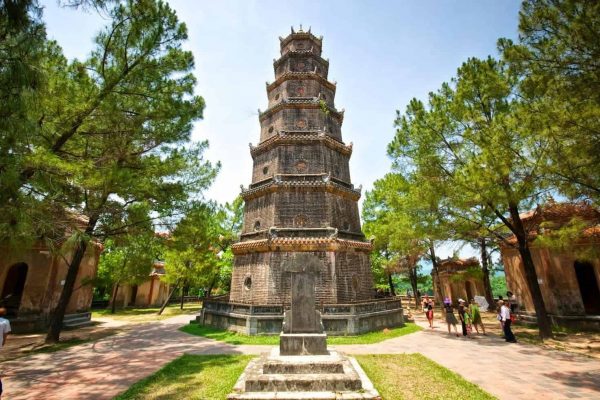
The Imperial City opens at seven and you go in at half past, before the heat and before the groups; entry is 200,000 VND and two hours is enough at a comfortable pace. One royal tomb follows at 150,000 VND — Minh Mang for its symmetry, Tu Duc for its shade. Then the car climbs the Hai Van Pass with stops, drops past the Lang Co lagoon, and reaches Hoi An in the late afternoon.
Hoi An old town
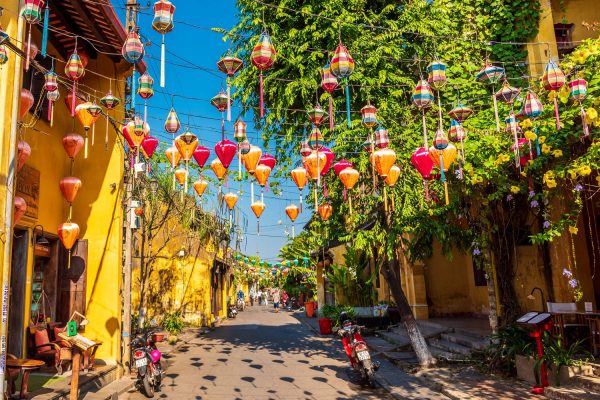
The old town ticket costs 120,000 VND and admits you to five of the twenty-two heritage buildings; the enforcement happens at the heritage-house doors in daylight, not at the street corners. Your guide picks the five that repay the time: the Japanese covered bridge, a Chinese assembly hall, a merchant house still lived in by the family that built it. The afternoon is free for a tailor or the beach.

Hoi An, and My Son if you want it
My Son is worth an early start: the Cham brick towers hold their detail in low light and the site is close to empty before nine, forty-five minutes out and forty-five back. If ruins in heat do not appeal, the alternative is a cooking class beginning in the market or a bicycle through the paddy to An Bang beach. The evening is yours regardless.
Hoi An to Ho Chi Minh City
The flight is deliberately after lunch so that a Hoi An morning is not spent at an airport; you can swim, walk the beach or make a last fitting. Da Nang is fifty minutes by road and the flight south an hour and twenty. Ho Chi Minh City arrives as heat and traffic after a week of small towns, which is the right way round.
Ho Chi Minh City
The War Remnants Museum comes first and the Reunification Palace second, because the palace reads better afterwards. Lunch in a market hall, then the Central Post Office, the Jade Emperor Pagoda and an hour in the coffee alleys off Ton That Thiep. The Cu Chi tunnels can take the afternoon instead, at the cost of about three hours in the car.

Down to the delta
Three and a half hours to Can Tho with a stop at Cai Be or Vinh Long for a boatyard and a fruit orchard. The delta is flat, brown and entirely organised around water as a road rather than as a view, and that is what makes it interesting. Late afternoon on a sampan through the narrow canals, then an early dinner, because tomorrow starts in the dark.
Cai Rang at dawn, then Phnom Penh
On the water at half past five. Cai Rang is a wholesale market and it runs whether or not anyone photographs it: boats sell by the sack and hang a sample from a pole so buyers can read it across the channel, and by eight it is thinning out. Then the road back to Ho Chi Minh City and the fifty-minute flight to Phnom Penh, landing at Techo International Airport.

Phnom Penh
Tuol Sleng in the morning and Choeung Ek after it, with the audio guide, and your guide will leave you alone inside both, which is the right way to visit them. It is a hard half day and this page will not soften it. The afternoon is the Royal Palace, the Silver Pagoda and the National Museum, whose Khmer sculpture is the best possible preparation for the temples ahead.
Phnom Penh to Siem Reap
National Road 6 takes about five and a half hours with a lunch stop at Kampong Thom and shows you the countryside the flight hides. The 45-minute flight is included at the same price if you would rather have the afternoon, and on a sixteen-day trip most people take it. Either way you are in Siem Reap in time for a quiet evening, because Angkor starts before five tomorrow.
Angkor
Angkor Wat opens at five and you are at the west causeway for it, which buys you the bas-relief galleries before the heat and before the crowds. Angkor Thom follows for the Bayon faces and the Terrace of the Elephants, then Ta Prohm strictly on the boardwalks. You are back at the hotel by midday, and the late afternoon is optional: Banteay Srei for the finest carving in the park, or the pool.

Depart Siem Reap
The third day on your Angkor pass is still valid if your flight is late enough, and Preah Khan at seven in the morning is a good use of it. Otherwise the morning market and a long breakfast. Siem Reap–Angkor International sits 40 to 50 km from town, so the transfer takes 45 to 60 minutes and is timed accordingly.
What it costs
Per person, twin share, land only. The car, the driver and the guide cost the same whether two or six people use them, which is why the rate falls with party size.
| Party size | Comfortable | Excellent |
|---|---|---|
| 2 travellers | USD 5,120 | USD 7,940 |
| 3 – 4 travellers | USD 4,400 | USD 6,820 |
| 5 – 8 travellers | USD 4,000 | USD 6,200 |
Roughly USD 250 to USD 500 per person per day. Comfortable means four-star hotels chosen for where they stand rather than for their star count, plus a well-run Lan Ha boat; Excellent means the named houses and a cabin with its own deck. A third Siem Reap night is quoted on request and usually adds USD 200 to USD 500 per person depending on standard. The pricing page has the detail and how to book covers deposits.
What is included, and what is not
What the price includes
- Fifteen nights in the hotels named in your quote, twin share, breakfast included
- One night aboard a small Lan Ha Bay cruise in a cabin with a window
- A private car and driver in Vietnam and in Cambodia, held for the whole day rather than for transfers
- A separate English-speaking national guide in each country
- All internal and regional flights listed in the day-by-day, economy class with a checked bag
- The Phnom Penh to Siem Reap leg by road or by air, at the same price, your choice
- Airport, pier and hotel transfers on arrival and departure in every city
- Entrance fees to every site named above, including the three-day Angkor pass at USD 62, the Hue Imperial City at 200,000 VND with one royal tomb, and the Hoi An old town ticket
- Meals exactly as marked each day: breakfast daily plus the listed lunches and dinners
- Cold water in the car and a 24-hour local telephone number in both countries
What it does not include
- International flights into Hanoi and out of Siem Reap
- Visas: the Vietnamese e-visa, and the Cambodian e-visa at USD 30 plus USD 6 processing or visa on arrival at USD 30
- The arrival cards — Cambodia e-Arrival at arrival.gov.kh, the Lao LDIF and the Thailand TDAC if a connection takes you through either country with an entry stamp. All are free and you file them yourself
- Travel insurance, which we require and will ask to see before departure
- Tips for guides and drivers
- Meals not listed in the day-by-day, and all drinks including with included meals
- Laundry, spa treatments, minibar and other hotel extras
- Anything added on the road: a third Angkor morning, a cooking class, a tailored suit
The journey in pictures




Who this journey is wrong for
Five reasons this trip is not for you. They are worth reading before you enquire rather than after you have paid a deposit.
- You want to be at Angkor without effort. Two nights in Siem Reap buys two temple mornings and nothing spare — no rest day, no third morning, no room to be ill. Three nights is better and the three-day pass at USD 62 already covers it, so the extra night costs only the hotel and the guide.
- Long road legs bother you. Ho Chi Minh City to Can Tho and back is three and a half hours each way, and Phnom Penh to Siem Reap is five and a half on National Road 6 unless you take the flight. The Hai Van Pass day runs three and a half hours with stops, and it is the best driving day on the trip.
- Heat on stone is a problem for you. Angkor passes 32 °C by ten in the cool season and 35 to 40 °C from March to May, and the Angkor Wat causeway has no shade. Hue and Hoi An are humid from May onwards.
- You want October or November dates and expect central Vietnam to be dry. That is typhoon and flood season on the Hue–Hoi An coast, worst in exactly those two months, and Hoi An old town floods most years. Book then and you accept a real chance of losing part of that section.
- You want it shorter than twelve days, on a shared coach, with an elephant ride, an orphanage visit or a stop at a silk or gem showroom that pays commission. We do not run any of it. A fixed sixteen-day schedule is also hard on children under about ten — see the family journey instead.
Ask about the sixteen days
Give us your month and your party size and we will send a dated itinerary with hotels named and a firm price.
Questions travellers ask most
Two nights in Siem Reap — is that really enough for Angkor?
It is enough for two temple mornings: Angkor Wat, Angkor Thom and Ta Prohm on the first, Banteay Srei and one more on the second. It is not enough for a rest day, and it leaves no margin if one of you wakes up unwell.
Three nights is better and we say so to everyone who asks. The three-day pass at USD 62 is valid on any three days within ten, so the third day at the ticket office is already paid for — you are only adding a hotel night and a guide day. Ask us to quote it.
Should we drive or fly from Phnom Penh to Siem Reap?
Both are included at the same price. National Road 6 takes about five and a half hours with a proper lunch stop at Kampong Thom, and it shows you stilt houses, dry-season paddy and roadside markets that the flight passes over in the dark.
The flight is 45 minutes, but Siem Reap–Angkor International opened in October 2023 and sits 40 to 50 km from town, so the transfer adds 45 to 60 minutes at that end. On a sixteen-day trip we usually recommend the flight and put the recovered afternoon into the first temple.
Will Hoi An be flooded if we travel in October or November?
It might be. Central Vietnam runs a typhoon and flood season from September to November, worst in October and November, and the Hoi An old town floods in most years — sometimes for a day, sometimes for a week, with the riverside streets navigable by boat.
We will still take the booking for those dates and we will tell you plainly what the risk is. What we do is build the Hoi An nights so they can be moved to the beach side or to Da Nang, keep the Hue day flexible, and insist on travel insurance that covers weather disruption. February to August is the dry window on that coast if your dates are movable.
Can we add days at the end, or start somewhere other than Hanoi?
Yes to both, within reason. The most common additions are a third night in Siem Reap, two nights in Sapa after Hanoi, or three or four beach nights on Phu Quoc before crossing to Cambodia. Any of these turns a sixteen-day trip into eighteen to twenty-one, which is where this route becomes comfortable rather than merely easy.
Reversing it to start at Angkor and finish in Hanoi is possible but we advise against it: Angkor is the strongest thing on the route and putting it first makes everything afterwards feel like an epilogue. If you want three countries in a similar shape, look at the 21-day Indochina Classic, or talk to us through the contact page.
Read next
Tell us about the journey you have in mind
Dates, party size and the places you care about are enough to start. You get a draft route and an indicative price, not a brochure.