The slow two-country route
Four nights in Luang Prabang, two in Vientiane by train rather than by road, four in Siem Reap with a day off between the temple mornings, and three in Phnom Penh. This is the slowest route we run and the one for travellers who have already done Vietnam and Thailand.
Who this journey is for
- Length
- 14 days, 13 nights
- Group
- 2 – 8, your party only
- Starts
- Luang Prabang
- Ends
- Phnom Penh
- Pace
- Easy — the slowest itinerary we sell
- From
- USD 3,500 per person
This route is for people who have already been to Vietnam and Thailand, or who never wanted them. Laos and Cambodia are the two quietest countries in the region and they reward being left alone in. Fourteen days across four places means an average of more than three nights each, which is unusual, deliberate, and the entire argument for this itinerary.
Four nights at Angkor is the part that changes the trip. It means two temple mornings with a full day off between them, rather than three consecutive sunrises and a headache. Anyone who has climbed out of bed at half past four on three mornings in a row knows the difference between seeing Angkor and enduring it. The day in the middle is not padding; it is what makes the second morning worth having.
Four nights in Luang Prabang works the same way. The town is small enough to walk end to end in half an hour and it takes about two days for the tourist version of it to fall away, which is roughly when most fourteen-day itineraries have already moved on.
What the fourteen days give you
- Four nights in Luang Prabang, long enough to see the alms round once, decline it the next morning and still have two days left.
- The Laos–China Railway from Luang Prabang to Vientiane: 1 hour 50 minutes on an EMU against roughly ten hours by road.
- Two nights in Vientiane, which is enough for a capital that does not pretend to be busy.
- A three-day Angkor pass at USD 62, valid on any three days within ten, used across two mornings with a day off in the middle.
- Banteay Srei on its own morning, 37 kilometres out, where the carving is finer than anywhere else in the park.
- A private guide and driver in Laos and a second pair in Cambodia, each working only in their own country.
- Three nights in Phnom Penh, which allows the S-21 morning to be followed by a day that is not about it.
- No driving day longer than about two hours anywhere on the route.
Trains, flights, and the two things people get wrong
The Luang Prabang to Vientiane leg is the best piece of transport in Indochina and it is also the one most often booked badly. The EMU covers it in 1 hour 50 minutes; the road takes about ten hours through mountains. Second class costs around USD 20. The problem is that station ticket windows open only three days before departure and second class sells out in the dry season, which is exactly when you want to travel.
Our office buys these seats through an agent weeks ahead. Travellers who plan to walk up to the counter on the day are, most of the time, buying a ten-hour minivan instead. The stations are also well out of town — Luang Prabang 12 kilometres, Vientiane 15 — so both ends carry a transfer of 20 to 30 minutes, which is in the itinerary and in the price.
There is no direct service between Vientiane and Siem Reap worth the connection times. The routing is via Bangkok or via Hanoi, and the total door to door runs five to seven hours depending on the day. We book the connection that leaves the most margin rather than the one that looks shortest on paper, and the day is written into the itinerary as a travel day rather than disguised as sightseeing. Siem Reap–Angkor International opened in October 2023 and sits 40 to 50 kilometres from town, so add a 45 to 60 minute transfer at the far end.
The second thing people get wrong is the Angkor pass. A one-day pass costs USD 37, three days USD 62 and seven days USD 72. The three-day pass is valid on any three days within a ten-day window, which is what makes the day off possible; you are not obliged to use them consecutively and a great many itineraries assume you are. The ticket office is on Apsara Road, open 04:30 to 17:30, and the pass carries your photograph and is not transferable. The park is generally open 07:30 to 17:30 with Angkor Wat itself opening at 05:00.
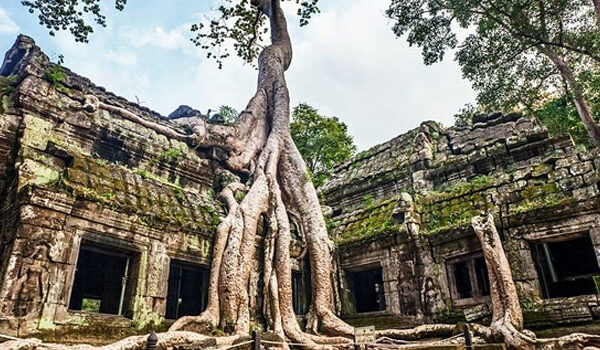
Two rules inside the park matter. Shoulders and knees must be covered at the inner temple entrances, and the guard on the upper level of Angkor Wat turns people away for it every day. At Ta Prohm you stay on the boardwalks. Phnom Bakheng has a hard cap of 300 people at sunset, which is why we do not build an evening around it.
Laos: visa on arrival for 30 days at roughly USD 30 to 45 depending on nationality, or an e-visa at laoevisa.gov.la. The Lao Digital Immigration Form has been mandatory since September 2025 at Vientiane, Luang Prabang and Pakse airports. Cambodia: e-visa at USD 30 plus USD 6 processing, 30 days single entry, about three working days at evisa.gov.kh, or visa on arrival at USD 30 at the airports. The separate Cambodia e-Arrival form is free, mandatory and filed at arrival.gov.kh within seven days of arrival. More on visas and entry. What the figures below cover is explained on our pricing page, the deposit sequence is on how to book, and the shorter Cambodia and Thailand pairing is here.
Day by day
Arrive Luang Prabang
The airport is four kilometres from town and the transfer takes ten minutes, which makes this the gentlest arrival in the region. Your guide meets you and nothing else happens today.
If you land before dark, walk the length of the peninsula to the confluence of the Mekong and the Nam Khan before dinner. It takes half an hour and it orients you for the next four days.
The alms round, the hill and the peninsula
Tak Bat, the alms round, runs roughly 06:00 to 07:00 from November to February and 05:30 to 06:30 from March to October. If you go, you watch in silence from at least five metres back, without flash, with shoulders and legs covered, and you do not touch a monk or follow the procession in a vehicle. Buses are banned inside the World Heritage zone for exactly this reason.
After breakfast the day covers the Royal Palace Museum, Wat Xieng Thong at the tip of the peninsula, and the 328 steps up Mount Phousi late in the afternoon.
Upriver to the Pak Ou caves
A slow boat works two hours upstream against the Mekong current to the Pak Ou caves, two chambers in a limestone cliff holding several thousand Buddha images left there over four centuries. The return downstream takes about an hour and a quarter.
The boat stops at Ban Xang Hai on the way back, a village that distils rice whisky and has done for a long time. The afternoon is free.
Kuang Si, and a day that ends early
Kuang Si falls are 29 kilometres south, about 45 minutes on a road that has been improved but is still a road. The water drops through a series of turquoise pools and you can swim in the lower two. The bear rescue centre at the entrance houses Asiatic black bears taken from the bile trade; it is a genuine sanctuary and takes twenty minutes.
Go at opening. By eleven the pools are full. The afternoon is free and most people spend it doing nothing on a terrace above the river.
The railway to Vientiane
The station is 12 kilometres out of Luang Prabang, so you leave the hotel about ninety minutes before departure. The train covers the distance in 1 hour 50 minutes, through a corridor of tunnels and viaducts that replaced a ten-hour mountain road. Second class is comfortable and costs around USD 20; your seats were bought weeks ago because the windows only open three days ahead.
Vientiane station is 15 kilometres from the centre. You are in the hotel by mid-afternoon with the rest of the day free.

Vientiane
Wat Si Saket is the oldest temple still standing in the city, built in 1818 and holding several thousand small Buddha images in wall niches; it survived the Siamese sack of 1827 that flattened everything around it. Haw Phra Kaew, That Luang and Patuxai fill the rest of the morning.
The COPE visitor centre in the afternoon deals with unexploded ordnance and the prosthetics programme that follows from it. It is short, it is well made, and it explains more about modern Laos than any temple will.
Fly to Siem Reap
A travel day, and it is written down as one. The routing is via Bangkok or via Hanoi because there is no direct service worth the connection times, and door to door runs five to seven hours. Your Lao guide sees you through departure at Wattay and a Cambodian guide meets you at the far end.
Siem Reap–Angkor International is 40 to 50 kilometres from town and the transfer takes 45 to 60 minutes. Dinner is in the hotel.
First temple morning: Angkor Wat and the walled city
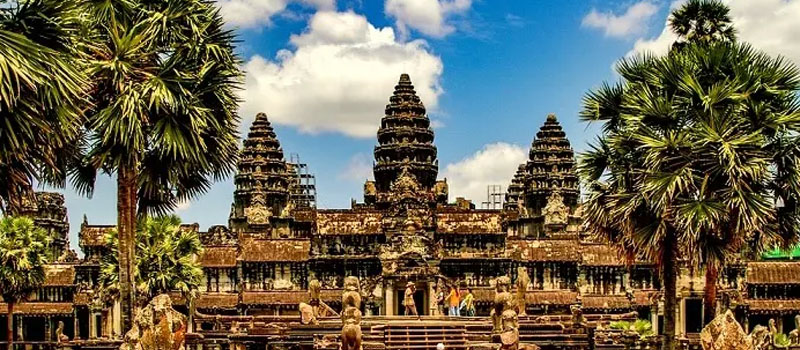
You are at the gate at 07:30 when the park opens, and inside Angkor Wat before the middle of the morning. The three-day pass at USD 62 was bought at the Apsara Road office the previous evening or first thing, and it carries your photograph.
Angkor Thom follows: the Bayon and its faces, the Terrace of the Leper King, and Ta Prohm on the boardwalks, which is where the trees are and also where everybody else is. You are back at the hotel by two, which is intentional.
The day off
Nothing is scheduled and the pass is not used. This is the day that makes the second temple morning work. The car and guide are on call from nine.
Most people take the Tonle Sap in the morning — Kampong Phluk, the stilt village, which stands twenty feet in the air in the dry season — and then sleep. Others do not leave the hotel. Both are correct.
Second temple morning: Banteay Srei and the outer group
Banteay Srei is 37 kilometres north-east and the pink sandstone carving there is finer than anywhere else in the park, which is why it gets its own early start rather than being tacked onto a longer day.
Coming back you stop at Banteay Samre or Pre Rup depending on the light and on how much stone you can still absorb. The afternoon is free and the pass has one unused day on it if you want a third morning.
Fly to Phnom Penh
A short flight of about 45 minutes lands at Techo International Airport, which took over Phnom Penh’s international traffic on 9 September 2025 and sits 19 kilometres south of the city. The old airport now handles domestic flights and private jets only.
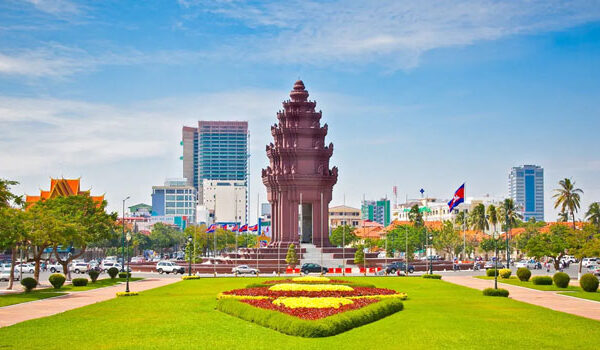
The afternoon is the riverfront where the Tonle Sap meets the Mekong, and the Royal Palace with its silver pagoda floor if the timing works.
The hardest half-day of the trip
The morning goes to Tuol Sleng, the school the Khmer Rouge turned into security prison S-21, and then 15 kilometres out to the killing field at Choeung Ek. It is three hours and it is difficult from the first room, which is the point of it being here.
You may decline it outright. Say so at breakfast and the guide will take you to the National Museum and the Russian Market instead, with no discussion, no argument and no change to the price.
Phnom Penh, slowly
A boat crosses to Koh Dach, the silk island, where looms still run under houses and the weaving is a household business rather than a showroom. You will not be steered towards a till.
The afternoon is free. The Central Market under its 1937 art deco dome, the National Museum if you skipped it, or a chair and a book on the riverfront.
Depart Phnom Penh
A transfer to Techo International, 19 kilometres south and about 40 minutes with traffic, timed to your flight. Allow more margin than you would at the old airport; it is further out and the road into it is still settling into its capacity.
What it costs
| Party size | Comfortable | Excellent |
|---|---|---|
| 2 travellers | USD 4,480 | USD 6,940 |
| 3 – 4 travellers | USD 3,850 | USD 5,970 |
| 5 – 8 travellers | USD 3,500 | USD 5,430 |
What is and is not included
What the price includes
- Thirteen nights: four in Luang Prabang, two in Vientiane, four in Siem Reap, three in Phnom Penh.
- Second-class seats on the Laos–China Railway from Luang Prabang to Vientiane, bought weeks in advance through an agent.
- The flight from Vientiane to Siem Reap via Bangkok or Hanoi, and the flight from Siem Reap to Phnom Penh, both in economy.
- A private English-speaking guide in Laos and a second in Cambodia, each working only in their own country.
- A private car with a driver throughout, including both railway-station transfers and the 45 to 60 minute run from Siem Reap–Angkor airport.
- The three-day Angkor pass at USD 62 and every other entrance fee named in the itinerary.
- The Pak Ou boat, the Kuang Si transfer and the Koh Dach crossing at Phnom Penh.
- Breakfast every morning plus the meals shown day by day.
- Airport meet-and-greet at Luang Prabang and a 24-hour contact number in each country.
What it does not include
- International flights into Luang Prabang and out of Phnom Penh.
- Visas: Lao visa on arrival or e-visa, and the Cambodian e-visa at USD 30 plus USD 6 processing.
- The free Lao Digital Immigration Form and the free Cambodia e-Arrival form, which you file yourself.
- Travel insurance, which we require and will ask to see before departure.
- Lunches and dinners on the days marked breakfast only, and all drinks.
- Tips for guides and drivers.
- A third temple morning on the unused pass day, if you take one.
The journey in pictures


Who this journey is wrong for
Five kinds of traveller will be happier on a different route, and it is better to establish that before a deposit is paid.
- Anyone who has not yet seen Vietnam or Thailand. Start with one of those; this is the route you take afterwards.
- Anyone who wants to move every second day. This itinerary is built around staying put, and the day off in Siem Reap is not negotiable without rewriting the whole thing.
- Anyone who expects to walk up to a Lao railway counter and buy a seat. The windows open three days ahead and second class sells out in the dry season, which is why we book weeks in advance.
- Anyone who wants an overland Vientiane to Siem Reap leg. It does not exist as a sensible journey; the routing is flown via Bangkok or Hanoi and takes five to seven hours door to door.
- Anyone travelling on under USD 200 per person per day. Two countries, four flights and rail seats at this standard cannot be run at that number.
Ask about a departure
Tell us your month and we will check the railway seats and the Angkor pass window before we quote.
Questions travellers ask most
Why four nights in Siem Reap rather than three?
Because the three-day Angkor pass at USD 62 is valid on any three days within ten, which means the temple mornings do not have to be consecutive. Four nights buys a full day off between them.
Three consecutive early starts at Angkor is how people come home saying the temples blurred. The day in the middle is the difference between seeing the park and enduring it.
Can we just buy the train tickets when we arrive?
In practice, no. Station ticket windows for the Laos–China Railway open only three days before departure and second class sells out in the dry season, which is precisely when you want to be travelling.
Our office buys through an agent weeks ahead. The alternative to a seat is about ten hours by road over the mountains, against 1 hour 50 minutes on the train.
Is there a direct flight from Vientiane to Siem Reap?
Not one worth the connection times. The practical routings run via Bangkok or via Hanoi and take five to seven hours door to door, which is why day seven is written into the itinerary as a travel day rather than dressed up as sightseeing.
At the far end, Siem Reap–Angkor International is 40 to 50 kilometres from town, so allow a further 45 to 60 minutes.
Do we have to visit S-21 and Choeung Ek?
No. It is the hardest half-day of any trip in this region and it can be declined without argument. Say so at breakfast and your guide will take you to the National Museum and the Russian Market instead. There is no cost either way and nobody will ask you to justify it.
If you do go, the guide is briefed to answer questions plainly, to keep the group small and to stop talking when you want silence.
Read next
Tell us about the journey you have in mind
Dates, party size and the places you care about are enough to start. You get a draft route and an indicative price, not a brochure.