Vietnam and Laos in seventeen days
Seventeen days, two countries, one party. Vietnam supplies the north, the old imperial capital and three nights in Hoi An. Laos supplies four nights in Luang Prabang and the rail line down to Vientiane, and it is the half of the trip that most people come home talking about.
Who this journey is for
- Length
- 17 days, 16 nights
- Group
- Private, 2 to 8 people
- Starts
- Hanoi, Vietnam
- Ends
- Vientiane, Laos
- Pace
- Easy to moderate
- From
- USD 4,250 per person
This route suits a couple or a small family who have a little over two weeks, want two countries rather than four, and would rather stay three nights in a town than one. Seven places in seventeen days is a moderate count for the region; the same seventeen days sold as a group tour would usually carry ten or eleven. The difference shows up as free afternoons, and as the fact that Luang Prabang gets four nights instead of the standard two.
It also suits travellers who care about the difference between Ha Long Bay and Lan Ha Bay, between a rowed sampan at Trang An and a queue, between an alms round watched properly and one photographed badly. Nobody on this trip is a stranger to you. The vehicle, the driver and the national guide in each country belong to your party for the day, which is what makes an unscheduled two-hour stop possible at all.
Trip highlights
- A night aboard a small boat in Lan Ha Bay, entered from Haiphong, where the boat count is measured in dozens rather than hundreds
- Trang An by rowed sampan through three flooded caves, about two hours on the water
- The Hue citadel and two royal tombs with a guide who reads the Chinese characters over the gates
- Three nights in Hoi An, enough to see the old town at 06:30 as well as at 19:00
- Four nights in Luang Prabang, including one early morning at the alms round watched in silence from a side street
- The Laos–China Railway from Luang Prabang to Vientiane, 1 h 50 against roughly ten hours by road
How this route actually connects
The join between central Vietnam and Laos is the part of this itinerary that decides everything else, so here it is plainly. The only sensible way across is to fly: Da Nang to Hanoi, then Hanoi to Luang Prabang, 1 h 10 with Lao Airlines daily or Vietnam Airlines three times a week. It is one travel day, and it is the travel day this route is built around.
Overland crossings between Vietnam and Laos do exist. They are not usable for a trip like this one. A Lao e-visa is not valid at any Vietnamese land border, and of the crossings only Dansavan, opposite Lao Bao, issues a visa on arrival. Getting to that border from Hue is a long day on roads that carry freight, and the road onward to Savannakhet then leaves you in the wrong half of the country for Luang Prabang. The flight costs a morning. The overland version costs two days and a real chance of being turned back at a barrier with the wrong sticker in your passport.
Inside Laos the second leg is easier and better. Luang Prabang to Vientiane on the Laos–China Railway takes 1 h 50, against roughly ten hours by road on Route 13. Second class is around USD 20. The catch is that station windows open only three days ahead and second class sells out through the dry season, so the seats are bought for you well in advance rather than on the day. Allow for the stations being a long way out of town: 12 km at Luang Prabang, 15 km at Vientiane.
If you have read elsewhere that you can cross from Hue or Hoi An into Laos by road on an e-visa, that advice is out of date. Apply for the Lao visa the way this trip uses it, or arrive by air where visa on arrival and the Lao Digital Immigration Form are both routine.
The route, day by day
Every day below is the day we actually operate. Driving times are door to door in normal conditions and include stops; where a leg is flown, the flight and its duration are given instead.
Arrive Hanoi
Your flight lands at Noi Bai and your guide meets you in the arrivals hall. The transfer into the Old Quarter takes about 45 minutes in ordinary traffic and closer to an hour if you land at six in the evening.
Nothing else is scheduled. There is a short orientation walk down to Hoan Kiem lake if you are awake enough to want it, and a table held for dinner five minutes from the hotel.
The thirty-six streets
The morning is spent on foot in the Old Quarter with a guide who lives in it: the guild names still painted on the shopfronts, Bach Ma temple at the top of Hang Buom, the hardware alley, the herb alley, and Dong Xuan market at the end of it.
After lunch you cross to the Temple of Literature and walk the five courtyards, then the Ho Chi Minh complex, the stilt house and the One Pillar Pagoda. The distances are short but they add up to about six kilometres of walking across the day.

Museums, and an afternoon of your own
The Vietnamese Women’s Museum takes about ninety minutes and is the best-curated museum in the city. Hoa Lo Prison is fifteen minutes away and takes another hour; it is uncomfortable in places and your guide will tell you which parts of the display are propaganda and which are not.
The afternoon is deliberately empty. Most people use it to sleep, or to walk the rail track at Long Bien, or to go back to a shop they saw yesterday. At 18:00 there is a water puppet show, forty-five minutes, and dinner afterwards.
Hanoi to Lan Ha Bay
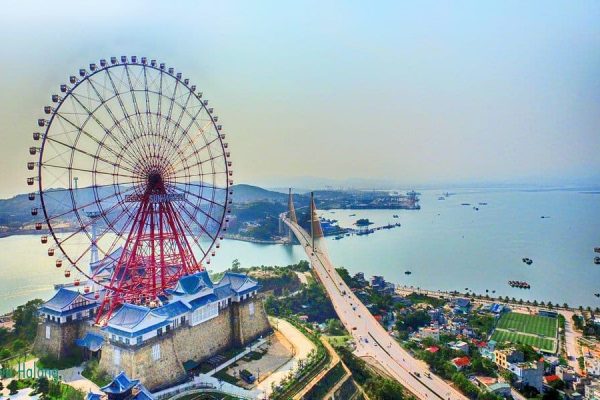
You leave the city at about 08:00 and reach the pier at Got, on the Haiphong side, in a little over two hours on the expressway. Lan Ha is entered from here rather than from Tuan Chau, and that single decision is why the water around your boat holds dozens of vessels rather than several hundred.
Lunch is served as the boat moves out through the karst. The afternoon is a kayak or a bamboo boat into a lagoon that is only reachable at the right tide, a swim off the stern if the water is warm, and then the overnight anchorage. Squid fishing off the back deck after dinner is optional and rarely productive.
Off the water, south to Ninh Binh
Tai chi on the sun deck at 06:30 for whoever surfaces, then a cave or a floating village before the boat turns for the pier. You are on land by 11:30 with an early lunch already eaten.
The road south to Ninh Binh takes about two and a half hours. The rest of the afternoon is yours at the hotel, which sits among limestone towers and rice with no town noise at all. Dinner is goat and burnt rice, which is what this province cooks.
Trang An by sampan, then the flight to Hue
A sampan takes you through Trang An in the morning, rowed by a woman who steers with her feet, ducking through three flooded caves where the roof comes down to a metre above the water. It is about two hours afloat and the earlier you go the fewer boats there are.
Those who want a view climb the 500 steps at Hang Mua before lunch. You then drive to Noi Bai for the afternoon flight to Hue, landing at Phu Bai in time for dinner on the river.
The citadel and two tombs
The Imperial City opens at 07:00 and you are there for it, before the heat and the tour groups. Entry is 200,000 VND. The compound is large and half-ruined, and the guide who walks it with you can read the Chinese characters over the gates, which changes the visit entirely.
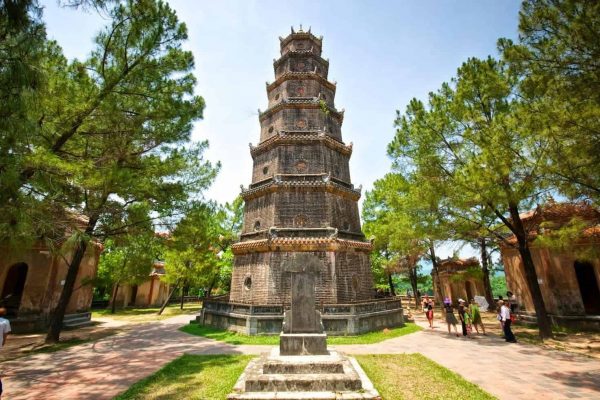
In the afternoon you see two royal tombs rather than five: Minh Mang for its symmetry and its water, Tu Duc for the poems and for the fact that the emperor who built it is not buried there. Each is 150,000 VND. Thien Mu pagoda on the way back if the light is good.
Over the Hai Van Pass to Hoi An
You leave Hue mid-morning and take the old road over the Hai Van Pass rather than the tunnel. The climb tops out at the French and American bunkers with the coast running away on both sides; there is usually cloud on the Hue side and sun on the Da Nang side, which is the whole point of the pass as a weather line.
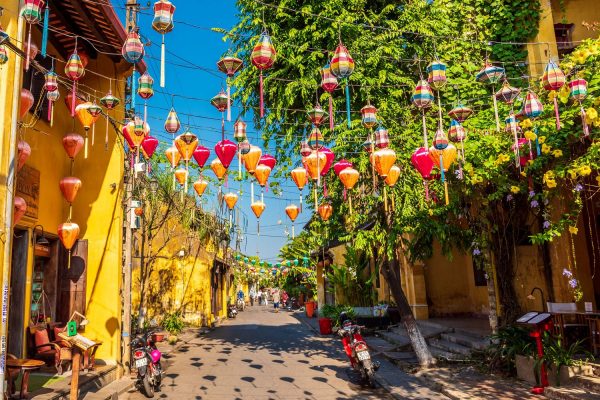
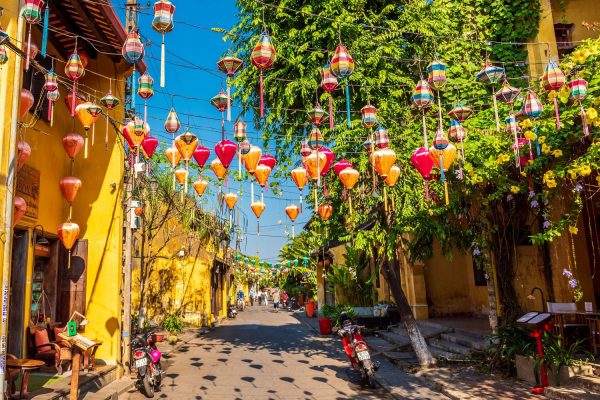
Lunch is at Lang Co lagoon. You reach Hoi An in the middle of the afternoon, and the rest of the day goes on the hotel pool or a first walk into the old town when the lanterns come on.
Hoi An old town
The old town walk starts at 07:00, which is the only hour it belongs to the people who live in it. The town ticket is 120,000 VND and admits you to five of twenty-two heritage buildings; your guide picks the five that are worth the entry, which usually means a merchant house, the Japanese bridge, an assembly hall and a family chapel.
The middle of the day is free. In the late afternoon you cross to Tra Que to see how the herb beds are worked, or you sit still. There are no commission stops on this trip, so nobody will take you to a silk factory or a marble workshop.
My Son, or nothing at all
My Son leaves at 06:30 to beat both the heat and the buses: about an hour each way, and roughly two hours among the brick Cham towers, several of them still holding bomb damage from 1969. Groups who would rather not do a second ruined site swap it for a cooking class or a bicycle circuit of the rice fields.
The afternoon is free either way. An Bang beach is fifteen minutes from the hotel and has real waves between October and February, when the lifeguard flags matter.
Vietnam to Laos: Da Nang, Hanoi, Luang Prabang
This is the travel day the route is built around. You are driven to Da Nang, fly north to Hanoi in 1 h 20, and connect to Luang Prabang in 1 h 10 on Lao Airlines or Vietnam Airlines. Visa on arrival is issued at Luang Prabang and the Lao Digital Immigration Form is filed for you beforehand.
The airport is ten minutes from town. What you notice first is the noise, or the absence of it: Luang Prabang has no motorbike swarm and a curfew that empties the streets by 23:30. Dinner is early and near the hotel.
The alms round, then the peninsula
You are up at 05:15. The alms round runs roughly 06:00 to 07:00 in the cool months, and you watch it from a side street rather than the Sisavangvong crowd: five metres back, seated or standing still, no flash, shoulders and legs covered, no conversation. If you would rather give alms than watch, your guide arranges sticky rice from a household that cooks it, not from a hawker selling it at the kerb.
After a late breakfast the day covers Wat Xieng Thong, the old royal palace and the Traditional Arts and Ethnology Centre, then the 328 steps up Phou Si before the crowd builds. Afternoon free.

Kuang Si and the country behind the town
Kuang Si is 29 km out, about 50 minutes each way. You go at 08:00, which puts you at the top pools before the vans. The water is that colour because of dissolved limestone, and it is genuinely cold. The bear sanctuary at the gate is a rescue centre and worth the twenty minutes.
On the way back you stop at a farm that grows and mills its own rice and lets you do the work badly, and at a weaving village where the looms are in the house rather than in a showroom. Neither is a shopping stop.
Upriver, and then an empty afternoon
A slow boat takes you two hours up the Mekong to the Pak Ou caves, where about four thousand discarded Buddha figures have been left in two limestone chambers over four centuries. The river journey is the better half of the outing.
You are back by early afternoon, and the afternoon is yours. Four nights here is deliberate: this is the one town on the route that repays doing nothing, and by day four you will have a coffee shop, a route to the river and an opinion about which noodle stall is right.
The train to Vientiane
Luang Prabang station is 12 km out of town and you check in an hour ahead, because security is airport-style and the train does not wait. The run to Vientiane takes 1 h 50 through tunnels and across viaducts that make the ten-hour road version look like a punishment. Seats are bought weeks ahead; second class sells out in the dry season.
Vientiane station is 15 km from the centre. You reach the hotel by early afternoon and see Pha That Luang and Wat Si Saket, which holds several thousand small Buddha images in wall niches and is the oldest thing standing in the city.

Vientiane at its own speed
The morning goes to the COPE visitor centre, which explains the unexploded ordnance still in the ground from the 580,000 bombing runs flown over Laos between 1964 and 1973, and to Buddha Park at Xieng Khuan, 25 km downriver, which is a concrete garden built by a mystic in 1958 and is unlike anything else in the region.
The afternoon is free. The Mekong promenade fills up at 17:00 with an aerobics class, a night market and a view across to Thailand, and dinner is on the river.
Depart Vientiane
Wattay airport is ten minutes from the centre, which is a gentler ending than most. Your guide sees you through check-in for the onward flight, most commonly Bangkok, Hanoi or Singapore for the long leg home.
Late departures get a late checkout where the hotel allows it, and a last walk along the river instead of four hours in a lobby.
What it costs
Prices are per person sharing a twin or double room, land only, and they fall as the party grows because the vehicle, the guide and the driver are shared across more people. The Comfortable column buys four-star hotels with character and a cabin on a good Lan Ha boat. The Excellent column buys the properties people name out loud: Sofitel Legend Metropole in Hanoi, Belmond La Résidence Phou Vao or Amantaka in Luang Prabang.
| Party size | Comfortable | Excellent |
|---|---|---|
| 2 travellers | USD 5,440 | USD 8,430 |
| 3 – 4 travellers | USD 4,680 | USD 7,250 |
| 5 – 8 travellers | USD 4,250 | USD 6,590 |
That works out at roughly USD 250 to USD 500 per person per day. Under USD 200 a day we cannot run this route at the standard described, and we will say so rather than quietly downgrade the hotels.
What is and is not included
What the price includes
- 16 nights of accommodation, every property named in your quote before you pay anything
- A private air-conditioned vehicle with driver throughout Vietnam and throughout Laos
- A separate English-speaking national guide in Vietnam and in Laos, with you for all touring days
- One night aboard a small boat in Lan Ha Bay, with a private cabin and all meals on board
- Domestic flights Hanoi–Hue, Da Nang–Hanoi and Hanoi–Luang Prabang, booked in advance
- Reserved seats on the Laos–China Railway from Luang Prabang to Vientiane, purchased weeks ahead
- All entrance fees on the itinerary, including the Hue Imperial City, the royal tombs, Trang An and the Hoi An town ticket
- All meals listed day by day: 16 breakfasts, 11 lunches and 4 dinners
- Airport and station transfers on every arrival and departure day
- A local mobile number that reaches a person, not a call centre, at any hour of your trip
What it does not include
- International flights into Hanoi and out of Vientiane
- Vietnamese e-visas and the Lao visa on arrival, and the Lao Digital Immigration Form, which we prepare with you but cannot file on your behalf
- Travel insurance, which we require of every traveller and check before departure
- Tips for guides and drivers, which are genuinely discretionary and never solicited
- Meals not listed above, and all drinks including bottled water outside the vehicle and the boat
- Laundry, spa treatments, minibar and other hotel extras
- Optional activities named as alternatives, such as a cooking class in place of My Son
The journey in pictures






Who this journey is wrong for
Four honest reasons to book something else.
- You want to cross from Vietnam into Laos by road. This route flies, on purpose, and we will not sell the overland version.
- You have twelve days rather than seventeen. Cut this route down and Luang Prabang loses the nights that make it worth reaching.
- You want Angkor or Bangkok as well. Two countries in seventeen days is already the honest limit; add a third and every stop becomes two nights.
- You are travelling on under USD 200 per person per day. At that budget the hotels, the private guides and the Lan Ha cabin all have to go, and what is left is not this trip.
- You want to join other travellers to bring the price down. Every departure here is your party alone, which is exactly why the two-traveller column is the expensive one.
Ask us about these seventeen days
Tell us your dates and who is travelling, and we will send a dated itinerary with hotels named.
Questions travellers ask most
Why do you fly from Vietnam to Laos instead of crossing by land?
A Lao e-visa is not valid at any Vietnamese land border, and of the crossings only Dansavan, opposite Lao Bao, issues a visa on arrival. Even when the paperwork works, the road puts you in Savannakhet, which is the wrong end of Laos for Luang Prabang.
The flight from Hanoi is 1 h 10 with Lao Airlines daily or Vietnam Airlines three times a week. It costs one morning instead of two days.
Is four nights in Luang Prabang too many?
It is more than most itineraries give it and it is the number we would defend hardest. Two nights buys the alms round and Kuang Si and nothing else. Four buys an empty afternoon, a second visit to the arts centre, a river trip and the point at which the town stops being a sight.
If you genuinely want to move faster, we would rather shorten Hoi An than Luang Prabang.
Do we need visas for both countries?
Vietnam runs an e-visa open to all nationalities for up to 90 days. US, Canadian, Australian and New Zealand passports have no exemption and must hold one. Twenty-four countries, including the UK, Germany, France, Japan and South Korea, get 45 days visa-free instead.
Laos issues a visa on arrival for 30 days at roughly USD 30 to 45 depending on nationality, or you can use the e-visa. The Lao Digital Immigration Form has been mandatory since September 2025 at Luang Prabang and Vientiane airports.
What happens if the Lan Ha Bay cruise is cancelled for weather?
Quang Ninh and Haiphong authorities close the ports outright on a storm warning, and after the capsizing of 19 July 2025 they close them earlier than they used to. That is the correct decision and we do not argue with it.
If your night afloat is cancelled we move you to a hotel on Cat Ba or back to Hanoi, refund the difference, and adjust the following day. This is one of several reasons we require travel insurance.
Read next
Tell us about the journey you have in mind
Dates, party size and the places you care about are enough to start. You get a draft route and an indicative price, not a brochure.