Luang Prabang in three or four nights
A peninsula of thirty-odd working monasteries and French shophouses where the Nam Khan runs into the Mekong. It is small enough to walk end to end in forty minutes, and it is the one town in Laos that most travellers have already decided to visit before they know why.
What this place actually is
| Region | Northern Laos, at the Mekong and Nam Khan confluence |
| Worth staying | 3 to 4 nights |
| Nearest airport | Luang Prabang International (LPQ), 4 km — or the railway station 12 km out |
| Best months | November to February |
| Known for | The dawn alms round, Wat Xieng Thong, the Kuang Si falls, the Mekong slow boat |
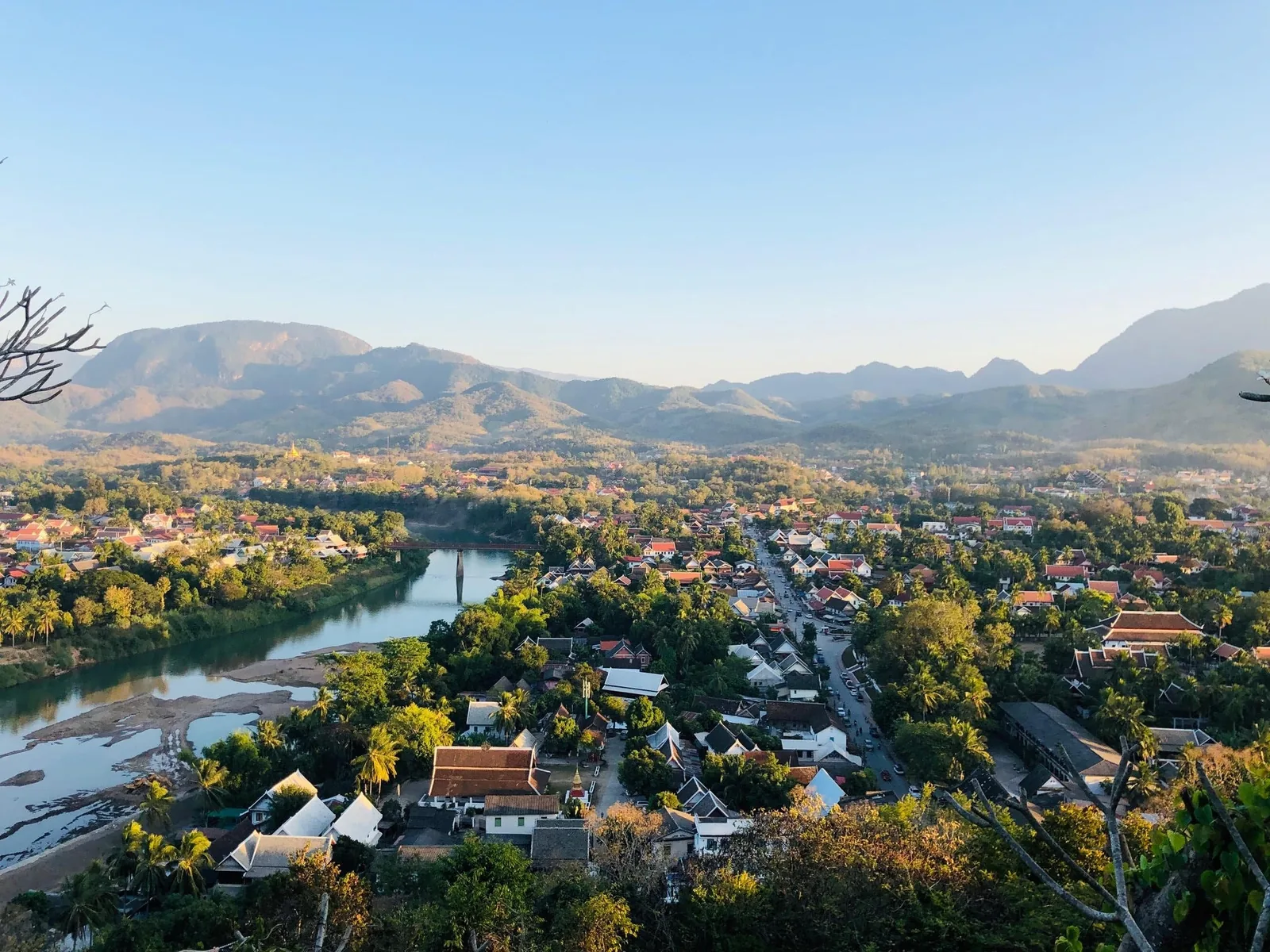
Luang Prabang sits on a tongue of land about a kilometre long, with the Mekong down one side and the Nam Khan down the other and Mount Phousi in the middle of it. The old royal capital of Laos was listed by UNESCO in 1995, and the listing is the reason the skyline is still low: no building on the peninsula rises above the palm line, there are no chain hotel towers, and the streets carry small vehicles because buses are not allowed inside the heritage zone. Around thirty monasteries still function within walking distance of each other, which means several hundred monks and novices actually live here rather than performing for visitors. Wat Xieng Thong, built in 1560 at the tip of the peninsula, has a roof that drops almost to the ground and a mosaic tree of life on its rear wall, and it takes about twenty minutes to look at properly.
The part that has been overbuilt is easy to name. Sisavangvong Road, the single main street through the heritage zone, is now an unbroken run of cafés, massage shops, tour desks and boutique conversions, and the night market that fills it from around 17:00 is largely the same machine-printed textiles you will be offered in Chiang Mai and Hanoi. Kuang Si, the waterfall 29 km south, receives most of its daily visitors between 10:00 and 14:00, and in the dry season the lower pools hold more people than water. Sunset on Phousi hill has become a queue on a staircase: three hundred-odd people on a summit built for thirty, holding phones. None of this is a reason to stay away. It is a reason to be somewhere else at those hours, which is the whole planning problem here and the reason the number of nights matters.
What survives all of it is the ordinary daily life of a small provincial town that happens to be beautiful. Novices sweeping courtyards at seven in the morning. The Phosi morning market on the far side of Phousi, which is a market for people who cook, not for people photographing food. Ban Xang Khong, the weaving and paper village 3 km upriver. The Traditional Arts and Ethnology Centre, a genuinely well-labelled museum of the highland ethnic groups that most visitors walk past. Get up early, go out late, and Luang Prabang gives you a different town from the one on the main street at four in the afternoon.
The alms round, and what has been done to it
Tak Bat is not a performance. Every morning before the sun is properly up, lines of monks and novices walk out from their monasteries in single file and receive sticky rice from residents kneeling on the pavement. The people giving have usually been up since four to steam the rice. This is a religious obligation on both sides, and it has been happening here for several centuries without an audience.
What tour groups have done to it over the past fifteen years is well documented and easy to see for yourself. Coaches used to unload at the edge of the zone and disgorge fifty people at once, who then stood in the road with flashes going, walked backwards in front of the line to get the shot, and in some cases bought rice from touts at the roadside and joined the giving as an activity. The rice sold at the kerb is often not fit to eat and monks have been made ill by it. Senior monks in Luang Prabang have repeatedly threatened to suspend the round altogether, and in some quarters of the town they have shortened or rerouted it. Buses are now banned inside the World Heritage zone, which has helped, but the behaviour has not gone away.
Watching it properly costs you nothing and takes about twenty minutes. Stand across the road, at least five metres back, and stay still. Do not use a flash, do not kneel in the line of the procession, do not put a lens within arm’s reach of a face, and do not follow the monks in a vehicle. Cover your shoulders and your legs. Do not talk. If you want to give rice, arrange it in advance through someone who will show you how, kneel where residents kneel, keep your head lower than the bowls, and buy nothing from a tout. Our guides brief this before the morning, walk you to a spot away from the main street where the line is shorter and the crowd is not, and then say nothing for the duration.
Roughly 05:30 to 06:30 from March to October and 06:00 to 07:00 from November to February. Watch in silence from at least five metres. No flash. Never touch a monk. Shoulders and legs covered. Never follow the procession in a vehicle — buses are banned inside the World Heritage zone in any case. If you would rather not watch at all, that is a reasonable position and we will not put it on your morning.
How many nights, and why fewer breaks it
Three nights is the working minimum and four is the number we book when the rest of the route allows it. The arithmetic is not complicated.
Arrivals here are almost all mid-morning or early afternoon, whether you fly from Hanoi, Siem Reap or Bangkok, or take the 12 km transfer in from the railway station. That first afternoon is worth a slow walk on the peninsula and nothing else; the heat sits between 13:00 and 16:00 and the light is flat. So night one buys you half a day.
Full day one goes to the alms round at dawn, an hour of sleep or breakfast afterwards, then Wat Xieng Thong, Wat Mai, the Royal Palace Museum and the Traditional Arts and Ethnology Centre before lunch, and the Phosi market in the late afternoon. Full day two is Kuang Si: 29 km and about 45 minutes each way, and the pools are worth two hours once the coaches have left, so we leave at 14:00 rather than at 09:00 and come back at dusk. That already fills three nights, with the last morning spent packing and transferring.
The fourth night is what buys the river. Pak Ou, the two caves full of abandoned Buddha figures at the mouth of the Nam Ou, is 25 km upstream: roughly two hours up against the current and about seventy-five minutes back down, which is a genuine half-day and the best half-day in Luang Prabang for anyone who likes boats. It also buys the weaving villages, a second dawn in case the first is rained out, and one afternoon with nothing in it. Cut to two nights and you get one full day, which forces a choice between the waterfall and the river, and you will spend that day moving rather than looking. Anyone who tells you Luang Prabang is a one-night stop has costed the hotel and not the town.
When to go
Two things drive the calendar here: the northeast dry season, and the smoke. Both matter more than rainfall.
| Months | Conditions | What it buys you, and what it costs |
|---|---|---|
| November – December | Dry, clear, 15 – 28 °C, cold at dawn | The best air and the best light of the year. Peak: hotels and rail seats need booking months ahead. |
| January | Dry and cool, haze starting late in the month | Alms round at 06:00 rather than 05:30, so you are not out in the dark. Air still clean until the last week or so. |
| February | Dry, warming, visibility beginning to drop | The last clean month, and rates ease once Chinese New Year has passed. |
| March | Hot and smoke-bound — the worst month | Nothing. The far bank of the Mekong disappears for days at a time and the hills do not come back. Avoid. |
| April | Hot, over 35 °C, smoke until the first storms | Pi Mai Lao, the Lao new year, in mid-April: water thrown everywhere, the town full, and most of it shut for three days. |
| May – June | First rains, air clears within days | Green hills, hard afternoon downpours that end, low rates, and the smoke gone. An underrated pair of months. |
| July – August | Wettest, Mekong high and brown | The river running fast, the countryside at its greenest, and the fewest visitors of the year on the main street. |
| September – October | Rain easing, rivers still full | Kuang Si at full volume, the rice terraces cut and gold in October, and a town that feels like itself again. |
Agricultural burning across northern Laos and northern Thailand fills the whole upper Mekong basin with smoke from about the last week of January until the first serious rains, usually in late April. March is the worst of it. Flights into LPQ divert or cancel on the bad days, the hills across the river vanish, and anyone with asthma will feel it within hours. This is the single most important month warning for Luang Prabang and we will move a whole itinerary to avoid it.
How to get there
By air
Luang Prabang International (LPQ) is 4 km from the peninsula, which is about ten minutes and USD 6 to 8 in a taxi. Hanoi to Luang Prabang is 1 hour 10 minutes, daily on Lao Airlines and three times a week on Vietnam Airlines. Siem Reap to Luang Prabang is 1 hour 25 minutes, five times a week on Vietnam Airlines. Bangkok is a little under two hours. Vientiane is about forty minutes in the air, but by the time you have added two airport transfers the train wins door to door and costs a fraction of the fare.
By rail from Vientiane
The Laos–China Railway does Vientiane to Luang Prabang in 1 hour 50 minutes. The same journey by road on Route 13 is roughly ten hours through the mountains. Second class is about USD 20. The comparison is not close and the train is now the default for this leg.
There is a catch, and it is the reason people miss trains here. Station ticket windows open only three days before departure, and in the dry season second class sells out. Seats therefore have to be bought through an agent weeks ahead, which is what we do as a matter of course when a journey includes this leg. The other catch is the station: Luang Prabang’s is 12 km out of town, a 25 to 30 minute transfer that costs USD 10 to 15, and Vientiane’s is 15 km from the centre. Budget an hour either side of the 1 hour 50 and the train is still comfortably the faster option.
By river from Huay Xai
The slow boat from Huay Xai, on the Thai border opposite Chiang Khong, takes two days downriver with a compulsory overnight at Pakbeng and about six hours on the water each day. The public boat is around USD 23 for the whole journey and is a hard bench with a lot of people on it. Private and premium boats — Shompoo, Mekong Smile, Luang Say — run around USD 250 per person with a seat you can sit in for six hours and a decent lunch. Either way the arrival pier is about 10 km outside Luang Prabang, so there is a final transfer at the end of the second day. This is a two-day commitment for one day of scenery, and it is the right choice only if the river itself is the point.
By road
Vang Vieng is about six hours by road or roughly an hour by rail. Vientiane by road is about ten hours and we do not run it. Nong Khiaw, four hours north on Route 13 and then Route 1, is the usual add-on for travellers who want the Nam Ou gorges.
What things cost here
Laos runs on kip but quotes tourists in dollars and baht, and the figures below are the dollar prices you will actually be given in late 2026. Cash is still king outside hotels; card acceptance is patchy on the main street and non-existent at the market.
| What | Rough cost |
|---|---|
| Guesthouse or simple hotel, per night | USD 25 – 45 |
| Comfortable boutique in a converted shophouse, per night | USD 90 – 170 |
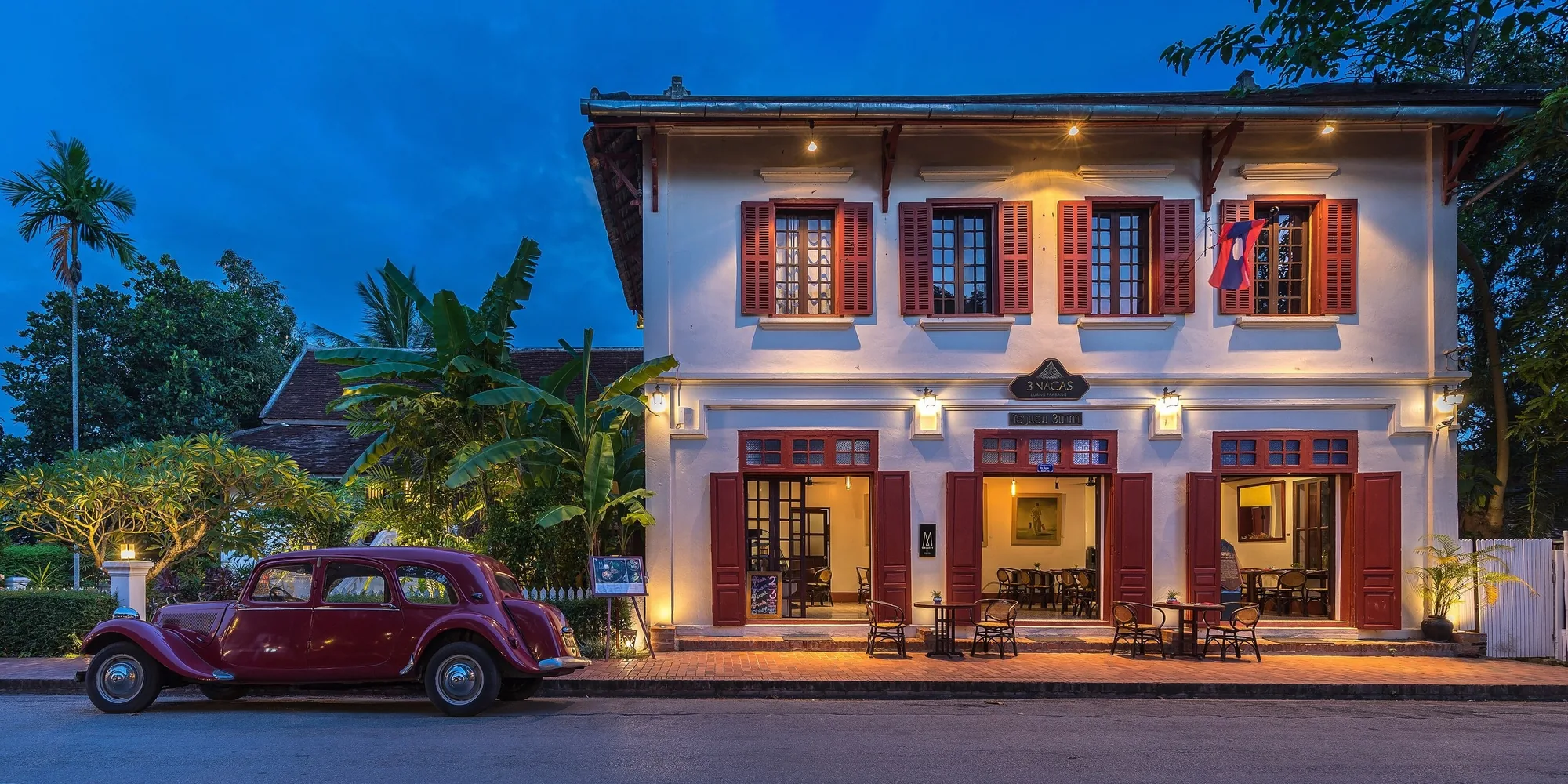
| The top houses — Amantaka, Rosewood, Belmond La Résidence Phou Vao | USD 450 – 1,200 |
| Noodle soup at the morning market | USD 1.50 – 3 |
| Dinner for two, riverside restaurant, with a bottle of wine | USD 45 – 85 |
| Temple and museum entries, each | USD 1 – 3 |
| Kuang Si falls entry | about USD 3 |
| Tuk-tuk across the peninsula | USD 2 – 4 |
| Airport transfer, 4 km | USD 6 – 8 |
| Railway station transfer, 12 km | USD 10 – 15 |
| Second class rail seat to Vientiane | about USD 20 |
A private car with driver and an English-speaking national guide, which is how our clients see the town and the falls, runs well above these numbers and is quoted inside the journey rather than bought by the day. The figures here are for calibration: they tell you whether a hotel rate you have been shown is sensible.
In pictures




When to skip it
Four situations in which Luang Prabang is the wrong call, and we would rather say so at the planning stage.
- March, and most of April. The smoke is not a haze that photographs badly — it removes the hills, the river light and the reason people come. If your dates are fixed in March, we route you through Cambodia and the Vietnamese coast instead.
- Any trip with fewer than three nights to give it. Two nights forces a choice between Kuang Si and the river and turns the town into a checklist. A one-night stop is a hotel bill, not a visit.
- Travellers who want nightlife. A curfew has been in force here for years and the heritage zone empties before midnight. That is one of the better things about the place, but it surprises people.
- Anyone unwilling to be up at half past five once. The alms round is the strongest single hour in Luang Prabang and skipping it leaves a town that is pretty and quiet and not much else.
The journeys that come here
Luang Prabang appears on five of our routes, and the reason it appears differs each time. On the Grand Indochina, 28 days it gets four nights in the middle of the trip, placed deliberately after the pace of northern Vietnam, with the Pak Ou half-day included and the Kuang Si afternoon left late. On Indochina Classic, 21 days it holds three nights and is reached by air from Hanoi in 1 hour 10, which keeps a whole day out of the transfer column.
The route that treats it as the destination rather than a stage is Vietnam and Laos, 17 days: Hanoi, the north, then Luang Prabang and Vientiane with the railway between them, and four nights here at the end where they do the most good. Thailand, Laos and Cambodia, 19 days arrives from Chiang Mai and is the one route on which we sometimes build in the two-day slow boat from Huay Xai, for parties who have said the river matters more than the extra day. Laos and Cambodia, 14 days is the shortest we will run with Luang Prabang in it, and it still gives the town three nights.
Every one of those routes is quoted with a driver and an English-speaking national guide in Laos, hotels named in the quote, and the railway seats bought in advance rather than hoped for. If your dates fall in the smoke, the honest answer is to move the dates or move the country, and we will tell you which before you pay anything. Start with when to go, or write to us with the month you are considering.
Ask about Luang Prabang
Tell us your month and we will say plainly whether the air will be clear and whether the train seats can be had.
Questions travellers ask most
Do we have to watch the alms round?
No. It is a religious obligation for the people taking part and an optional twenty minutes for you. Some travellers decide that standing on a pavement watching a private act of faith is not for them, and that is a defensible position.
If you do want to see it, your guide will pick a street away from the main procession, brief the rules the night before, and stay silent throughout. Nobody will hand you a basket of rice unless you have asked for one in advance.
Is the train from Vientiane worth it over the flight?
Yes, for almost everyone. The rail leg is 1 hour 50 minutes against roughly ten hours by road, and against a forty-minute flight that needs two airport processes around it. Second class is about USD 20.
The one thing it demands is planning. Station windows open three days before departure and second class sells out in the dry season, so the seats are bought through an agent weeks ahead. The station is also 12 km out, so allow half an hour at each end.
How bad is March really?
Bad enough that we will rebuild an itinerary around it. Agricultural burning across northern Laos fills the valley with smoke from late January, and March is the peak. On the worst days the far bank of the Mekong is not visible from the peninsula.
Flights into LPQ are occasionally diverted. If your travel dates are locked to March, Cambodia and southern Vietnam are the better use of the same fortnight, and we will say so.
Is the two-day slow boat from Huay Xai worth doing?
Only if the river is the point. It is two days on the water with a compulsory overnight at Pakbeng and about six hours of sitting each day, and the arrival pier is 10 km outside town.
The public boat is around USD 23 and is a bench. A private or premium boat — Shompoo, Mekong Smile, Luang Say — is around USD 250 per person and is the version we book when a client asks for it.
Read next
Tell us about the journey you have in mind
Dates, party size and the places you care about are enough to start. You get a draft route and an indicative price, not a brochure.