Thailand, Laos and Cambodia in nineteen days
Nineteen days across three countries, joined by a river rather than by a series of airport lounges. Bangkok and Chiang Mai come first, then the Friendship Bridge at Chiang Khong and two slow days down the Mekong to Luang Prabang. Angkor and Phnom Penh finish it.
Who this journey is for
- Length
- 19 days, 18 nights
- Group
- Private, 2 to 8 people
- Starts
- Bangkok, Thailand
- Ends
- Phnom Penh, Cambodia
- Pace
- Moderate
- From
- USD 4,750 per person
This route is for people who like the joins as much as the places. It crosses a land border on foot, spends two days on a river at eleven kilometres an hour, takes a Chinese-built high-speed line through the mountains of northern Laos, and only then reaches Angkor. Anyone whose main interest is the temples alone should book a shorter Cambodia trip; the point of nineteen days is watching one country turn into the next at ground level.
The pace is moderate rather than easy. There are two consecutive six-hour days on the Mekong, an early border morning, and one flight that routes through a third airport because the direct sector does not exist. In exchange, three of the four hardest transfers in mainland Southeast Asia are handled properly, and you sleep three nights in each of the four places worth three nights.
Trip highlights
- The Grand Palace at 08:30 on the dot, when it opens and before the coach fleet arrives
- Two days down the Mekong from Huay Xai to Luang Prabang on a private or premium boat, not the public one
- The compulsory overnight at Pakbeng, a one-street town that exists because the river takes two days
- The alms round in Luang Prabang, watched in silence from five metres back on a side street
- The Laos–China Railway to Vientiane, 1 h 50 instead of ten hours on Route 13
- Two full days at Angkor on a three-day pass, including Banteay Srei and Ta Prohm early
How this route actually connects
Thailand into Laos is a land crossing and a good one. From Chiang Rai you drive to Chiang Khong, cross the Fourth Thai–Lao Friendship Bridge to Huay Xai, clear Lao immigration, and are on the water by late morning. The boat then takes two days with a compulsory overnight at Pakbeng, roughly six hours on the river each day. There is no way to do it in one; the Mekong has rapids that are not run after dark.
Which boat you take matters more than anything else on this itinerary. The public boat costs about USD 23 for the whole journey and seats around a hundred people on car seats bolted to the deck, with an engine at your back for twelve hours. A private or premium boat of the Shompoo, Mekong Smile or Luang Say class costs roughly USD 250 per person, carries a fraction of the number, has a proper toilet, a bar, a guide and space to move, and stops at villages the public boat drives past. This trip books the second kind and the price reflects it.
Getting from Laos to Cambodia is where honesty is required. Vientiane to Siem Reap has to be flown and there is no direct service, so you connect through Bangkok or Hanoi and it takes most of a day. Siem Reap to Phnom Penh is either five and a half hours by road on National Road 6, or a 45-minute flight; the road is in good condition and we usually drive it, breaking at Kampong Thom.
Every crossing between Thailand and Cambodia has been shut since 23 June 2025, including Poipet–Aranyaprathet, Cham Yeam–Hat Lek, O’Smach–Chong Jom and Ban Pakard–Pailin. After armed clashes in July and December 2025 the ceasefire is holding, but Thai authorities have said there is no plan to reopen during 2026. Bangkok to Siem Reap must be flown, about 1 h 15. Any operator still selling an overland Bangkok–Siem Reap leg is selling a journey it cannot run.
The Thai visa exemption drops from 60 days to 30 days on 15 September 2026 for the 60 eligible countries and territories, with one extension of up to 30 more days available at immigration. Visa-exempt entries by land are capped at twice per calendar year; air arrivals are uncapped. The Thailand Digital Arrival Card is mandatory and free at tdac.immigration.go.th within 72 hours of arrival, and any site charging you for it is not the official one.
The route, day by day
Driving times are door to door and include stops. River hours are time on the water. Where a leg is flown, the flight and its duration replace the drive.
Arrive Bangkok
You land at Suvarnabhumi and your guide meets you past customs. The transfer into the city takes 45 minutes at three in the morning and an hour and a half at five in the afternoon, and there is no way to know in advance which one you get.
The rest of the day is unscheduled. If you arrive in daylight, the hotel will point you at the river ferry, which is the correct first thing to do in Bangkok.
The palace, the reclining Buddha, and the canals
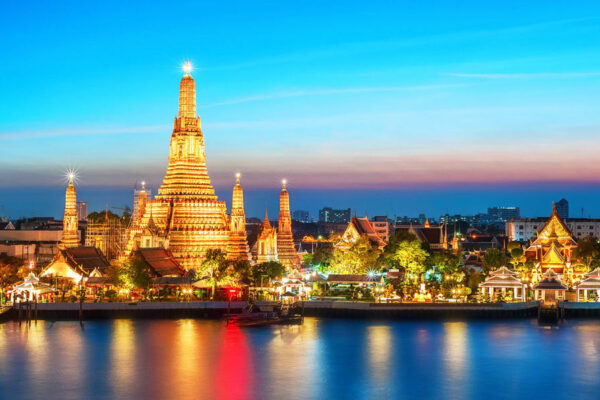
You are at the Grand Palace for 08:30, when it opens, because by ten the forecourt is solid. Entry is 500 baht and the dress code is enforced at the gate: shoulders and knees covered, no exceptions and no arguing. Wat Phra Kaeo is inside the same wall and holds the Emerald Buddha, which is jade and about 66 cm tall.
Wat Pho is a ten-minute walk and 300 baht, and the reclining Buddha is 46 metres long in a hall barely bigger than it is. In the afternoon a long-tail boat takes you into the Thonburi canals, where the city still sits on stilts over the water.
Chinatown, and an afternoon off
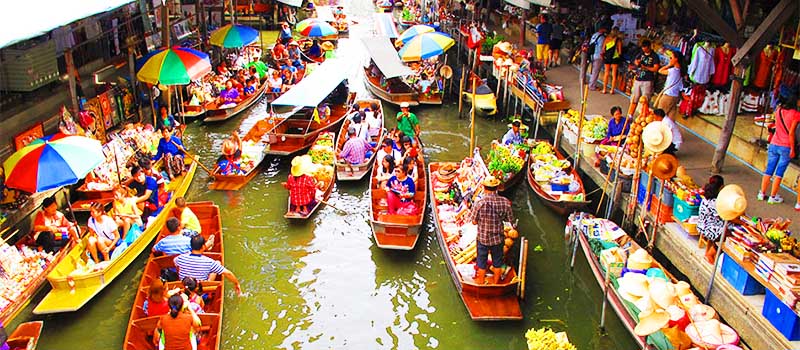
The morning goes to Talat Noi and Yaowarat on foot: the metalworking lanes, the shrine courtyards, and the shophouses that have not yet been sold. It is a walking morning of about five kilometres, mostly in shade.
The afternoon is free. Jim Thompson’s house takes ninety minutes and is worth it; so does an hour in a chair at the Oriental. In the evening the street food of Yaowarat opens at about 18:00 and the guide takes you to six stalls rather than one restaurant.
Bangkok to Chiang Mai
A morning flight of 1 h 15 puts you in Chiang Mai before lunch. The airport is fifteen minutes from the old city, which is a square kilometre inside a moat and a broken brick wall built in 1296.
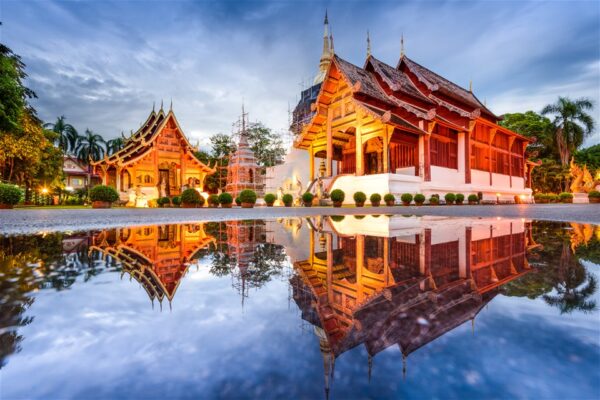
The afternoon is spent walking it: Wat Chedi Luang, whose 60-metre stupa lost its top in an earthquake in 1545, Wat Phra Singh, and the small wooden monasteries in between where the monks will talk to you if you sit down.
Doi Suthep, and the crafts that are still made
Doi Suthep sits at 1,050 metres, 40 minutes up a road with 100 bends, and the last 306 steps go up between two naga balustrades. Go before 09:00 and the terrace is still cool and half empty; the view over the plain depends entirely on the haze.
The afternoon covers the San Kamphaeng road workshops that still produce rather than sell: an umbrella maker, a silversmith beating a bowl, a lacquer bench. Nobody takes you to a jewellery showroom, and we pay no commissions anywhere on this trip.
Elephants at a distance, and a kitchen
The morning is at an observation-only elephant sanctuary an hour out of the city. You watch, you help prepare food, and you do not ride and do not bathe them; camps that offer riding or bathing shows are not used by this company and we will explain why at length if you ask.
The afternoon is a cooking class in a garden that grows most of what you use, which in northern Thailand means khao soi, larb and a curry paste you pound yourself. It ends with eating what you made, so dinner is included and large.
North to Chiang Rai and the Golden Triangle
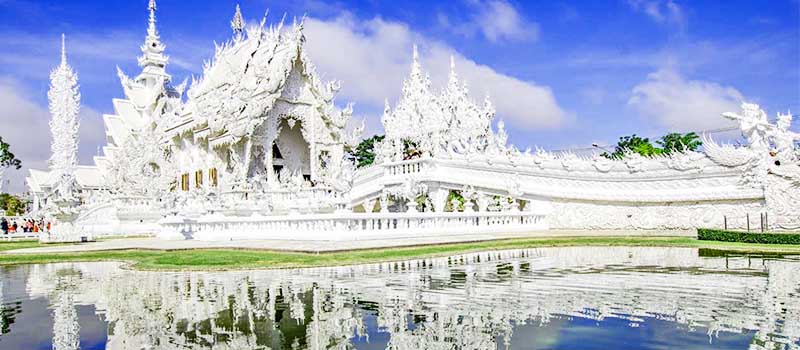
The road to Chiang Rai takes about three hours with two stops: the hot springs at Mae Kachan, which is a leg-stretch rather than a sight, and Wat Rong Khun, the white temple, which is a private artwork begun in 1997 and still unfinished.
In the late afternoon you stand at Sop Ruak, where the Ruak meets the Mekong and Thailand, Laos and Myanmar touch. The Hall of Opium above it is a serious museum about the trade that made this corner famous, and it takes ninety minutes.
Across the border, and onto the Mekong
An early start takes you to Chiang Khong and the Fourth Thai–Lao Friendship Bridge. Thai exit, the shuttle bus across, Lao arrival, visa and the Lao Digital Immigration Form: about an hour if the coaches have not just arrived, longer if they have. Your Lao guide meets you on the far side at Huay Xai.
You are on the water by late morning. The first day runs about six hours downstream past sandbanks, buffalo, gold panners and villages with no road to them, with lunch served on board and a village stop before Pakbeng. The town is one street on a steep bank and it exists because the river takes two days.
Pakbeng to Luang Prabang
The second river day is the better one. The valley narrows, the current speeds up through the rapids above Pak Ou, and the boat stops at the caves where about four thousand discarded Buddha figures have been left in two chambers over four hundred years.
The pier is roughly 10 km outside Luang Prabang and you are driven the last stretch, reaching the hotel in the late afternoon. Dinner is early, because you will be up at 05:15.
Tak Bat, then the peninsula
The alms round runs roughly 06:00 to 07:00 in the cool months. You watch it from a side street rather than from the Sisavangvong crowd: five metres back, silent, no flash, shoulders and legs covered, and never following the procession in a vehicle. Vehicles are banned inside the heritage zone for exactly this reason.
After breakfast the day covers Wat Xieng Thong, the royal palace museum and the Traditional Arts and Ethnology Centre, which is the best single hour in town for understanding who actually lives in northern Laos. Afternoon free.
Kuang Si, and the last of the slow days
Kuang Si is 29 km out and takes 50 minutes each way. Going at 08:00 puts you at the upper pools before the vans arrive. The water is that milky turquoise because of dissolved limestone, and it is cold enough to make swimming a decision rather than a plan.
The bear rescue centre at the gate is worth twenty minutes. On the way back you stop at a village that weaves in the house rather than in a showroom, and the rest of the afternoon is yours.
The train south to Vientiane
Luang Prabang station is 12 km out of town and check-in closes well before departure, so you leave the hotel early. The Laos–China Railway covers the distance in 1 h 50 through tunnel after tunnel; the road version is about ten hours. Seats are bought weeks ahead because the windows only open three days before and second class sells out all dry season.
Vientiane station is 15 km from the centre. The afternoon takes in Pha That Luang, Wat Si Saket with its thousands of small Buddha images in wall niches, and the COPE centre, which explains the unexploded ordnance still being cleared from the war.
Vientiane to Siem Reap
There is no direct flight, so this is a connecting day through Bangkok or Hanoi and it takes most of it. Wattay airport is small and ten minutes from the hotel, which softens the start.
You land at Siem Reap–Angkor International, which opened in October 2023 and sits 40 to 50 km from town, so allow 45 to 60 minutes for the transfer. Your Cambodian guide meets you at arrivals and dinner is at the hotel.
Angkor: the great temples
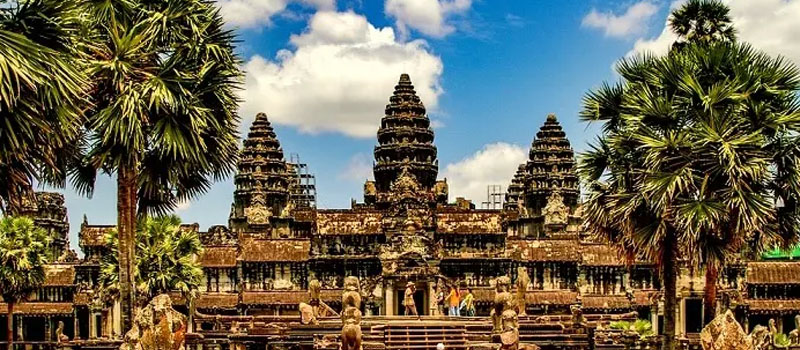
A three-day pass costs USD 62 and is valid on any three days within ten; the ticket office on Apsara Road opens at 04:30 and the pass carries your photograph. You start at Angkor Wat, which opens at 05:00, and walk the west causeway and the third enclosure with the bas-reliefs before the heat arrives.
After a break at the hotel through the middle of the day you take Angkor Thom in the afternoon: the south gate, the Bayon and its face towers, the Terrace of the Leper King. Shoulders and knees must be covered at the inner entrances.
Banteay Srei, Ta Prohm and the lake
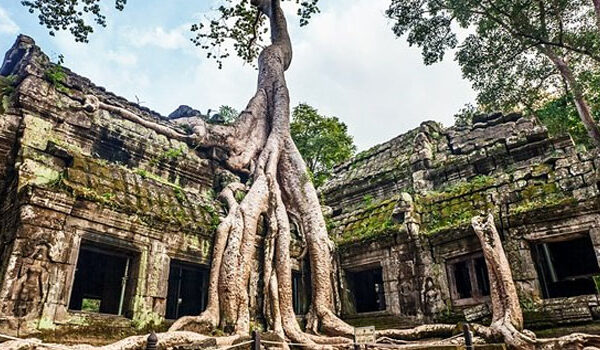
Banteay Srei is 37 km out and worth the drive: pink sandstone carved so finely that the lintels look like woodwork, and it is small enough to see properly in an hour. Ta Prohm on the way back is the one with the trees through the walls, and you stay on the boardwalks, which exist because the stone is moving.
The afternoon goes to Tonle Sap, to a stilted village rather than to a floating one built for boats of visitors. Your guide will tell you plainly which villages take money for photographs and which do not.
South to Phnom Penh
National Road 6 runs to Phnom Penh in about five and a half hours, and the road is in good condition. You break at Kampong Thom for lunch, and Sambor Prei Kuk, a seventh-century brick complex older than Angkor and almost empty, is a worthwhile hour if you want it. Groups who would rather not drive take the 45-minute flight instead.
You reach the city in the late afternoon. Phnom Penh is louder and more commercial than Siem Reap, and the riverfront at 18:00 is where it shows itself.
The difficult day
Tuol Sleng and Choeung Ek take the morning and they are hard. About 20,000 people passed through the school that became S-21 and a handful walked out. Your guide will pace it, will stop when you want to stop, and will not photograph you doing it.
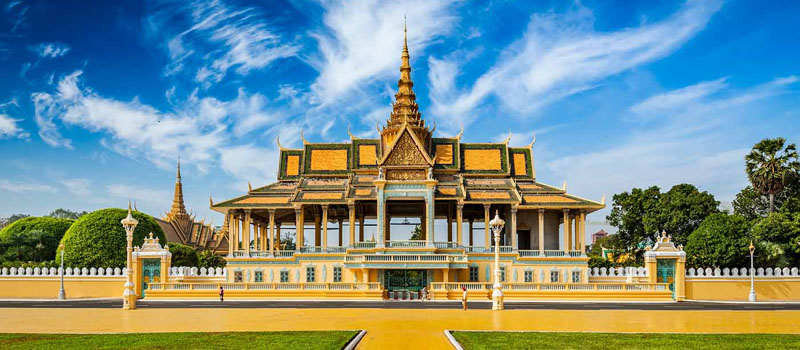
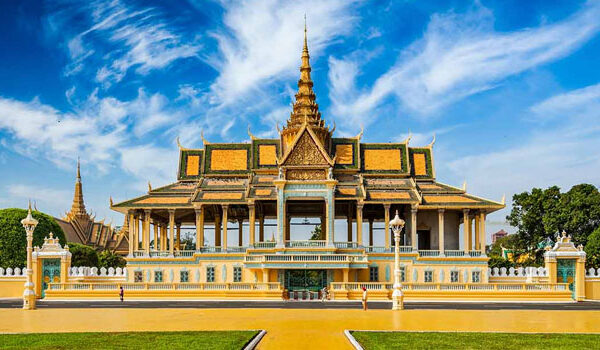
The afternoon is deliberately lighter: the Royal Palace and the Silver Pagoda, whose floor is five thousand silver tiles, and the National Museum, which holds the Angkorian sculpture that is no longer at Angkor. Children under twelve do not go to Choeung Ek with us.
Phnom Penh at your own pace
The morning is free. Most people use it for the Russian Market, for a cyclo hour through the French quarter, or for the textile workshop at Wat Than. Anyone who wants a river morning can take a boat to the confluence of the Mekong and the Tonle Sap.
A last dinner is booked somewhere worth the last dinner. Bills, tips and airport timings are settled this evening rather than in the car tomorrow.
Depart Phnom Penh
International flights now leave from Techo International Airport, 19 km south of the city, which opened on 9 September 2025; the old airport handles domestic services and private jets only. Allow an hour for the transfer in morning traffic.
Your guide sees you through check-in. Most long-haul routings connect through Bangkok, Singapore, Kuala Lumpur or Seoul.
What it costs
Per person, sharing a twin or double, land only. The largest single variable in this quote is the boat: a private or premium Mekong vessel at roughly USD 250 per person rather than the USD 23 public boat is the reason two of these nineteen days are pleasant rather than endured. The Excellent column buys 137 Pillars House or the Four Seasons in Chiang Mai, Amantaka or Rosewood in Luang Prabang, Amansara or Raffles Grand Hotel d’Angkor in Siem Reap.
| Party size | Comfortable | Excellent |
|---|---|---|
| 2 travellers | USD 6,080 | USD 9,420 |
| 3 – 4 travellers | USD 5,230 | USD 8,110 |
| 5 – 8 travellers | USD 4,750 | USD 7,360 |
That is roughly USD 250 to USD 500 per person per day. Three countries mean three sets of guides, three sets of drivers and four internal air or rail sectors, which is why this route sits above a two-country trip of the same length.
What is and is not included
What the price includes
- 18 nights of accommodation, every property named in your quote before you commit
- A private vehicle with driver in Thailand, in Laos and in Cambodia
- A separate English-speaking national guide in each of the three countries
- Two days on the Mekong from Huay Xai to Luang Prabang on a private or premium boat, with lunch on board and the Pakbeng overnight
- The border crossing at Chiang Khong to Huay Xai, assisted end to end by our staff on both sides
- Reserved seats on the Laos–China Railway from Luang Prabang to Vientiane, bought weeks ahead
- Flights Bangkok–Chiang Mai and Vientiane–Siem Reap, and the Siem Reap–Phnom Penh sector by road or air as you choose
- A three-day Angkor pass at USD 62, the Grand Palace at 500 baht, Wat Pho at 300 baht and every other entrance on the itinerary
- All meals listed day by day: 18 breakfasts, 12 lunches and 6 dinners
- Airport, pier and station transfers throughout, and a local number that reaches a person at any hour
What it does not include
- International flights into Bangkok and out of Phnom Penh
- Thai, Lao and Cambodian visas, and the three mandatory arrival cards: the Thailand Digital Arrival Card, the Lao Digital Immigration Form and the Cambodia e-Arrival form, all of which you file yourself and none of which should cost money beyond the visa fee
- Travel insurance, which we require and check before departure
- Tips for guides, drivers and boat crew, which are discretionary and never solicited
- Meals not listed above, and all drinks including bottled water outside the vehicle and the boat
- Laundry, spa, minibar and other hotel extras
- Optional additions such as Sambor Prei Kuk or a second cooking class
The journey in pictures


Who this journey is wrong for
Five reasons to choose a different route.
- You want to cross overland from Thailand into Cambodia. Every crossing has been shut since 23 June 2025 and no operator can open it for you.
- Twelve hours on a river over two days sounds like a chore rather than the point. It is the spine of this itinerary and it cannot be cut without losing Laos entirely.
- You want beach time. There is none in these nineteen days, and adding Koh Samui or Phu Quoc means adding four days, not two.
- You want to travel in March. Burning season in northern Thailand and northern Laos runs late January to late April and is worst in March; Chiang Mai measured 188 micrograms per cubic metre of PM2.5 on 29 and 30 March 2026.
- You need everything at one standard. This route spends a night at Pakbeng, where the best room in town is a good lodge and nothing more.
Ask us about these nineteen days
Send us your dates and party size and we will come back with a dated itinerary and named hotels.
Questions travellers ask most
Can we drive from Bangkok to Siem Reap instead of flying?
No. All Thailand–Cambodia land crossings have been closed since 23 June 2025, including Poipet–Aranyaprathet. After clashes in July and December 2025 the ceasefire is holding, but Thai authorities have said there is no plan to reopen during 2026.
This route reaches Cambodia by air from Vientiane for that reason. If you see an itinerary with an overland Bangkok–Siem Reap leg on it, the operator either has not updated the page or is hoping you will not check.
Why not take the cheap public boat down the Mekong?
Because it is twelve hours over two days sitting on a car seat bolted to a wooden deck, with about a hundred other people and an engine directly behind you. The fare is about USD 23 and it is honest value for what it is.
A private or premium boat of the Shompoo, Mekong Smile or Luang Say class runs about USD 250 per person, carries far fewer passengers, has a proper toilet and a bar, and stops at villages. On a nineteen-day trip at this standard, spending two of those days uncomfortable to save USD 227 is a false economy.
How long can we stay in Thailand without a visa?
From 15 September 2026 the visa exemption is 30 days rather than 60, for the 60 eligible countries and territories, with one extension of up to 30 further days available at a Thai immigration office. This trip spends seven nights in Thailand, well inside the limit.
One detail catches repeat visitors: visa-exempt entries by land are capped at twice per calendar year. Arrivals by air are not capped. The Thailand Digital Arrival Card is separate, mandatory and free, filed within 72 hours of arrival.
Is Pakbeng worth an overnight, or can we skip it?
It cannot be skipped. The Mekong between Huay Xai and Luang Prabang is not run after dark because of the rapids, so every boat stops at Pakbeng. The town is one street on a steep bank with a few lodges and a generator that used to go off at ten.
Treat it as part of the river rather than as a destination. The evening on the bank watching the boats tie up is better than the room you sleep in.
Read next
Tell us about the journey you have in mind
Dates, party size and the places you care about are enough to start. You get a draft route and an indicative price, not a brochure.