Eighteen days for three generations
Hanoi, a night on the water in Lan Ha Bay, Hoi An, Ho Chi Minh City, three mornings at Angkor, Bangkok and three nights on Koh Samui. Built for a party that includes a nine-year-old and a seventy-eight-year-old, and paced for both.
Who this journey is for
- Length
- 18 days, 17 nights
- Group
- 2 – 8, one family only
- Starts
- Hanoi
- Ends
- Koh Samui
- Pace
- Easy — drives capped at four hours
- From
- USD 4,400 per person
This route is for a booking that contains three generations: grandparents, parents and children, travelling together, sharing meals and often sharing a car. That party has a different set of constraints from a couple, and almost none of them are about which temples you see.
The constraints are mechanical. How long the car is moving before somebody needs to get out. Whether the rooms connect. Whether the luggage fits. What time the sun becomes a problem for a grandmother and a seven-year-old at the same site. This page is mostly about those things, because they are what decides whether an eighteen-day trip works.
Families who have travelled together in Europe often assume the heat is the difficulty. It is not, on its own. The difficulty is heat plus a long drive plus a schedule that cannot absorb an hour of delay, and the fix for all three is the same: fewer moves, shorter drives, earlier mornings.
What the eighteen days give you
- No driving day over four hours, and a stop every ninety minutes on every drive without anyone having to ask.
- Connecting rooms requested at booking and confirmed by the hotel by name, in writing, before you pay the balance.
- A vehicle chosen for boot space rather than seat count, so three generations of luggage travels with you rather than following in a second car.
- Temple mornings that start at 07:30 and finish before eleven, every day, at Angkor and in Hue-style heat anywhere else.
- A guide briefed to take the children ahead while the grandparents sit, and to come back for them.
- One night on a private boat in Lan Ha Bay with kayaks and swimming, which is the day most children name afterwards.
- Three nights on Koh Samui with nothing at all on the schedule.
The mechanics that actually matter
Driving
Four hours is the cap on any single driving day, and it is a cap rather than a target. The driver stops every ninety minutes whether or not anyone has asked, because the person who most needs the stop is usually the one who will not ask for it. Toilets are checked in advance on every route; the ones on the Hanoi–Haiphong expressway and the Hoi An road are known and used.
The car is a seven- or eight-seat van with a roof box or a following boot, not a minibus with seats where the luggage should go. Families with three generations arrive with three generations of suitcases, and the single most common complaint on family trips is that the luggage did not fit and someone rode with a bag on their knees for two hours.
Rooms
Connecting rooms are requested at the time of booking, named on the confirmation, and chased with the hotel again fourteen days out. A hotel that will not confirm them is not used on this route. Where connecting rooms genuinely do not exist — and in some of the older colonial buildings they do not — we say so before you book rather than at check-in.
Grandparents are put on a low floor near a lift where the building allows it. Cots and rollaway beds are confirmed by number, not assumed.
Mornings and heat
Temple mornings start at 07:30, which is when the Angkor park gates open, and end by eleven. Angkor runs 35 to 40 °C in March, April and May, and a child and a grandparent both stop functioning at the same hour of the same day. Lunch is back at the hotel and the afternoon is the pool. This is not a soft schedule; it is the only schedule that gets everybody to day eighteen.
Water is in the car in quantity. Sunscreen and hats are checked before you leave, by the guide, out loud, every morning, and nobody is too old for that.
The guide
One guide per country, briefed on the party before you land. On a temple morning the guide walks ahead with the children and gives them something to find, then comes back to whoever is sitting in the shade with the grandparents. That is a skill and not every guide has it, which is why the same handful of people work our family departures.
If a child has had enough at ten o’clock, the morning ends at ten o’clock. The car is always at the gate.
The wider argument for how to build a trip around a mixed-age party is in travelling as a family. The deposit, the balance date and what we need from you are on how to book, and you can ask us anything through contact.
What is not on this route, and why
No elephant riding, anywhere on this route or any other. No orphanage visits, which are tourism built on children who cannot consent to it. No staged hill-tribe villages where a community is paid to be looked at. If a driver offers any of the three as an extra, tell us and he will not drive for us again.
Tuol Sleng and Choeung Ek are not on this itinerary. That is why Phnom Penh is not on it either. The S-21 morning is one of the most worthwhile three hours in Cambodia and it is not something to put in front of a nine-year-old, and splitting the party so that half of it goes is a bad day for everyone. Families with teenagers of sixteen and over often want it, and for those parties we route through Phnom Penh instead of flying Ho Chi Minh City to Siem Reap direct. Ask and we will quote it.
The War Remnants Museum in Ho Chi Minh City is handled the same way: available, not scheduled, and discussed with the parents rather than sprung on the group.
Below what age this trip stops working
Roughly six. Below that the arithmetic goes wrong in three places at once. A child of four will not walk five kilometres over uneven sandstone at Angkor, so somebody carries them in 34-degree heat. Five flights over eighteen days means five airport days, and a pre-schooler does not have four of those in them. And the parts of the trip that pay for the effort — the temples, the boat, the market — are largely lost on a child who will not remember them.
From six upwards it works, and from about nine it works well. If your youngest is four, a fourteen-day Vietnam-only route with two beach stops is the better trip, and we will build that instead.
Day by day
Arrive Hanoi
Your guide meets the whole party at Noi Bai and the drive into the city takes 45 minutes to an hour. Nothing is scheduled. Dinner is in the hotel because the first night after a long-haul flight with children is not the night to go looking for a restaurant.
Hanoi at walking pace
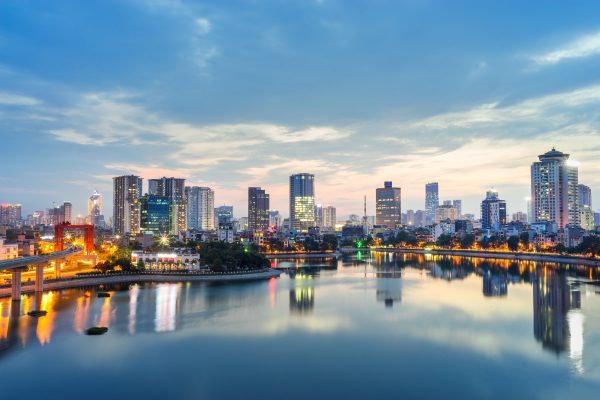
The morning is the Old Quarter on foot with a long stop for a drink, then the Temple of Literature, which has courtyards and shade and somewhere to sit. The afternoon is free and most families sleep through it.
The water puppet theatre at five o’clock lasts an hour and is the one piece of scheduled culture that children reliably enjoy.
Hanoi: the museum, and the pool
The Museum of Ethnology on the western edge of the city has full-size stilt houses in the garden that children can climb into, which makes it the one museum in Hanoi that works for a mixed-age party. The morning ends there.
The afternoon is the hotel pool. Tomorrow starts early and involves a boat.
To Lan Ha Bay
The drive to Haiphong takes about two and a half hours on the expressway, with one stop. The boat leaves early in the afternoon, lunch is served as it works out into the bay, and the kayaks and the swimming platform come out around four.
Cabins are adjoining where the boat allows it. Dinner is on deck and the bay is quiet by nine.

Lan Ha to Hoi An
Breakfast is early, the boat is alongside mid-morning, and the drive back to the airport is about three hours with two stops. The flight to Da Nang is 1 h 20 min and the transfer to Hoi An another 45 minutes. It is the longest day of the eighteen and everything after it is easier.
Hoi An old town, early
You walk the old town from 08:00, before the groups and while the streets are still cool. The 120,000 VND ticket admits you to five of the twenty-two heritage buildings, including the Japanese bridge and one of the old merchant houses.
Back at the hotel by eleven. The afternoon is the beach at An Bang, fifteen minutes away, or the pool.

A cooking morning at Tra Que
Tra Que is a working market garden outside Hoi An where families are given a basket, a list and a bed of herbs, and the cooking class that follows is hands-on rather than a demonstration. Children get their own station and something to chop that is not dangerous.
Lunch is what you cooked. The afternoon is free and nobody wants anything else after it.
Fly to Ho Chi Minh City
Da Nang to Tan Son Nhat is 1 h 20 min and the transfer into District 1 takes 30 to 50 minutes depending on the hour. The afternoon covers the Reunification Palace and the old post office, both short, both indoors.
The delta, or the city
Two options and the family picks one the night before. The delta at My Tho and Ben Tre is a three-hour round trip by road with a sampan through the water-coconut channels and a bee farm, and it is a long day for a small child. The alternative stays in the city: Cho Lon, the Thien Hau temple and the Ben Thanh market.
The Cu Chi tunnels are the third option and are a firm no for anyone under about ten. The tunnels are tight, hot and dark.

Fly to Siem Reap
A flight of about 1 h 10 min. Siem Reap–Angkor International sits 40 to 50 kilometres from town and the transfer takes 45 to 60 minutes. The afternoon is the hotel pool and an early dinner, because the temple mornings begin tomorrow.
Angkor Wat and the Bayon, 07:30 to eleven
Gates at 07:30 for Angkor Wat, then Angkor Thom and the Bayon, where the faces are the thing children look for and count. Under-12s enter free on a passport; the adult three-day pass is USD 62 and carries your photograph.
Back at the hotel by eleven for lunch and the pool. Shoulders and knees must be covered at the inner entrances, children included.

Ta Prohm and Banteay Srei
Ta Prohm first, on the boardwalks, where the fig roots have come down through the galleries; it is the temple that photographs best and the one children ask to see. Banteay Srei follows, 37 kilometres out, with the finest carving in the park and a short flat circuit.
Finished by eleven again. The afternoon is free.
Fly to Bangkok
About 1 h 15 min in the air; the land border has been closed at every crossing since June 2025, so this leg is flown. The afternoon is a boat on the Chao Phraya, which covers a lot of the city from a seat and costs nothing in energy.
The Grand Palace, early, then a market
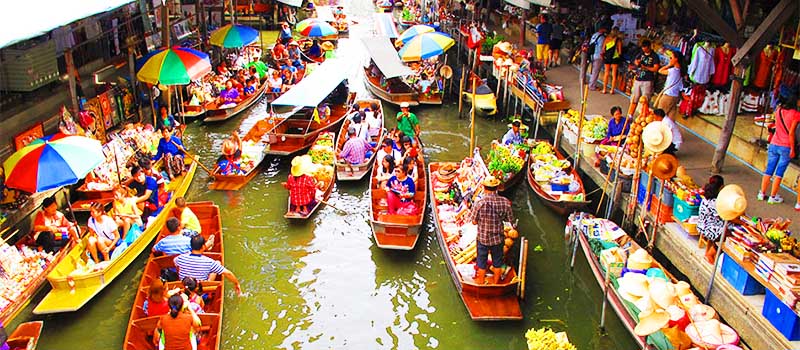
The Grand Palace opens at 08:30, costs 500 baht and enforces its dress code at the gate: covered shoulders and knees for everyone, including children. You go at opening and you are out before the middle of the day. Wat Pho and the reclining Buddha is 300 baht and is next door.
The afternoon is free. A night market is the usual choice and it is the one part of Bangkok that a twelve-year-old will describe to their friends.
Fly to Koh Samui
Bangkok to Samui is about an hour and the airport is open-air, which makes it the easiest arrival of the trip with children in tow. The transfer to the coast runs 20 to 40 minutes and nothing is scheduled after it.
Koh Samui: the first day of nothing
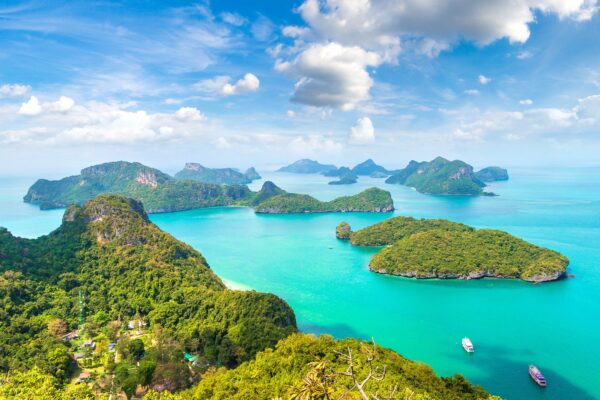
The first beach day of a long trip is the one that does the work. Nothing is booked, nobody is collected, and the guide has gone home — on the islands we hand over to the hotel and step back, because a family that has just spent a fortnight on a schedule needs a day without one.
If the children want structure, the hotel arranges it directly: kayaks, a snorkel trip to Koh Tan, a cooking hour. We do not pre-book any of it, because guessing at day fifteen what a nine-year-old will want on day sixteen is how families end up paying for excursions nobody takes.
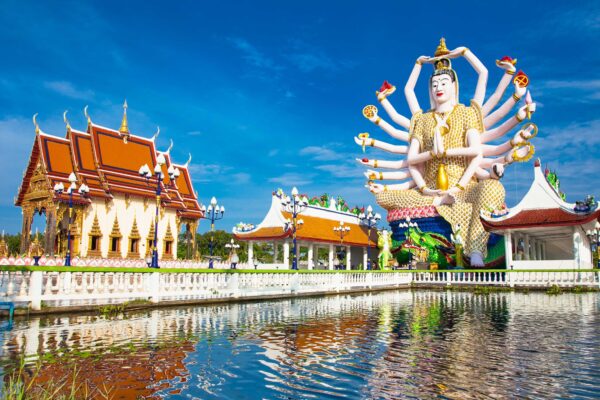
Koh Samui: the second day of nothing
The second day is when the grandparents stop checking the time. Most parties split for a few hours around now — the older generation to a long lunch, the younger to the water — and reconvene at dinner, which is the shape a multi-generational holiday takes when it is left alone.
The north and west coasts are calmer than Chaweng and that is where we book. If you want one outing on the island we suggest the Na Muang waterfall early, before the coaches, and back at the hotel by eleven.
Koh Samui, and home
Three nights on Samui are quoted here as the closing leg; on most family bookings the last two are spent entirely between the beach and the pool, and the day ends with a transfer to Samui airport for the flight home.
If you would rather have five nights than three, say so and we will re-quote. It is the cheapest change on this itinerary and the one most families make.
What it costs
| Party size | Comfortable | Excellent |
|---|---|---|
| 2 travellers | USD 5,630 | USD 8,730 |
| 3 – 4 travellers | USD 4,840 | USD 7,500 |
| 5 – 8 travellers | USD 4,400 | USD 6,820 |
A child under twelve sharing a room with two adults is quoted at 70 per cent of the adult rate. Under-12s also enter the Angkor park free on production of a passport, which is checked at the ticket office on Apsara Road. Children aged twelve and over are quoted at the adult rate because they occupy an adult seat, an adult bed and an adult temple pass.
What is and is not included
What the price includes
- Seventeen nights: three in Hanoi, one aboard in Lan Ha Bay, three in Hoi An, two in Ho Chi Minh City, three in Siem Reap, two in Bangkok, three on Koh Samui.
- Connecting rooms requested at booking, confirmed by the hotel by name in writing, and chased again fourteen days out.
- A private guide and a private driver in Vietnam, in Cambodia and in Thailand, each briefed on your party before you land.
- A vehicle sized for the luggage as well as the passengers, with water aboard on every transfer.
- One night on a private boat in Lan Ha Bay, full board, with kayaks and a swimming platform.
- Five flights: Hanoi–Da Nang, Da Nang–Ho Chi Minh City, Ho Chi Minh City–Siem Reap, Siem Reap–Bangkok and Bangkok–Koh Samui, booked in advance.
- The three-day Angkor pass at USD 62 for adults, the Hoi An town ticket, the Grand Palace at 500 baht and Wat Pho at 300 baht.
- The Tra Que cooking morning, including the market basket and lunch.
- Breakfast every morning plus the meals listed day by day, and a 24-hour contact number in each country.
What it does not include
- International flights into Hanoi and out of Koh Samui.
- Visas: Vietnamese e-visas where the passport requires one, Cambodian e-visas at USD 30 plus USD 6 each, and the free Thailand Digital Arrival Card for every traveller including children.
- Travel insurance for the whole party, which we require and will ask to see.
- Lunches and dinners on the days marked breakfast only.
- Cots, rollaway beds and connecting-room surcharges where a hotel levies one; these are quoted separately and named.
- Babysitting, kids’ club fees and spa treatments.
- Tips for guides, drivers and boat crew.
The journey in pictures





Who this journey is wrong for
Five kinds of family should not book this trip, and it is better said now.
- Families whose youngest child is under about six. The walking, the heat and four airport days do not work at that age, and a fourteen-day Vietnam-only route does.
- Families who want the S-21 and Choeung Ek morning in the same booking as a nine-year-old. Route through Phnom Penh with teenagers only, and we will build that version instead.
- Families who expect elephant riding, an orphanage visit or a hill-tribe village. We do not sell any of the three and no amount of money changes that.
- Families who want eighteen days and eleven stops. This route already has seven and each one costs a half day of packing, transferring and finding your feet.
- Families budgeting under USD 200 per person per day. At that number the rooms do not connect, the car is too small and the guide is shared, and the trip stops being the one described here.
Tell us the ages
Give us the ages of everyone travelling and the month, and we will tell you whether this is the right eighteen days.
Questions travellers ask most
How young is too young for this trip?
Roughly six. Below that, the walking at Angkor, the heat and four airport days across eighteen travelling days stop adding up, and most of what the trip is for is lost on the child anyway.
From six it works and from about nine it works well. If your youngest is four we will build a fourteen-day Vietnam route with two beach stops instead, and it will be the better holiday.
Will you confirm connecting rooms?
Yes. They are requested when the booking is made, named on the hotel confirmation, and chased again fourteen days before arrival. A hotel that will not confirm them in writing is not used on this route.
Where a building genuinely has no connecting rooms — some of the older colonial hotels do not — we tell you before you pay rather than at check-in, and we offer an alternative.
Why is Phnom Penh not on the itinerary?
Because Tuol Sleng and Choeung Ek are the reason to go there, and that morning is not something to put in front of a child. Splitting the party so half of it goes makes a poor day for everyone.
Families whose youngest is sixteen or over often do want it. For those parties we route through Phnom Penh rather than flying Ho Chi Minh City to Siem Reap direct, and we quote it as a variation.
How long are the drives?
No driving day exceeds four hours, and the longest single leg is the Hanoi to Haiphong run at about two and a half. The driver stops every ninety minutes on every drive, without waiting to be asked.
Toilet stops are checked in advance on each route. Water is in the car on every transfer, and the vehicle is chosen for luggage space rather than seat count.
Read next
Tell us about the journey you have in mind
Dates, party size and the places you care about are enough to start. You get a draft route and an indicative price, not a brochure.