Two countries that stay unalike
Three nights in Hanoi, one on the water in Lan Ha Bay, three in Hoi An and two in Ho Chi Minh City, then a one hour forty minute flight to Bangkok for three nights and Chiang Mai for two. Two countries, six places, and one short hop between them.
Who this journey is for
- Length
- 15 days, 14 nights
- Group
- 2 – 8, your party only
- Starts
- Hanoi
- Ends
- Chiang Mai
- Pace
- Easy — no driving day over three hours
- From
- USD 3,750 per person
This is the pairing for travellers who want two countries that are genuinely unalike, rather than three that blur into one long corridor of temples. Vietnam and Thailand do not resemble each other in food, in language, in religion, in architecture or in how a street behaves at seven in the morning. Fifteen days is enough to feel the difference and not enough to blunt it.
It is also the easiest of our routes to run. There is exactly one international leg inside the trip — Ho Chi Minh City to Bangkok, one hour forty minutes, on a route with about a dozen departures a day between Vietnam Airlines, Vietjet, Thai Airways and Thai AirAsia. If a flight is cancelled there is another one three hours later. On our four-country journeys a missed connection costs a day; here it costs an afternoon.
Fourteen nights split across six places gives an average of two and a bit nights each, which is our floor rather than our preference. Anyone who wants three or four nights everywhere should look at the twenty-day and twenty-one-day routes instead. What this itinerary buys with its pace is contrast: north Vietnam, the water, central Vietnam, the south, then Thailand twice over.
What the fifteen days give you
- Three nights in Hanoi, which is one more than most fifteen-day itineraries allow and the difference between seeing the Old Quarter and walking around in it.
- A night on Lan Ha Bay, entered from Haiphong, where the boat count is a fraction of the Ha Long core and the anchorages are quieter.
- Three nights in Hoi An with a car and driver on call, so My Son in the morning and the beach in the afternoon are both possible on the same day.
- Two nights in Ho Chi Minh City, enough for the Reunification Palace, Cho Lon and one long evening walk, and not enough to tire of the noise.
- One flight between countries: Tan Son Nhat to Suvarnabhumi, one hour forty, booked in advance in economy.
- The Grand Palace at 500 baht and Wat Pho at 300 baht with a guide who knows which gate to use at 08:30, plus a morning on the Thonburi canals.
- Two nights in Chiang Mai at a time of year when the air is clear, which is not most of the year.
- A private English-speaking guide and a private driver in each country, working only for your party.
One flight, one visa change, and the month you must not book
Three practical things shape this itinerary more than anything else on the page, and all three are easier to deal with before you book than after.
Burning season in northern Thailand runs from late January to late April and is worst in March. On 29 and 30 March 2026 PM2.5 in Chiang Mai reached 188 micrograms per cubic metre, twelve times the World Health Organization guideline, and on 24 March alone there were 158 wildfires burning across fifteen districts. Thailand banned open burning from 1 February to 31 May 2026 and the smoke came anyway, because much of it drifts in from across the borders. If you are set on March, we will run this route and finish in Bangkok or on the coast instead of Chiang Mai. What we will not do is put you in the north in March and describe the view as hazy.
The second thing is the Thai visa rule. From 15 September 2026 the visa exemption for the sixty countries and territories that hold it — the United States, the United Kingdom, Canada, Australia, Japan and most of Europe among them — drops from 60 days to 30. Fifteen days is comfortably inside that, so this route is unaffected, but anyone planning to stay on in Thailand afterwards needs to know the number changed. One extension of up to 30 further days is available at a Thai immigration office. Visa-exempt entries by land are capped at twice per calendar year; arrivals by air are not capped, and you arrive by air.
The third is the Thailand Digital Arrival Card. It is mandatory, it is free, and it must be filed within 72 hours of arrival at tdac.immigration.go.th. Websites that charge a fee for it are not official and are not doing anything you cannot do yourself in ten minutes. Our office sends the link and a reminder at the right moment; we do not file it for you, because it asks for your passport details and your first night’s address, and you should be the one entering those.
The Vietnamese e-visa is open to all nationalities for stays of up to 90 days, single or multiple entry, applied for online at the Immigration Department portal. Twenty-four countries hold a 45-day exemption instead, including the United Kingdom, Germany, France, Italy, Spain, the Netherlands, Japan and South Korea. United States, Canadian, Australian and New Zealand passports hold no exemption and must carry an e-visa. Full detail is on our visas and entry page.
The best months for this combination are November to February, which is when northern Vietnam is dry and cool, central Vietnam is past its flood season, and Thailand is at its coolest and driest. September to November is the wrong window for Hoi An in particular: that is typhoon and flood season on the central coast, worst in October and November, and Hoi An floods most years. The month-by-month picture is set out on when to go, and what sits behind the figures below is explained on our pricing page. The deposit and the sequence are on how to book. What the three Bangkok nights are actually for is on the Bangkok page.
Day by day
Arrive Hanoi
Your guide meets you inside the arrivals hall at Noi Bai and drives you into the Old Quarter, about 40 kilometres and 45 minutes to an hour depending on the time of day. Nothing else is scheduled.
Dinner is either in the hotel or a five-minute walk from it. Hanoi is seven hours ahead of London and twelve ahead of New York, and the first evening is better spent losing the flight than seeing anything.
Hanoi on foot
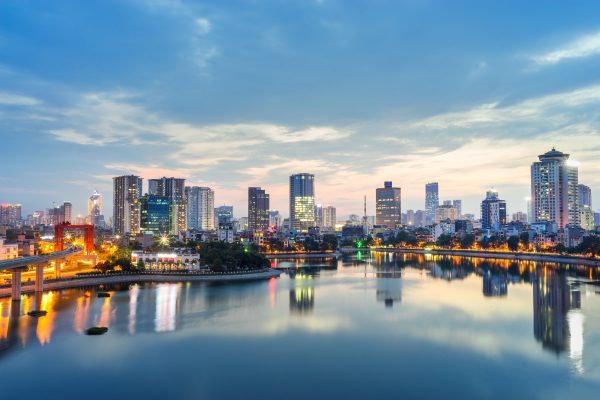
The morning runs from the Temple of Literature, founded in 1070 and still laid out as five courtyards, to the Ho Chi Minh mausoleum complex and the One Pillar Pagoda, then to the Presidential Palace gardens. The afternoon is the Old Quarter itself: thirty-six streets that still carry the names of the trades that filled them, Hoan Kiem lake, and the Ngoc Son temple on its island.
Your guide will walk this rather than drive it. The distances are short and the traffic is the point.

Hanoi, your way
A free day with the car and guide on call. Most people take the Vietnamese Women’s Museum in the morning, which is the best single museum in the city, and then either Hoa Lo prison or the ceramic village at Bat Trang, 14 kilometres downriver.
The other option is to do nothing at all until six, when the streets around Ta Hien fill up and the beer comes out of a keg onto a plastic stool. Both are legitimate uses of a third day in Hanoi.
Hanoi to Lan Ha Bay
The drive east to Haiphong is about two hours on the expressway, and the boat leaves from Got pier around midday. Lan Ha is entered from Haiphong rather than from Ha Long city, and it carries a fraction of the traffic of the Ha Long core — the same karst, far fewer hulls.
The afternoon is kayaking or a tender through the floating villages, and the boat anchors for the night in a bay where you will see two or three other vessels rather than forty.

Disembark, fly to Da Nang, drive to Hoi An
Brunch is served as the boat works back towards the pier and you are ashore around eleven. Cat Bi airport in Haiphong is 30 to 40 minutes away and the flight to Da Nang takes an hour and twenty; when the schedules do not line up we drive back to Noi Bai instead and fly from there, which is longer but reliable.
From Da Nang it is 45 minutes south to Hoi An. You will arrive in time to walk into the old town before dinner.
Hoi An old town
The old town ticket costs 120,000 dong and admits you to five of the twenty-two heritage buildings; enforcement happens at the doors of the heritage houses in daylight and nowhere else. Your guide will pick five that are worth the entry rather than the five nearest the ticket booth.
Tan Ky house, the Japanese covered bridge, the Fujian assembly hall and the market are the spine of the morning. The afternoon is free, and if you want clothes made this is the day to be measured, because a fitting takes two visits and you have three nights.
My Son, then the coast
My Son is 45 kilometres inland, an hour by road, and it is a group of Cham brick sanctuaries built between the fourth and the thirteenth centuries. Several were destroyed by bombing in 1969 and the craters are still there beside the towers. Go at opening, before the coaches and before the heat.
You are back at the coast by early afternoon. The beach is fifteen minutes from the old town and the rest of the day is unscheduled.

Fly to Ho Chi Minh City
A late-morning flight from Da Nang lands at Tan Son Nhat in an hour and twenty. Long Thanh, the new airport east of the city, has still not begun commercial service, so the arrival is the old one, close in and busy.
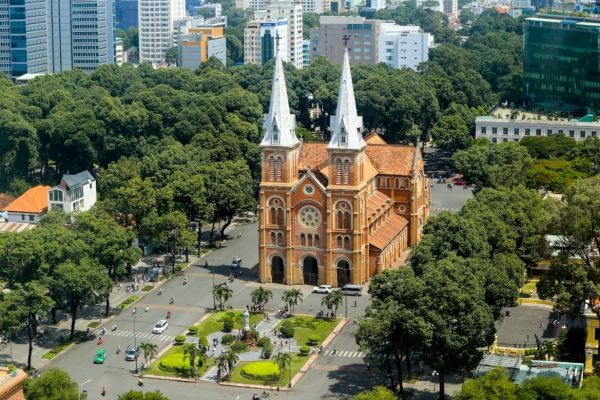
The afternoon covers the Reunification Palace, the central post office and the streets of District 1 on foot. Your first hour in Saigon traffic will tell you more about Vietnam than any museum.
Ho Chi Minh City
The morning goes to Cho Lon, the Chinese quarter, and the Thien Hau temple where incense coils burn down slowly from the roof beams over several weeks. Binh Tay market is next door and sells to shops rather than to visitors.
The War Remnants Museum is available in the afternoon and is a hard hour. It is your call, and it will not be put in the car without asking you first. The alternative is the Cu Chi tunnels, an hour and a half each way, or an afternoon off.
Fly to Bangkok
Tan Son Nhat to Suvarnabhumi is one hour forty in the air on a route with about a dozen departures a day, which is why this is the easiest border in the region to cross. File your Thailand Digital Arrival Card within 72 hours of arrival at tdac.immigration.go.th before you leave for the airport; it is free and takes ten minutes.
A Thai guide and driver meet you on the other side. The evening is free, and the hotel is on the river or a short walk from a Skytrain station, depending on the standard you have chosen.

The Grand Palace, Wat Pho and the river
You are at the Grand Palace gate at 08:30 when it opens, because by ten the courtyards are full. Entry is 500 baht and the dress code is enforced at the door: shoulders and knees covered, no exceptions, and the shirts they lend you are not comfortable. Wat Pho and the reclining Buddha follow at 300 baht, ten minutes away on foot.
The afternoon is on the water: the public express boat up the Chao Phraya, which costs less than a coffee, and Wat Arun on the Thonburi bank.
Bangkok behind the river
A long-tail boat through the Thonburi canals takes you into the half of Bangkok that still lives with its back to the water: wooden houses on stilts, a temple landing every few hundred metres, monitor lizards on the bank. Two hours, and it is the best thing in the city.
The afternoon is yours. Jim Thompson’s house, the Bangkok National Museum and Chinatown after dark are the three we would suggest, in that order.
Fly to Chiang Mai
A morning flight north takes an hour and ten. Chiang Mai airport is four kilometres from the old city, which is the shortest airport transfer of the whole trip.
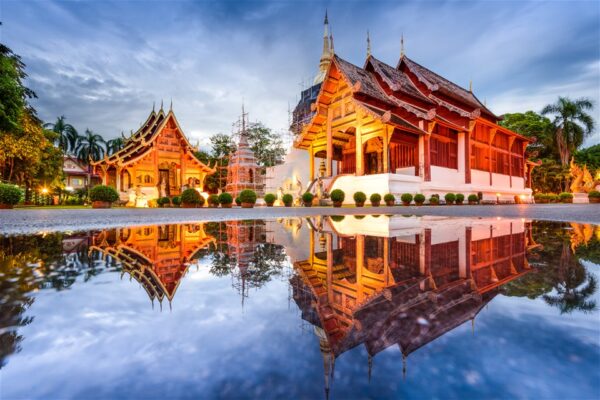
The afternoon is inside the walls: Wat Phra Singh, Wat Chedi Luang and its broken brick tower, and the lanes between them, which are quiet in a way nothing in Vietnam or Bangkok has been.
Doi Suthep and the hills
Doi Suthep sits 15 kilometres above the city at 1,050 metres, reached by a road of switchbacks and then 306 steps, and you go at eight to have the terrace to yourself. The view back over the plain is the reason people say Chiang Mai is in a valley.
The afternoon is a choice: a cooking class that starts at a market, the village of Mae Kampong an hour east in the hills, or nothing.
Depart Chiang Mai
A transfer to the airport timed to your flight. Most people connect through Bangkok; there are also direct services to Singapore, Taipei and several Chinese cities.
What it costs
| Party size | Comfortable | Excellent |
|---|---|---|
| 2 travellers | USD 4,800 | USD 7,440 |
| 3 – 4 travellers | USD 4,130 | USD 6,400 |
| 5 – 8 travellers | USD 3,750 | USD 5,810 |
What is and is not included
What the price includes
- Fourteen nights: three in Hanoi, one aboard in Lan Ha Bay, three in Hoi An, two in Ho Chi Minh City, three in Bangkok, two in Chiang Mai.
- A private English-speaking guide in Vietnam and a second in Thailand, each working in their own country.
- A private car with a driver throughout, including the Hanoi to Haiphong run and every airport transfer.
- Three flights: Haiphong or Hanoi to Da Nang, Da Nang to Ho Chi Minh City, and Ho Chi Minh City to Bangkok, all booked in advance in economy.
- The domestic flight from Bangkok to Chiang Mai, also booked in advance.
- One night full board aboard a Lan Ha Bay vessel in a balcony cabin, with kayaks and the tender.
- Every entrance fee named in the itinerary, including the Hoi An old town ticket, My Son, the Grand Palace at 500 baht and Wat Pho at 300 baht.
- Breakfast every morning plus the meals shown day by day.
- Airport meet-and-greet at Hanoi and at Bangkok, and a 24-hour contact number in each country.
What it does not include
- International flights into Hanoi and out of Chiang Mai.
- Visas: a Vietnamese e-visa where your passport requires one, and the free Thailand Digital Arrival Card, which you file yourself.
- Travel insurance, which we require and will ask to see before departure.
- Lunches and dinners on the days marked breakfast only, and all drinks.
- Tips for guides, drivers and the boat crew.
- Laundry, spa treatments and anything charged to your room.
- The optional Cu Chi tunnels excursion and the Chiang Mai cooking class if you take them.
The journey in pictures
Who this journey is wrong for
Four kinds of traveller should book something else, and it costs everyone less to say so now.
- Anyone who wants to be in Chiang Mai in March. The burning season peaks that month and the air is unbreathable; we will move the ending rather than pretend otherwise.
- Anyone who wants three or four nights in every stop. Fourteen nights across six places averages a little over two, and that is the deal this route makes.
- Anyone who wants Laos or Cambodia in the same fifteen days. Four countries in a fortnight is airports, not travel, and we do not sell it.
- Anyone travelling on under USD 200 per person per day. This route cannot be run at that number and we would rather decline than deliver a thinner version of it.
- Anyone who wants a shared departure with other guests. Every journey we run is one party only, which is also why it costs what it costs.
Ask about a departure
Tell us your month and we will tell you what the air is doing in the north and what the flights cost that week.
Questions travellers ask most
Why fly Ho Chi Minh City to Bangkok instead of going overland?
Because the flight is one hour forty minutes on a route with roughly a dozen departures a day, and the overland alternative runs through Cambodia and takes the better part of three days. Nobody who has costed both would choose the road.
It also means a cancelled flight costs you an afternoon rather than a day, since the next departure is usually within three hours.
Is March really that bad in Chiang Mai?
Yes. Burning season in the north runs from late January to late April and peaks in March. PM2.5 in Chiang Mai hit 188 micrograms per cubic metre on 29 and 30 March 2026, twelve times the WHO guideline, and 158 wildfires were burning across fifteen districts on 24 March alone.
Thailand banned open burning from 1 February to 31 May 2026 and the smoke still arrived, much of it from across the borders. If you must travel in March we will end the trip in Bangkok or on the coast.
What changed with the Thai visa exemption?
From 15 September 2026 the exemption for the sixty eligible countries and territories drops from 60 days to 30. One extension of up to 30 further days can be applied for at a Thai immigration office.
Fifteen days is well inside the limit, so this route is not affected. Visa-exempt land entries are capped at twice per calendar year; air arrivals are uncapped, and you arrive by air.
Do we have to file the Thailand Digital Arrival Card ourselves?
Yes, and it takes about ten minutes. It is mandatory, it is free, and it must be filed within 72 hours of arrival at tdac.immigration.go.th. Our office sends the link and a reminder at the right point in the countdown.
Any website charging a fee for the TDAC is not official. We do not file it on your behalf because it asks for your passport details and your first night’s address, and those should come from you.
Read next
Tell us about the journey you have in mind
Dates, party size and the places you care about are enough to start. You get a draft route and an indicative price, not a brochure.