Chiang Mai in three or four nights
A walled town of temples at the foot of a mountain, with the best regional food in Thailand and the worst air in Asia for two months of the year. Both of those things are true, and only one of them is normally mentioned in a brochure.
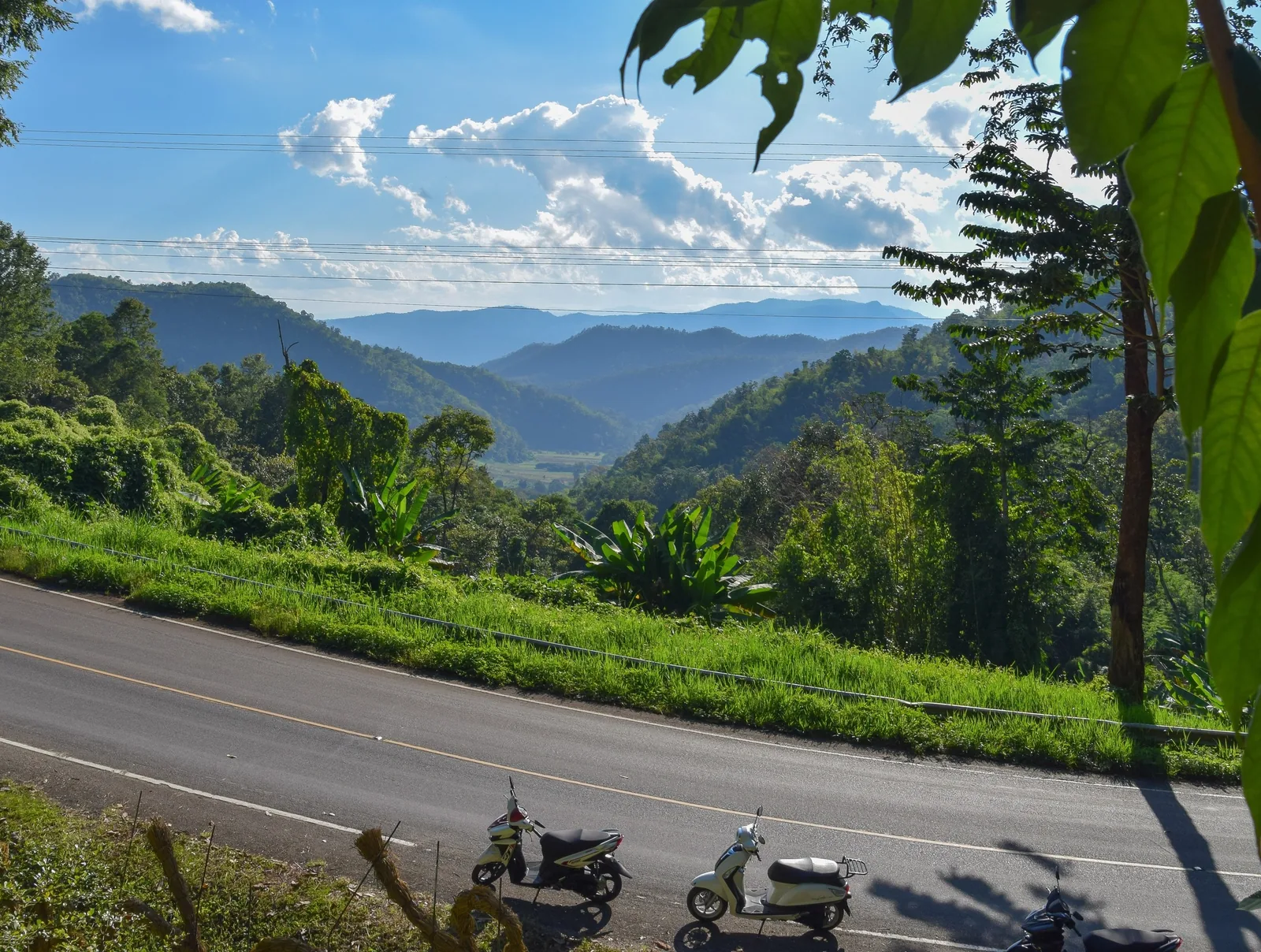
What this place actually is
| Region | Northern Thailand |
| Worth staying | 3 to 4 nights |
| Nearest airport | Chiang Mai (CNX), 4 km, 15 min |
| Best months | November to February |
| Known for | Doi Suthep, the walled old city, northern Thai food, the Sunday walking street |
This is the single most important fact on this page. Farmers and forest fires fill the northern valleys with smoke every year from late January to late April, and March is the worst of it. In 2026, Chiang Mai PM2.5 reached 188 µg/m³ on 29 and 30 March — twelve times the World Health Organization guideline of 15 — and the city was ranked the most polluted in the world on several days that month. On 24 March alone, 158 wildfires were burning across fifteen districts, and two districts were declared disaster zones. Thailand banned all open burning from 1 February to 31 May 2026 and the smoke still came. We will not sell Chiang Mai in March. If your dates fall in March we will say so in the first reply and move the northern nights somewhere else rather than take the booking.
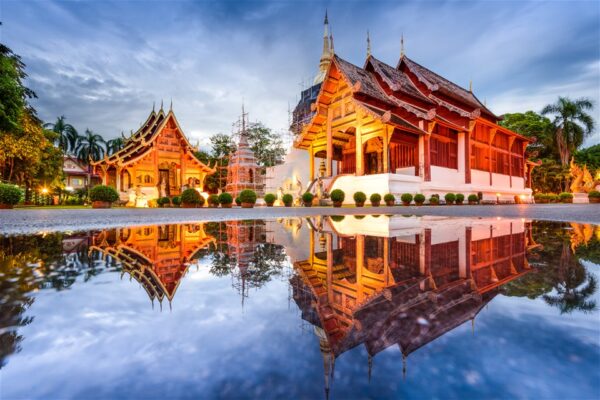
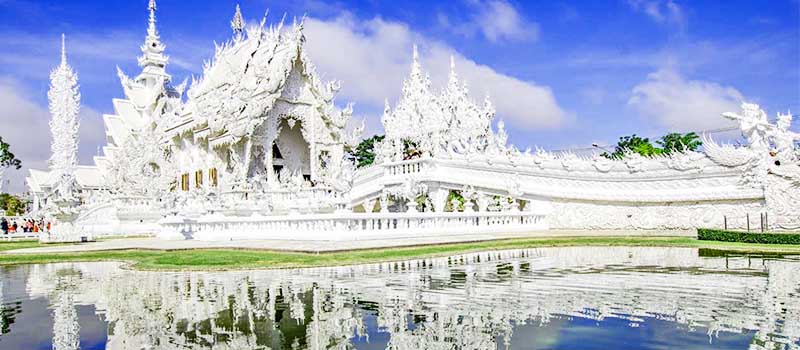
Chiang Mai was founded in 1296 as the capital of the Lanna kingdom, and the moat and the remnants of the brick wall still draw a square about 1.5 km on each side around the old town. Inside it there are around thirty working monasteries. Wat Chedi Luang holds a brick chedi begun in 1441 that stood some 80 metres high until an earthquake took the top off it in 1545, and the stump is still the largest structure in the old city. Wat Phra Singh at the western end keeps the Lai Kham chapel, whose murals show nineteenth-century Lanna dress in ordinary domestic detail. None of this takes more than a morning on foot, and the old city is flat, shaded and small enough to walk end to end in half an hour.
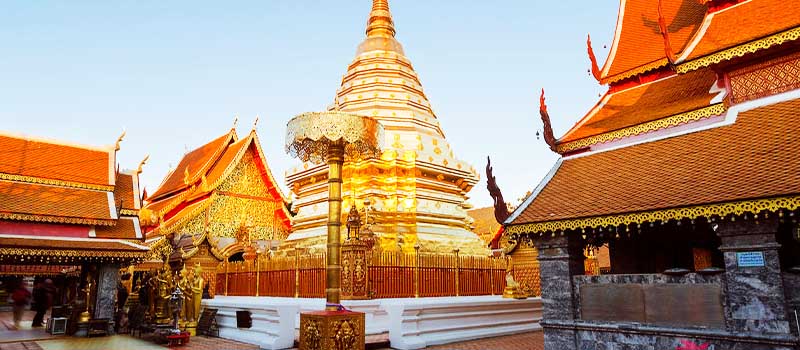
Doi Suthep is the other fixed point: a monastery at 1,073 metres on the mountain 15 km west of town, reached by a winding 30 to 40 minute drive and then either a cable car or 306 steps flanked by a naga balustrade. Entry for foreign visitors is 30 baht. Go at 07:00 and it is monks, bells and a valley under mist. Go at 10:30 and it is four coach parties on a staircase. The difference is entirely a matter of what time you get in the car, which is the recurring theme of planning here.
The food is the real reason to give this town four nights rather than two. Northern Thai cooking is a separate cuisine from the central Thai food sold abroad: khao soi, a curry noodle soup with a crisp noodle nest on top; sai ua, a coarse herb sausage; nam prik ong and nam prik num, chilli relishes eaten with steamed vegetables and pork crackling; larb muang, which is nothing like the Isaan version. Talat Ton Lamyai and the small morning markets outside the moat sell to cooks. The Sunday walking street runs the length of Ratchadamnoen Road from late afternoon into the evening and is genuinely local in its food and largely not in its souvenirs.
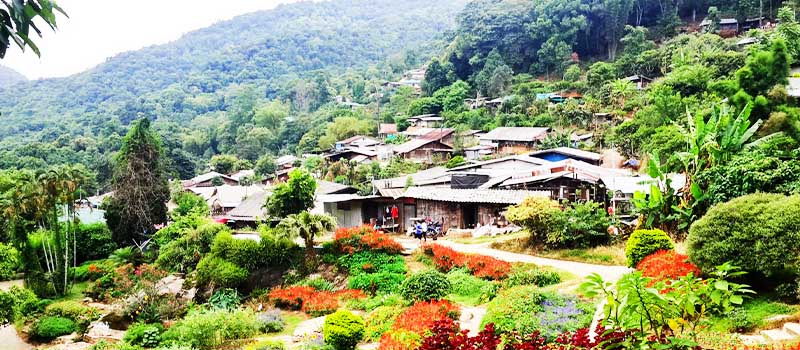
The over-visited part: Nimmanhaemin Road has become a strip of identical concrete-and-plant cafés serving the same flat white to the same photograph; the nightly bazaar east of the moat is machine-printed textiles and Bluetooth speakers; and the ring of so-called elephant sanctuaries in the Mae Rim and Mae Wang valleys is now the single largest industry attached to this town. That last one gets its own section below, because it is the thing we most often have to argue about with a new client.
What we will not book here
This is a short list and it is not negotiable, and it is easier to read it now than to discover it in a quote.
- No elephant riding, anywhere, in any form, including the ones described as bareback or traditional.
- No camp that advertises bathing with elephants or riding them. Bathing looks gentle and is not: an animal that stands still in a river for eight hours of visitor shifts has been trained to, and the training is the part you do not see.
- No staged hill-tribe village visits, where a village is paid to be visited and the visit is the economy.
- No long-neck village. The Kayan women in these settlements are largely Burmese refugees with restricted movement, and admission is charged at the gate for the sight of them.
- No gem shops, no silk factories, no lacquer workshops, no commission stops of any kind. Our guides are salaried and take nothing from a shop.
What we will do instead, if animals are the point of the trip for you, is put you in touch with a genuine observation-only project where the animals are not handled by visitors at all and the number of people on site is capped. It is less photogenic and it costs about the same. Some clients decline it once they realise there is no touching involved, and that is a fair answer — we would rather have that conversation than sell a morning we do not believe in. Read how our guides work for why none of this costs you a discount.
How many nights, and why fewer breaks it
Three nights minimum, four if the food matters to you or if you want a day outside the valley. The arithmetic here is not about the flight, because CNX is 4 km from the old city and the transfer is fifteen minutes; it is about the fact that the two best hours of a Chiang Mai day are both in the morning and you cannot spend them in the same place.
Day one takes the old city on foot from about 08:00: Wat Chedi Luang, Wat Phra Singh, the small lanes between them, a market, lunch, and an afternoon that should be free because it will be 33 °C. Day two starts at 07:00 for Doi Suthep before the coaches, comes back down by 10:30, and has the rest of the day for the Lanna Folklife Museum, a cooking class that actually starts at a market, or nothing at all. Day three is the one that justifies the fourth night: the Mae Sa valley, the Samoeng loop, a working village, or a slow morning of nothing followed by the Sunday walking street if your dates catch it. Two nights gives you one full day and forces the mountain and the old city into the same morning, which means Doi Suthep at 10:30 with the coaches. That is the specific failure, and it is why we quote three.
Flying in and out on the same day — which some operators sell as a Chiang Mai day trip from Bangkok — buys you a temple, an airport and a photograph. It is not a thing we build.
When to go
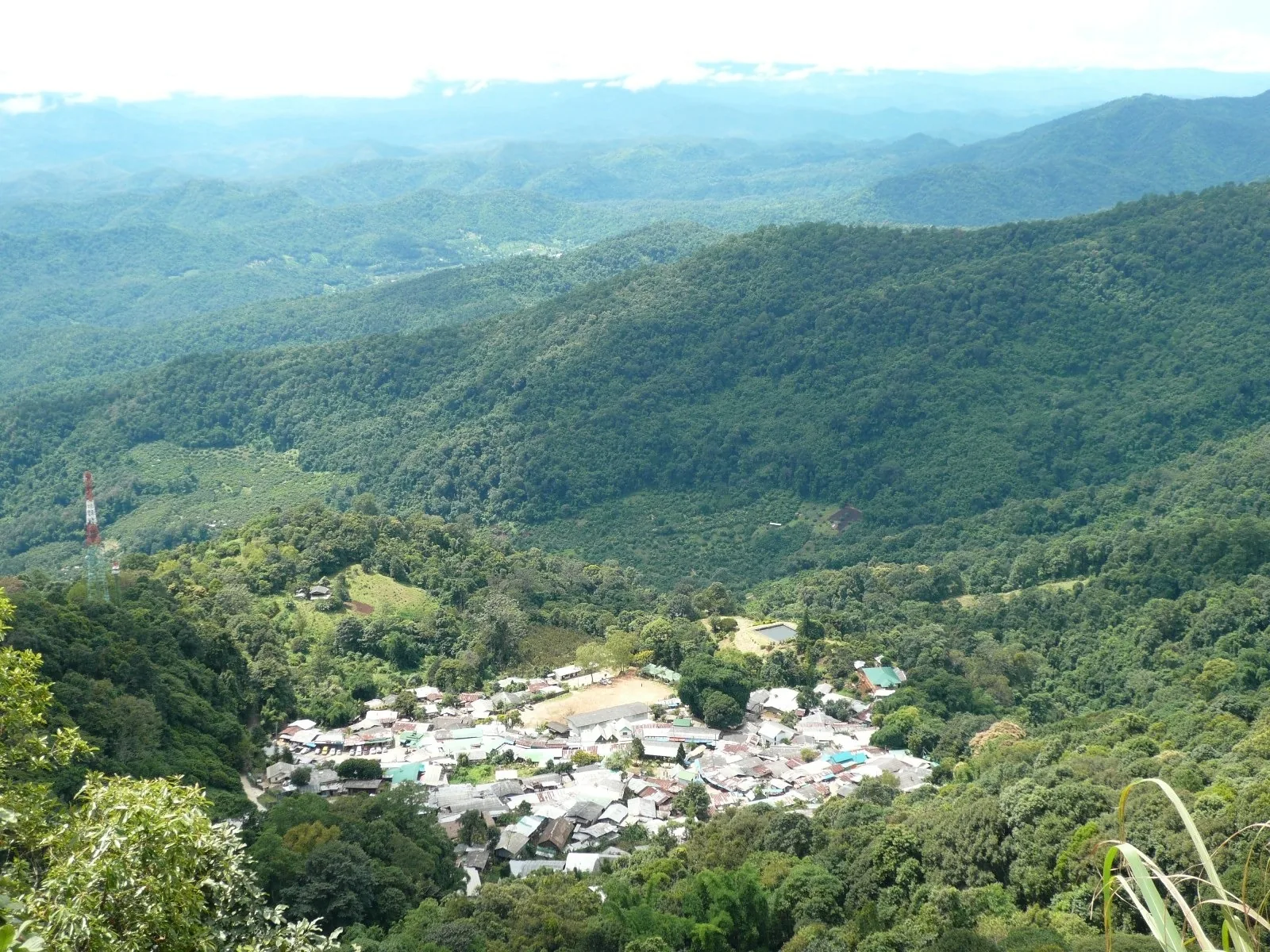
Chiang Mai sits in a bowl of mountains at about 310 metres, and that bowl is the reason the seasons here are more extreme than Bangkok in both directions: cooler and clearer in winter, and unable to clear its own air in spring.
| Months | What it is like | Verdict |
|---|---|---|
| November to January | Cool and dry, 15–28 °C, clear air, cold mornings on the mountain | The best window of the year. Book early; this is also when everyone else comes. |
| Late January to February | Warming, air quality starting to fall as burning begins | Still workable, and cheaper. We watch the daily readings and will tell you what they are. |
| March | Burning season at its worst. PM2.5 reached 188 µg/m³ on 29–30 March 2026, twelve times the WHO guideline of 15 | We do not sell Chiang Mai in March. No exceptions, and no discount that makes it acceptable. |
| April | Hot, 38–40 °C, smoke usually clearing late in the month. Songkran mid-April | Marginal. Songkran in Chiang Mai is the biggest in Thailand and worth planning for deliberately. |
| May to October | Green season, afternoon rain, 24–33 °C, air completely clear | Underrated. Cheapest rooms, cleanest air of the warm half of the year, mornings usually dry. |
What the bad season buys you is worth spelling out, because there are two different bad seasons here and only one of them is genuinely bad. The green season, June to October, buys clean air, a thin crowd, hotel rates 30 to 45 per cent below January, and a valley that is actually green rather than brown — the rain arrives in the afternoon and lasts an hour or two. Northern Thailand in August is a good trip and almost nobody sells it as one. The burning season buys you nothing. Rooms are cheap in March because the air is unbreathable, and a room rate is not compensation for 188 micrograms per cubic metre.
When a client’s dates fall in March, here is what we substitute. If the trip can move, we move it to late November or January. If the dates are fixed, we take the northern nights out and put them into Cambodia or the Gulf coast — usually Siem Reap plus Koh Samui, which is dry and pleasant in March — or we add them to central Vietnam, where February to April is the dry window. What we do not do is move you to Luang Prabang instead, because northern Laos burns on the same calendar for the same reasons and swapping one smoke bowl for another helps nobody. Read when to go for how this interacts with the rest of a four-country route.
How to get there
Chiang Mai International (CNX) is 4 km from the old city and the transfer is 15 minutes, which makes it the easiest arrival on any Indochina route. Bangkok to Chiang Mai is about 1 h 15 in the air with a dozen departures a day on Thai Airways, Bangkok Airways, Thai AirAsia and Thai Vietjet. Direct regional services run to Kuala Lumpur, Singapore, Taipei and Seoul, but almost every client we route through here connects via Bangkok.
The overnight train from Bangkok covers 751 km in roughly 12 to 13 hours. A second-class air-conditioned sleeper berth costs around 900 to 1,300 baht, the first-class two-berth compartments sell out weeks ahead, and the train arrives in the early morning. It is a real experience and it costs you a night of hotel and most of an arrival day, so we offer it only where a client asks. By road, Bangkok to Chiang Mai is about 700 km and 9 to 10 hours, which is three times our five-hour driving-day cap and not something we build.
Onward within the north: Chiang Rai is 190 km, about 3 h 15 by road. Pai is 130 km of 762 curves and roughly 3 h 30, which is genuinely unpleasant for anyone prone to motion sickness. Lampang is 100 km and 1 h 30. Crossing into Laos, the practical routes are a flight to Luang Prabang via Bangkok, or the road north to Chiang Khong and the Mekong slow boat, which takes two days with a compulsory overnight at Pakbeng and about six hours on the water each day.
On arrival paperwork: the same rules apply here as at every Thai entry point. From 15 September 2026 the visa exemption is 30 days rather than 60 for the sixty countries and territories that hold it, with one extension of up to 30 further days available at a Thai immigration office, and visa-exempt land entries limited to two per calendar year while air arrivals are unlimited. Everyone arriving must also file the Thailand Digital Arrival Card. It is mandatory, it is free, it is filed within 72 hours of arrival at tdac.immigration.go.th, and any website charging you for it is not the government. Full detail sits on visas and entry.
What things cost here
Chiang Mai is the cheapest place on a Thailand route for food and guiding and the most variable for hotels, because the difference between a good boutique in the old city and a resort in the Mae Rim valley is a factor of five.
| What | Rough cost |
|---|---|
| Comfortable boutique in or near the old city, per night | USD 70 – 130 |
| Upper-comfort, riverside or garden resort, per night | USD 160 – 300 |
| Four Seasons Resort Chiang Mai, 137 Pillars House, per night | USD 400 – 1,100 |
| Bowl of khao soi at a market stall | 50 – 70 baht |
| Dinner for two, good northern restaurant | 700 – 1,400 baht |
| Doi Suthep entry, foreign visitor | 30 baht |
| Wat Chedi Luang entry | 50 baht |
| Full-day cooking class with market visit | 1,200 – 1,800 baht |
| Metered or app taxi across town | 80 – 150 baht |
| Airport transfer, private car | 250 – 400 baht |
A day here lands at the lower end of our USD 250 to 500 per person per day band, and that is before the hotel choice. The one line that surprises people is the mountain: a private car with driver and a guide for the Doi Suthep morning costs less than the coach seat sold at a hotel desk in Bangkok, because there is no coach, no commission stop and no waiting for forty other people.
In pictures
When to skip it
- Your dates fall in March. We will not sell it and you should not buy it elsewhere. Anyone with asthma, a heart condition, young children or an elderly traveller in the party should extend that to the whole of February to April.
- You came to Thailand for a beach. The north has none, and a Chiang Mai stop inserted between Bangkok and an island costs you two flights and a day for a change of subject you did not want.
- You have already spent a week in Luang Prabang. The two towns share a monastic architecture, a river-valley setting and a food culture, and back to back they flatten each other. Put Cambodia or the coast between them.
- You expected an elephant experience of the riding or bathing kind. We do not book it, and if that is the reason for the stop then the stop has no reason.
The journeys that come here
Chiang Mai appears on four of our routes, for two to four nights depending on how much Thailand the trip carries. Grand Indochina, 28 days puts it after the Laos leg and before the run south, which works because the two mountain towns are separated by a week and a change of country. Thailand, Laos and Cambodia, 19 days takes it directly after Bangkok and uses it as the jumping-off point for the crossing into Laos.
On Vietnam and Thailand, 15 days the north is the shortest stop we will build here, two nights, with the Doi Suthep morning at 07:00 rather than the coach hour. Cambodia and Thailand, 13 days flies Siem Reap to Bangkok — the land border has been shut since June 2025 — and then north for four nights before the return.
All four quotes name the hotel, put a licensed English-speaking national guide and a private car with you throughout Thailand, and state the driving times rather than rounding them down. If your dates are in the burning window we will say so before we quote, not after. Send us the dates and write to us, and we will tell you whether the north is right for your particular month.
Ask about northern Thailand
Tell us your month and we will tell you honestly whether Chiang Mai belongs in it.
Questions travellers ask most
How bad is the burning season, really?
Bad enough that we decline bookings. Chiang Mai PM2.5 reached 188 µg/m³ on 29 and 30 March 2026, twelve times the World Health Organization guideline of 15, and the city ranked as the most polluted in the world on several days that month.
On 24 March alone 158 wildfires burned across fifteen districts and two districts were declared disaster zones. Thailand banned all open burning from 1 February to 31 May 2026 and the smoke came anyway. Late January to late April is the season; March is the worst of it.
What do you substitute if our dates are in March?
If the trip can move, we move it to late November, December or January. If the dates are fixed, we take the northern nights out and put them into Cambodia and the Gulf coast — Siem Reap plus Koh Samui — or into central Vietnam, which is dry from February to April.
We do not substitute Luang Prabang. Northern Laos burns on the same calendar for the same reasons, so swapping one valley for another gains you nothing.
Can you arrange an elephant experience?
Not of the usual kind. No riding, in any form, and no camp that advertises bathing or riding. An animal that stands in a river for eight hours of visitor shifts has been trained to do it, and the training is the part that is not shown.
Where animals are the point of the trip, we can place you with an observation-only project where visitors do not handle the elephants and numbers on site are capped. It costs about the same and photographs less well.
Is three nights enough, or should we take four?
Three works: one day for the walled old city on foot, one for Doi Suthep at 07:00 before the coaches arrive, and the flexibility to keep an afternoon free in 33 °C heat.
Four is better if food matters to you, if you want a day in the Mae Sa valley or on the Samoeng loop, or if your dates catch the Sunday walking street. Two forces the mountain and the old city into one morning, which puts you at Doi Suthep at 10:30 with four coach parties.
Read next
Tell us about the journey you have in mind
Dates, party size and the places you care about are enough to start. You get a draft route and an indicative price, not a brochure.