Phnom Penh, and the half-day that matters
A working capital on the confluence of the Mekong and the Tonle Sap, with the best pre-Angkorian sculpture in the world in one building and the record of the Khmer Rouge in two others. It asks more of a visitor than any other city on these routes.
What this place actually is
| Region | Southern Cambodia, at the Mekong and Tonle Sap confluence |
| Worth staying | 2 to 3 nights |
| Nearest airport | Techo International (KTI), 19 km south — opened 9 September 2025 |
| Best months | November to April |
| Known for | The National Museum, the Royal Palace, Tuol Sleng, the riverfront |
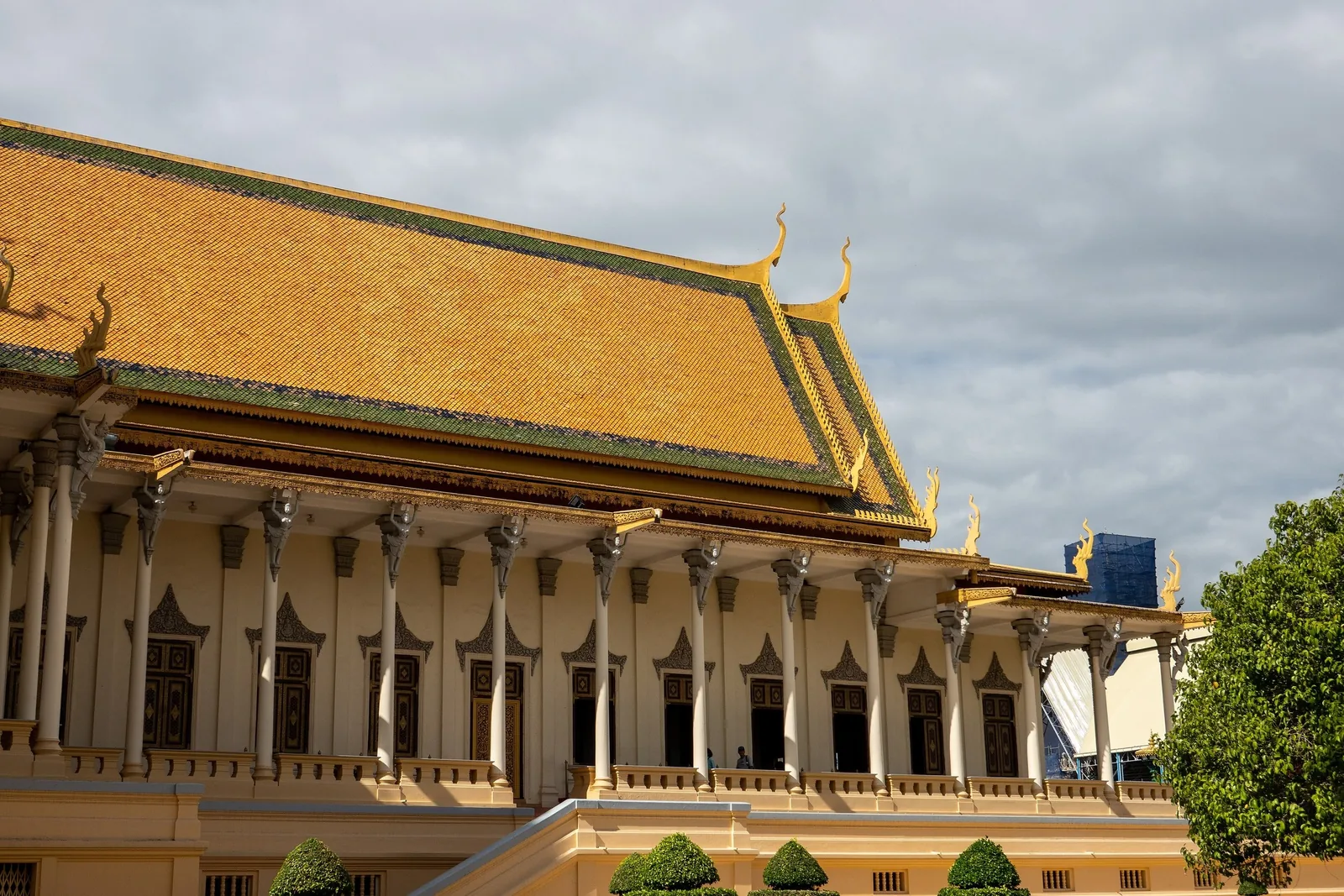
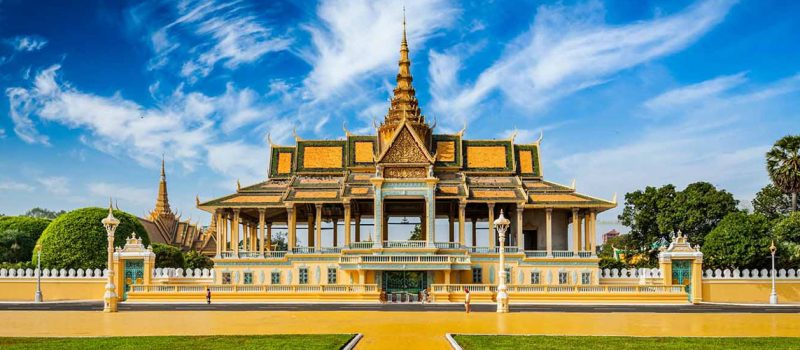
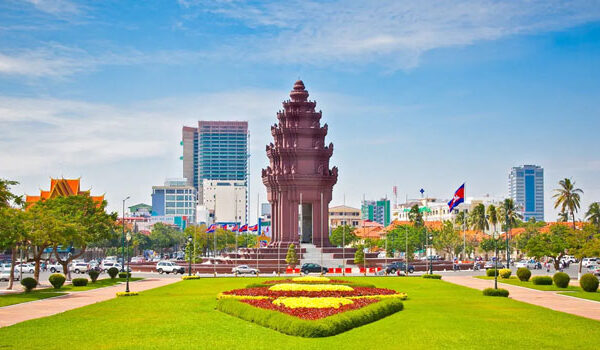
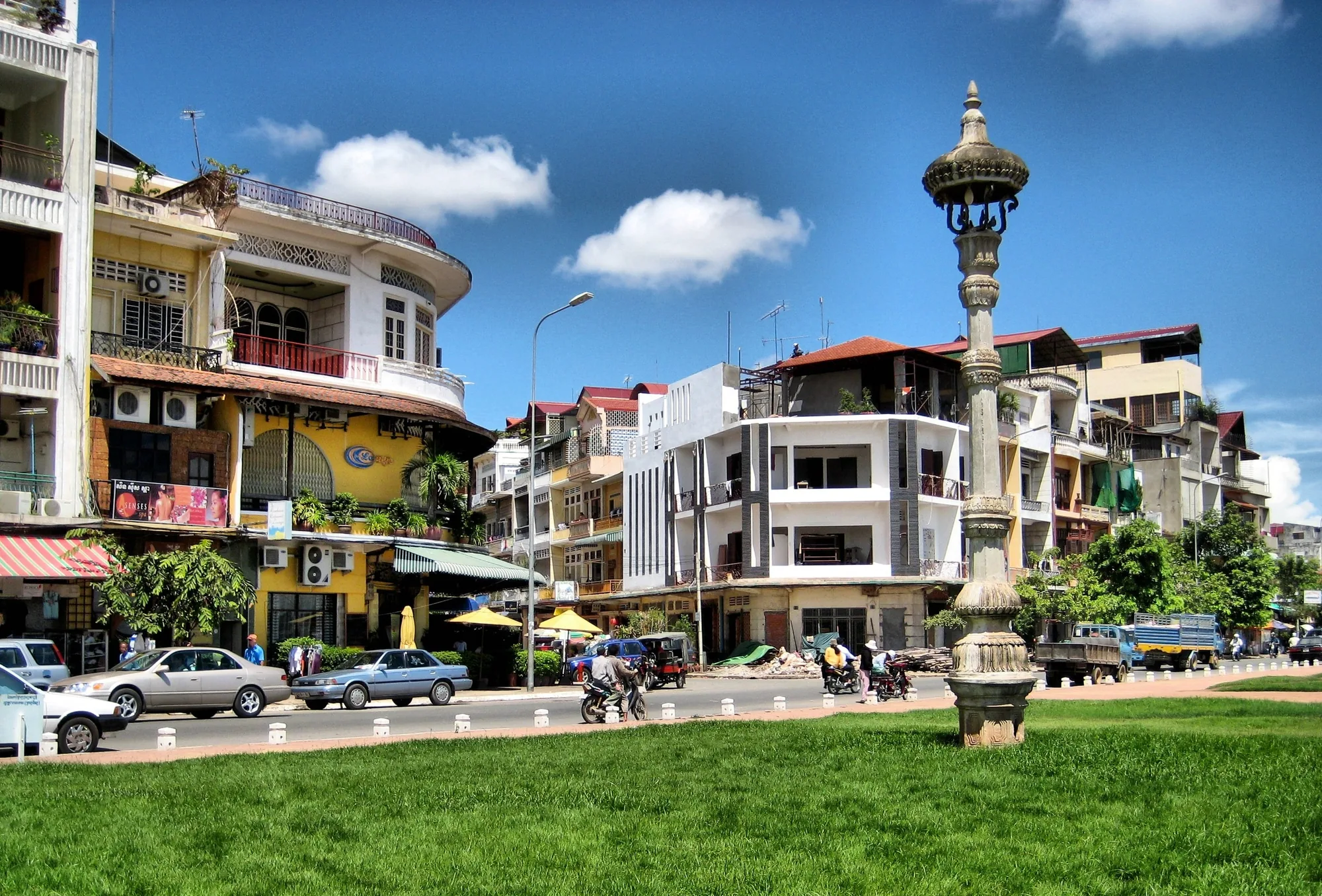
Phnom Penh sits where the Tonle Sap river meets the Mekong, and where the Mekong then splits into the Bassac. That confluence, the Chaktomuk, is the reason the city is here and the reason the riverfront is its best hour of the day. The centre is compact: the Royal Palace and the Silver Pagoda, the National Museum next door, Wat Phnom on its small hill to the north, the covered art deco bulk of the Central Market, and a French quarter of shuttered buildings running back from the water. Around two and a half million people live in the wider city and it feels like it — this is a capital doing capital things, not a heritage town.
The National Museum holds the best collection of pre-Angkorian sculpture anywhere. Not the best in Cambodia: the best. The seventh and eighth-century Phnom Da and Sambor Prei Kuk pieces in the first gallery are the sculptures that everything at Angkor descends from, and standing in front of them for an hour before you go north makes the temples legible in a way no guidebook will. Most visitors give it forty minutes on the way to somewhere else. Give it two hours and go before Siem Reap, not after.
The part that has been overbuilt is the riverfront and the blocks behind it. Sisowath Quay is now a continuous run of bars and hostels aimed at a market that arrives for three nights and drinks. Behind it, and along Norodom and Monivong, a decade of Chinese-financed construction has put up towers with no relation to anything around them and left several unfinished. The city is also loud, the traffic is genuinely difficult, and the pavements are parked on. None of that is hidden and none of it should decide your trip. Walk at seven in the morning or five in the afternoon, use the museum and the palace early, and the capital gives back more than Siem Reap does in the evening.
The hard half-day
Tuol Sleng and Choeung Ek make the hardest half-day of any trip in this region, and it should be described honestly rather than listed as a highlight.
Tuol Sleng is a former secondary school in the middle of the city that the Khmer Rouge turned into Security Prison 21. Between 1975 and 1979 at least 12,000 people were held, interrogated and killed there or at the killing field of Choeung Ek, 15 km outside town. The site has been left largely as it was found: the iron beds, the cells partitioned in brick, the photographs the regime took of every prisoner on arrival. Choeung Ek is a field of excavated pits with a memorial stupa of skulls at its centre, visited with an audio guide that is very well made and very hard to listen to. The two together take about four hours including the drive.
This can be declined. Some travellers know they should not do it and are right about that; some go and wish they had not; a great many say afterwards that it was the most important thing they did in Cambodia. There is no correct answer and we do not push one. If you would rather not, we build the morning around the National Museum, the palace and Wat Phnom instead, and nothing about the trip suffers except the depth of what your guide can explain. What we do not do is put it in front of children. Our family journeys route around Phnom Penh entirely for that reason, and where a party includes teenagers of sixteen or over we discuss it with the parents in advance rather than at the gate.
If you go: your guide will not narrate inside the buildings unless you ask. Photography of the prisoner portraits is legal and widely done, and we would ask you to think about it first. Survivors sometimes sit at the exit selling their published accounts, and buying one directly from them is a reasonable thing to do. Afterwards, do not schedule anything. Take the afternoon.
How many nights, and why fewer breaks it
Two nights is the working minimum and three is what we book when the route has room. The reason is that this city has one heavy day and one light one, and running them together spoils both.
Count it out. Arrival is usually early afternoon after a 45-minute flight from Siem Reap or a 50-minute one from Ho Chi Minh City, or a five and a half hour drive from either. That afternoon takes the National Museum, which wants two hours, and the riverfront at dusk. Full day one is the hard half-day at Tuol Sleng and Choeung Ek in the morning and nothing in the afternoon — and that is the correct shape, not laziness. Nobody looks at a Silver Pagoda well at three in the afternoon on the day they have been to Choeung Ek.
That already accounts for two nights, with the palace, the Silver Pagoda, Wat Phnom and the Central Market pushed into a departure morning that will also contain a 19 km transfer to Techo. Three nights lets the palace have its own morning at eight, when the compound is cool and near enough empty, and buys the things people ask for afterwards: the Russian Market for silver and textiles, a sunset hour on the Mekong by boat, Oudong or the silk island of Koh Dach as a half-day out of town, or simply an afternoon by a pool with nothing scheduled after the day before.
One night does not work. It forces the hardest four hours in Cambodia into an arrival day and sends you to an airport the following morning, and travellers who do it remember the capital as an ordeal rather than a city.
When to go
| Months | Conditions | What it buys you, and what it costs |
|---|---|---|
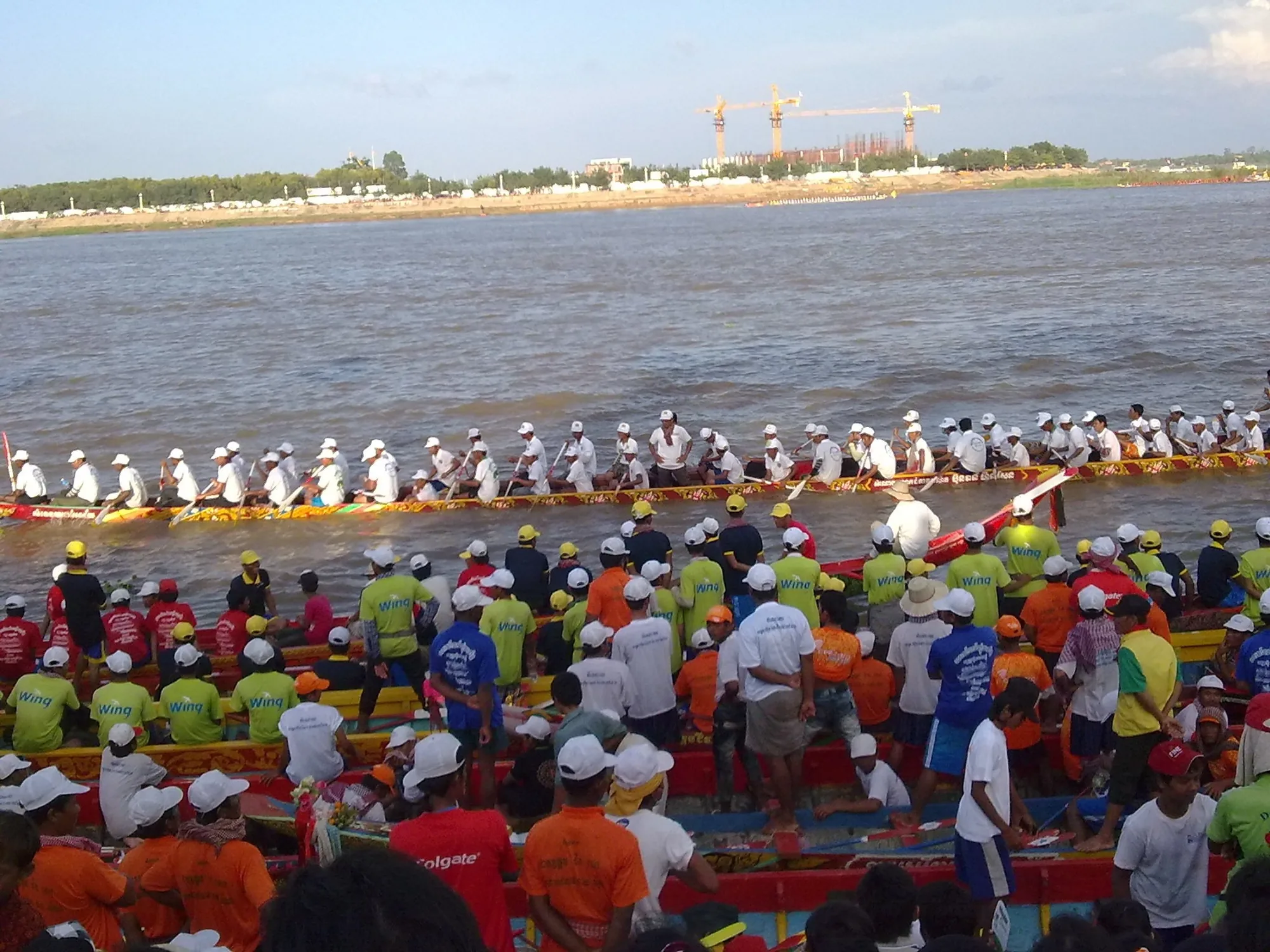
| November – February | Dry, 24 – 32 °C, low humidity | The best months and the busiest. The Water Festival on the river falls in November and is the biggest thing that happens here all year. |
| March – May | Dry, 35 °C and above, humid by May | Low rates. Khmer New Year in mid-April empties the city as people go home to the provinces, which is either charming or inconvenient. |
| June – August | Wet season, hot, storms in the late afternoon | Green countryside, cheap rooms, and mornings that are usually dry. The Mekong is rising and the river looks its best. |
| September – October | Wettest of the year | The confluence at full flow, and in late October or early November the Tonle Sap reverses direction, which is the reason the Water Festival exists. Street flooding after heavy rain is normal. |
The bad season buys you a river. From roughly June the Mekong pushes so hard that the Tonle Sap runs backwards and fills the great lake, then reverses again as the water drops. Being on the quay in late October when the current turns is worth more than a dry afternoon in February, and the hotel rate will be a third lower.
How to get there
All international traffic moved to Techo International Airport (KTI), 19 km south of the city, on 9 September 2025. The old Phnom Penh International now handles domestic flights and private jets only. Anyone booking a hotel transfer against the old airport is booking the wrong one, and it is the most common planning error on this city in 2026. Allow 35 to 50 minutes from Techo to a riverfront hotel depending on traffic.
By air
Siem Reap is a 45-minute hop. Ho Chi Minh City is about 50 minutes, Bangkok about 1 hour 15, and Singapore around two hours. Techo is 19 km south on the National Road 2 corridor, and a private transfer runs USD 20 to 30.
By road
Phnom Penh to Siem Reap is about five and a half hours on National Road 6, a two-lane highway with heavy truck traffic and a driving day we cap accordingly. Ho Chi Minh City is about six hours by road through the Bavet and Moc Bai crossing, which is a functioning land border and one we do use, or 50 minutes by air. Sihanoukville is roughly three hours on the expressway and is not a place we send anyone. Kampot and Kep are three to four hours south and are.
By river
Mekong river ships working between Siem Reap and Ho Chi Minh City call at Phnom Penh, and the quay is in the centre of the city rather than at an industrial terminal, so passengers walk off into the capital. The Tonle Sap boat north to Siem Reap runs only when the lake is high, roughly August to early January, takes five to seven hours and is not comfortable.
What things cost here
Like Siem Reap this is a dollar economy, with riel as change below a dollar. Phnom Penh is measurably cheaper than Bangkok or Ho Chi Minh City at every tier.
| What | Rough cost |
|---|---|
| Guesthouse or simple hotel, per night | USD 25 – 45 |
| Comfortable four-star with a pool, per night | USD 80 – 160 |
| The top houses — Raffles Hotel Le Royal, Rosewood | USD 250 – 700 |
| Bowl of kuy teav or a market lunch | USD 2 – 4 |
| Dinner for two, good Khmer or French restaurant, with wine | USD 40 – 80 |
| National Museum entry | about USD 10 |
| Royal Palace and Silver Pagoda entry | about USD 10 |
| Tuol Sleng entry with audio guide | about USD 10 |
| Choeung Ek entry with audio guide | about USD 6 |
| Tuk-tuk across the centre | USD 2 – 4 |
| Airport transfer from Techo, 19 km | USD 20 – 30 |
| Licensed English-speaking guide, per day | USD 40 – 65 |
In pictures
When to skip it
Phnom Penh is the stop we most often remove from a route, and these are the reasons.
- When you are travelling with children. Tuol Sleng and Choeung Ek are the substance of a visit here, they are not for children, and splitting the party so half of it goes makes a poor day for everyone. Our family routes fly Ho Chi Minh City to Siem Reap direct instead.
- When you can only give it one night. That forces the hardest half-day in Cambodia onto an arrival afternoon, and the city never recovers from it in your memory.
- When someone in the party has a good reason not to go near the genocide sites. That reason does not need explaining to us. The city still works — the museum, the palace, the river — but be clear that you are taking out its centre of gravity, and consider whether two nights are still worth it.
- When your route already has Ho Chi Minh City, Siem Reap and a Mekong cruise in a fortnight. Something has to go, and three river cities in fourteen days is one too many.
The journeys that come here
Seven of our routes stop in Phnom Penh, and the length of the stop tracks the length of the trip. Grand Indochina, 28 days gives it three nights, with the museum on the arrival afternoon, the hard half-day the next morning, and the following afternoon deliberately empty. Indochina Classic, 21 days and Vietnam and Cambodia, 16 days take two, arriving by air from Ho Chi Minh City in 50 minutes rather than spending six hours on the Moc Bai road.
On Mekong River Journey, 15 days the capital arrives from the water: the ship ties up in the centre of the city, guests walk ashore, and the S-21 morning is done with the guide who has been aboard since Kampong Chhnang. Thailand, Laos and Cambodia, 19 days and Laos and Cambodia, 14 days both give it two nights on the way south, and Cambodia and Thailand, 13 days opens here before Angkor, which is the right order for the sculpture.
Every one of those quotes names the hotel, includes a licensed English-speaking national guide in Cambodia, and costs the transfer against Techo rather than the old airport. If you want the capital out of your route we will take it out and say what you lose. Read when to go for the month, look at Siem Reap for the other half of Cambodia, and then write to us.
Ask about Cambodia
Tell us your dates and who is travelling, and we will say how many nights the capital earns on your route.
Questions travellers ask most
Which airport do we fly into?
Techo International (KTI), 19 km south of the city. It took over all international traffic on 9 September 2025 and the old Phnom Penh airport now handles domestic flights and private jets only.
Check any transfer you have been quoted. Operators and hotels still working from the old airport will have costed a short drive, and the real one is 35 to 50 minutes depending on traffic.
Do we have to visit Tuol Sleng and Choeung Ek?
No. It can be declined and a number of our clients decline it. We replace the morning with the National Museum, the Royal Palace and Wat Phnom, and we do not raise it again.
If you do go, allow four hours including the drive to Choeung Ek, and put nothing in the afternoon afterwards. Your guide will stay quiet inside the buildings unless you ask questions.
Is it suitable for children?
The city is. The genocide sites are not, and they are the substance of a visit here. We do not put them in front of children and we do not split a party so that half of it goes.
Our family journeys leave Phnom Penh out entirely and fly Ho Chi Minh City to Siem Reap direct. Where the youngest traveller is sixteen or over we route through the capital and discuss the morning with the parents first.
How do we get to Siem Reap from here?
Either about five and a half hours on National Road 6, which is a real two-lane highway with heavy truck traffic, or a 45-minute flight. Most of our routes fly it and spend the saved day at Angkor.
There is also a boat across the Tonle Sap, but it runs only when the lake is high, roughly August to early January, takes five to seven hours and is uncomfortable. We rarely recommend it.
Read next
Tell us about the journey you have in mind
Dates, party size and the places you care about are enough to start. You get a draft route and an indicative price, not a brochure.