A wholesale market at dawn, and why day trips miss it
The Mekong Delta is 40,000 square kilometres of river, rice and orchard between Ho Chi Minh City and the sea, home to about seventeen million people and crossed by more water than road. The one thing everybody comes for — the Cai Rang floating market at Can Tho — works only before about 08:00, which is why the delta is a place you sleep in rather than a place you visit for the day.
What this place actually is
| Region | Southern Vietnam, the nine mouths of the Mekong |
| Nights worth staying | 1 to 2 nights, in Can Tho |
| Nearest airport | Tan Son Nhat (SGN), then 3 h 30 by road to Can Tho |
| Best months | December to April, dry; high water September to November |
| Known for | The Cai Rang wholesale floating market, canal life, orchards and rice, the water route into Cambodia |
The Mekong finishes here. After 4,900 kilometres from the Tibetan plateau the river splits into nine branches and empties into the South China Sea, and the land it built is flat, silted, intensely farmed and almost entirely at sea level. Roughly seventeen million people live on it. It produces more than half of Vietnam’s rice and most of its fruit and farmed fish. Roads exist, but the network that matters is water: canals cut in the nineteenth and twentieth centuries, sampans, ferries, and boats that are somebody’s shop.
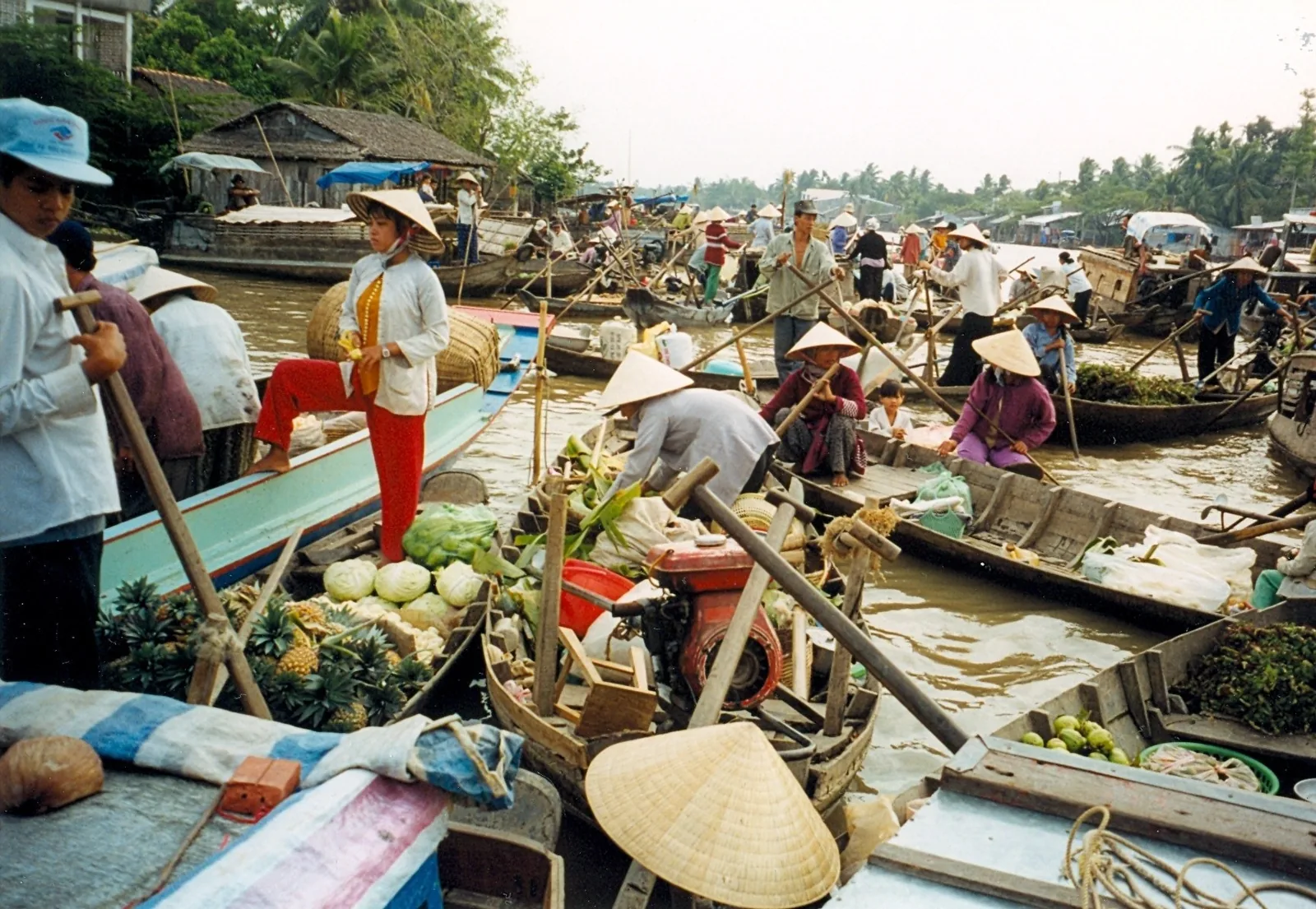
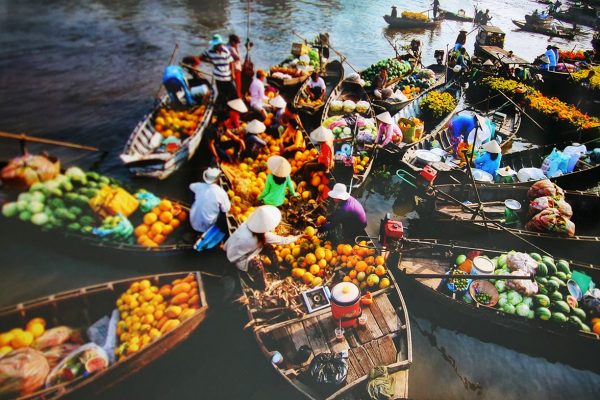
The Cai Rang floating market, six kilometres from Can Tho, is the reason most itineraries come. It needs to be described honestly. It is a wholesale market. Boats moored mid-river sell pineapple, watermelon, taro and cabbage in quantity to smaller boats that resell them ashore, and each seller hangs a sample of the produce from a bamboo pole so buyers can read the offer from a distance. That is a working system, not a display. Trade starts before dawn, peaks between 05:30 and 07:00 and is largely finished by 08:00, at which point the boats disperse and what remains is a handful of vendors selling coffee and noodles to visitors. It is smaller than it was twenty years ago, because bridges and trucks now do much of the work that the market used to do.
The over-visited part is the eastern edge. My Tho and Ben Tre sit ninety minutes from Ho Chi Minh City and take the great majority of day-trip traffic: a short sampan ride under palm fronds, a coconut-candy workshop, a honey tea, a bee, a python for photographs, and a bus back. Several thousand people a day do exactly that circuit. It is not a scandal, but it is not the delta either — it is the delta’s waiting room, and it is what people mean when they come back and say the Mekong was disappointing.
How many nights, and why fewer breaks it
One night in Can Tho is the minimum that works. Two is better if you want the delta as a place rather than a market. Zero nights — the day trip from Ho Chi Minh City — cannot work, and here is the arithmetic.
- Can Tho is 3 h 30 from Ho Chi Minh City by road. Cai Rang finishes trading by about 08:00. To reach the market while it is a market, you would leave the city at 04:00 and arrive already late.
- Because that is impossible, day trips go to My Tho or Ben Tre instead — 1 h 30 away, no floating market, a coconut workshop and a sampan. That is the substitution, and it is usually made without being explained.
- Staying the night in Can Tho puts you on the water at 05:15. You reach Cai Rang at 05:45, in the dark, as the wholesale boats are still rafting up, and you watch an hour of actual trade before the first day-trip boat appears.
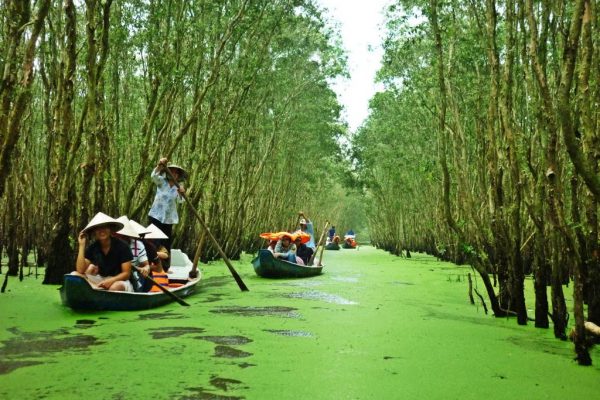
- The second night buys the part nobody photographs: the small canals at Phong Dien, a rice-noodle workshop that is a family business rather than a stop, an orchard at Vinh Long, a homestay dinner, and the roads between them, which run along dykes past houses that face the water.
So what does a night buy that a day cannot? Two hours at the only time the market exists, and a delta evening — the light going flat over the rice, the river traffic changing to freight, the town eating outdoors. A day trip buys three hours in a minibus and a coconut sweet. The two are not the same product and should not be sold at the same price.
The delta is also a border. Fast boats run Chau Doc → Kaam Samnor → Phnom Penh on the Bassac and the Mekong, with immigration formalities handled mid-river at the two posts, and the crossing takes most of a day. It replaces a flight with a river, and it is the reason some Vietnam-and-Cambodia journeys run south to north rather than the other way. It also means an extra night at Chau Doc, which is a working border town and not a resort.
When to go
The delta has two seasons and, unusually, the wet one is not the one to avoid. Water level matters more here than rainfall, because the level changes what the boats can do and what the fields look like.
| Months | What it is like | What that season buys you |
|---|---|---|
| December – February | Dry, 24–32 °C, low water, clear mornings. | The most comfortable weather and the most reliable early starts. The canals are at their lowest, so some of the smallest channels are shallow for a sampan. |
| March – April | Dry and hot, 33–37 °C, lowest water of the year. | Fruit season in the orchards. Salt intrusion pushes further inland in these months, which is a real problem for farmers and a visible one from the road. |
| May – August | Wet season, afternoon downpours, water rising. | Green fields, fewer visitors, lower prices, and mornings that are usually clear — which is all the market needs. The rain arrives after the day’s work is done. |
| September – November | Highest water of the year, the flooding season the delta is built around. | The delta at full volume: flooded rice fields, boats reaching places they cannot reach in March, and the fish and bird life that comes with high water. Some low roads go under, and the central coast is having its typhoon season at the same time. |
If your journey runs mid-November to early February, which is the window that works across all four countries, you get the delta dry, cool and low. That is the right compromise. See the when-to-go page for how the four calendars line up.
How to get there
There is no meaningful flight into the delta for a traveller coming from Ho Chi Minh City. It is a road journey, and then a boat.
By road
- Ho Chi Minh City → Can Tho is about 3 h 30 by private car, 170 km, most of it on the expressway and then Highway 1. Leaving before 07:00 or after 09:30 avoids the worst of the exit from the city.
- Ho Chi Minh City → My Tho is 1 h 30 and Ben Tre about 2 h. These are the day-trip distances, and they are the reason day trips do not reach Cai Rang.
- Can Tho → Chau Doc is about 3 h, which is the leg to build in if you are continuing into Cambodia by water.
- We cap a driving day at five hours, so a Ho Chi Minh City to Can Tho transfer with two stops is a comfortable day and a Ho Chi Minh City to Chau Doc run in one go is not.
By air
- Can Tho International (VCA) exists and handles a thin domestic schedule plus some regional charters. Flights from Hanoi and Phu Quoc operate but not daily, and the schedule is not stable enough to build a journey around.
- Tan Son Nhat (SGN) is the practical airport. Arrive there, spend two nights in Ho Chi Minh City, then drive south.
By water
- Can Tho → Cai Rang market is 6 km, about 30 minutes by boat, and the boat leaves at 05:15 to be useful.
- Chau Doc → Phnom Penh via Kaam Samnor runs by fast boat and takes most of a day including the two immigration stops. A Cambodian e-visa or visa on arrival is needed; the Cambodia e-Arrival form is separate, free and mandatory, filed at arrival.gov.kh.
- Full Mekong cruises between Siem Reap and Ho Chi Minh City run seven nights on ships from Pandaw, Heritage Line, Aqua Expeditions and Avalon. In low water, roughly December to July, the ships cannot cross Tonle Sap Lake to Siem Reap and the final leg is flown or driven — check that before you book anything.
What things cost here
The delta is the cheapest part of southern Vietnam to eat and sleep in, with one exception: the two or three river lodges that charge international prices for a canal frontage.
| Item | What you pay |
|---|---|
| Homestay, double, breakfast | 400,000 – 700,000 VND (USD 15 – 27) |
| Good hotel in Can Tho, riverfront | USD 55 – 120 |
| River lodge or garden resort, Can Tho or Cai Be | USD 150 – 320 |
| Bowl of bun rieu or hu tieu at a market | 35,000 – 60,000 VND |
| Riverside dinner, elephant-ear fish, for two | 400,000 – 700,000 VND |
| Private boat to Cai Rang and the small canals, 3 h | 600,000 – 1,000,000 VND for the boat, not per head |
| Shared market boat | 150,000 – 250,000 VND per person |
| Taxi across Can Tho | 50,000 – 100,000 VND |
| Chau Doc → Phnom Penh fast boat, one way | USD 35 – 60 depending on operator |
| Cambodia e-visa | USD 30 plus USD 6 processing, 30 days single entry |
Hire the whole boat rather than a seat on one. The difference is a few hundred thousand dong and it buys you the departure time, which in a place where the market is over by 08:00 is the only variable that matters.
What it looks like




When to skip it
- You cannot spare the night. A delta day trip from Ho Chi Minh City does not reach Cai Rang and never will — the market is 3 h 30 away and finished by 08:00. Without a night in Can Tho, skip the region entirely and put the day into the city or the coast.
- You are already doing a Mekong cruise. A seven-night ship covers this water properly, and a road trip to Can Tho before boarding duplicates the same landscape at lower quality.
- You need a comfortable hotel every night. The delta’s best rooms are good rather than luxurious, and the most interesting places to sleep are homestays with fans, mosquito nets and a shared table. If that is a problem, the delta is a day of driving to somewhere you would rather not be.
- Your trip is fourteen days or fewer and Cambodia is in it. The nights are better spent giving Angkor a third day or the central coast a third night than adding two more transfers to an already full route.
The journeys that come here
The delta appears in our southern routes as one or two nights and, on the river journeys, as the spine of the whole trip.
On the long routes it is a deliberate slow section. Grand Indochina, 28 days takes two nights here between Ho Chi Minh City and the flight into Cambodia, and Indochina Classic, 21 days takes one, which is enough for Cai Rang and nothing else. Vietnam In Depth, 20 days gives it two nights plus Chau Doc, because that is the version where the south is a region rather than a stopover.
Two journeys are built around the water itself. The Mekong river journey, 15 days follows the river from the delta up into Cambodia, with the low-water caveat written into the itinerary rather than buried in the terms. Vietnam and Cambodia, 16 days offers the Chau Doc to Phnom Penh boat as the border crossing in place of a flight, which turns a transfer day into a travelling day and is the single change that most improves that route.
If you want the delta as more than a market — the Cambodian border by water, a homestay, three days of canals — say so when you write. Send the month, the number of travellers and whether the boat crossing appeals, and a routing sketch comes back within three working days. Start here.
One night in Can Tho, on the water at 05:15
Tell us your dates and whether Cambodia is in the plan. We will show you whether the river crossing beats the flight.
Questions travellers ask most
Can we see the floating market on a day trip from Ho Chi Minh City?
No. Cai Rang is 3 h 30 from the city by road and its trade is largely finished by 08:00, so a day trip arrives after the market has dispersed. Day trips go to My Tho or Ben Tre instead — a sampan ride and a coconut-candy workshop, no floating market. If you want Cai Rang, you sleep in Can Tho and leave the pier at 05:15.
Is the market staged for tourists?
No, and that is the point. It is a wholesale market where boats sell produce in quantity to smaller boats, with a sample hung from a bamboo pole so buyers can read the offer from a distance. It is smaller than it was, because bridges and trucks now carry much of the trade, and the vendors selling coffee and noodles to visitors are the minority of what floats there before seven in the morning.
Can we cross into Cambodia by boat from here?
Yes. Fast boats run from Chau Doc to Phnom Penh via the Kaam Samnor and Vinh Xuong posts, with immigration handled mid-river and the crossing taking most of a day. You need a Cambodian e-visa (USD 30 plus USD 6, about three working days) or visa on arrival, plus the free Cambodia e-Arrival form filed at arrival.gov.kh. Build in a night at Chau Doc, which is a working border town rather than a resort.
Does the high-water season make it worse?
It makes it different. Water is highest September to November, which floods the rice fields, opens channels that are too shallow in March and brings the fish and birds with it. Some low roads go under. The trade-off is that the central Vietnamese coast is in its typhoon season at the same time, so a September delta usually means a compromised Hoi An.
Read next
Tell us about the journey you have in mind
Dates, party size and the places you care about are enough to start. You get a draft route and an indicative price, not a brochure.